The Future of the Composites Industry (as I see it) and Wrap for the Summer

I thought this week, partly because I’m taking the summer off and partly because I have seen some rather interesting announcements recently, that I would talk about where I think the future or trend or arc of the industry is headed. And by future, since this is such a fast changing industry, what I mean is for the next decade or so. Predicting what is going to happen in this industry beyond that timeframe is something of a fool’s errand, so I’m not going to even attempt it. Instead I want to focus on some fairly recent announcements in the industry and what I think they mean for the future of both the big and the small organizations in this industry.

The first one of these that I want to talk about, which is I believe where the industry is going, is the recently announced merger between Huntsman and Olin, two titans in the industrial chemicals business both of which have large footprints in the composites industry. These two companies actually have quite a bit of synergy and from a technical perspective the merger makes sense – they really don’t compete head to head with most of their respective product lines. Huntsman is primarily focused on the complex formulations and high performance resins business with their epoxy and urethane resins and adhesives. Olin, originally a gun powder manufacturer (Winchester is an Olin company), has a precursor manufacturing capability with their chlorine and caustic soda manufacturing business that is one of the largest in the industry. So, with Olin in the upstream chemicals business and Huntsman in the downstream business with extremely well established product lines and downstream supply capabilities, this is actually a good match for both companies.
The fact that two titans in the industry are merging also says quite a bit about the industry in general. I have talked about this in previous posts, but what this does demonstrate is that the composites industry is morphing from more of a technology development and high end (read high cost and high profit margin) materials industry to more of a commodities industry where companies like the new OlinHuntsman (that’s what the company will be called) will begin to compete more on cost than product capability. This has been happening in the carbon fiber industry now, and here it is again in the resin side of the industry.

More evidence of this is the recent renaming of what really was the first composites company, the Owens-Corning glass fiber business, to “The Original Composites Company™. The company renamed itself with the closing of the sale of the glass fiber business of Owens-Corning to Praana, a large Indian materials conglomerate that was already in the glass fiber manufacturing and supply business in Asia. This does make sense based on the trends in the industry and the fairly recent focus of the Owens-Corning glass fiber business on markets in Asia where the wind turbine industry has a high demand for glass fiber.
This sale of the glass fiber business and name change was announced at JEC this last March in Paris, and I wrote a little bit about it at the time. So, I thought it would add one more example of the current trend that I see in the composites industry. And on a google search, the google AI basically says the same thing. This is a current trend across the industry, and it is happening worldwide as composites become more of a commodity material and competition morphs from one in which competition over material capability is being overcome by competition over material cost at the same capability.
These mergers and acquisitions in the composites industry are being driven by three major drivers, all of which speak to the future of the industry and the industry’s changing customer base. First, the mergers and acquisitions are being driven by the need for sustainability. While this means different things to different people, to the industry as a whole it means quite a bit more than just lowering carbon footprint. It means that the customer base for composites today is demanding more environmentally friendly materials. And it also means that the industry is focusing more on the future of the industry and survivability of the major sectors of the business. Lowering carbon footprint and figuring out what to do with end of life composites (talking wind turbine blades mostly here) is a necessary first step, but to sustain the industry over the long term, more automated manufacturing and cost reductions without sacrificing the quality and properties of composites that make them such a compelling choice in many industries is also required. Finally, it is the ability of the composites business to push into more high volume and cost sensitive markets like automotive and sporting goods which is also part of sustainability or survivability of the industry.
Most in the industry already know this and also know about the other things that must go along with sustainability. Those things primarily have to do with supply chain consolidation and rework and automated manufacturing to reduce cost and increase volume. That’s not to say that touch labor can be completely eliminated, but that sort of highly skilled technician level work that has been the mainstay of the industry for decades is going to be relegated to the difficult to make and high performance end of the market rather than being the mainstream that it has been historically. In other words, the low volume market like fighter aircraft and other defense related systems that require the highest performance materials just to stay ahead of our adversaries. That market will not go away, but it is becoming less and less of a share of the overall composites industry even today. It really isn’t that the high end is reducing in total volume, it is that the real growth in the composites industry is coming at the lower end of the market where production is more cost sensitive and competition is fiercer.
One more trend of note comes from what I have been talking about now for about 6 months, what to do with end of life composites to retain the value of the material when it can no longer be used safely in its original application. I see that as not only a burgeoning part of the industry but also as something of an assist in the supply chain for applications that are not aerospace. The use of recycled fibers and also recycled resins in the sporting goods, recreational marine, and even in the automotive industry is beginning to take hold. That means that the people who recycle end of life wind turbine blades like the Composite Recycling / Fiberloop partnership with Verretex that I have written about are growing in both importance in the market and also in sales volume. This partnership / consortium was one of the first in this end of the business and they have since signed up in a much larger consortium led by Beneteau to scale up their fiberglass recycling business and become a reliable supplier to the remainder of the composites industry.
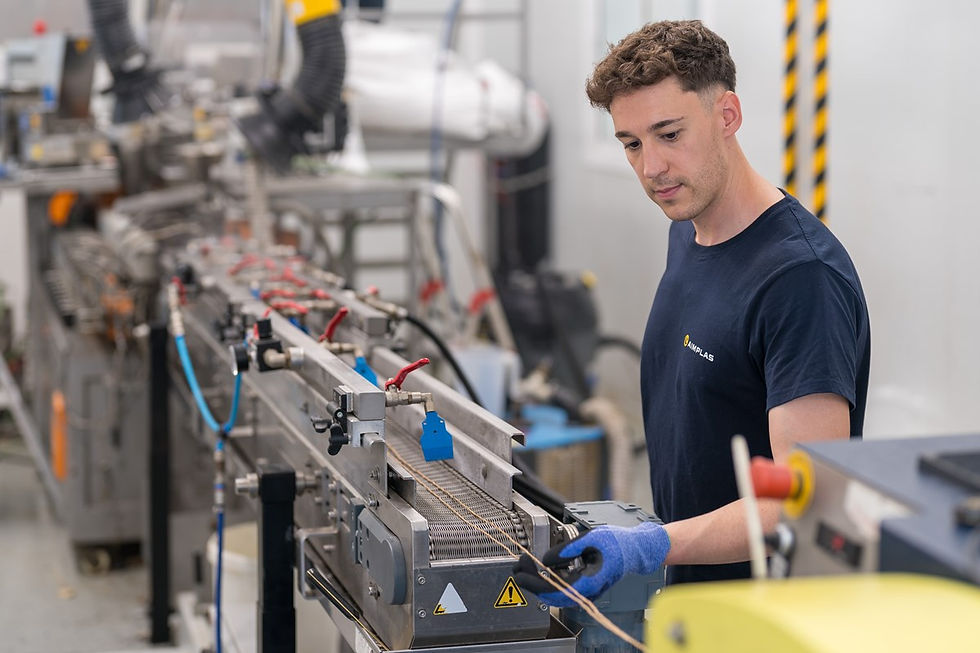
Even more evidence of the sustainability trend and the industry’s attempt to reduce carbon footprint is the IMPLICIT Project, pictured above. These folks have focused their efforts on all of the plastic stuff besides the fibers and resins and prepreg cutoffs that become waste in the composites business. Believe me, there’s lots of it. Vacuum bagging materials, films, peel plies from prepregs, absorbent fabrics, and a myriad of other packaging materials are actually the bulk of the tonnage that goes into the trash dumpster at any composites manufacturing facility. While people don’t talk about it all that much because it is not as visible or valuable as something like prepreg cutoffs, it is still a problem that the composites industry is painfully aware of.
So, Ned’s prediction for the future of the industry should be fairly obvious at this point. The market consolidation, mergers of giants, and morphing of the industry from a specialty industry into much more of a commodities business model where costs will drive more of the decisions than will the competition to have the strongest fiber or highest performance material is not only going to continue, it will become the dominant feature of the industry in the not too distant future. There will still be new developments coming from the likes of Hexcel and Toray, as well even as OlinHuntsman and their ilk, but that will begin to fade as the most important aspect of the industry and what will become more of a focus in the industry is new automated, high rate manufacturing processes in high volume, lower margin industries like automotive and sporting goods. This is actually a good thing that is happening to the industry because it means that not only will everyone that is in the business now have a larger market to play in, more companies will also come along and will spur tremendous growth in the composite materials industry into the future. In other words, I see a rather bright future for the industry for at least the next decade if not for the foreseeable future.
The wind turbine industry will also be a large part of this as well because despite the current Administration’s attempts to do away with that industry, the fact is that in 2024 more electricity was generated in the US from wind and solar than from coal. And, coal is still fading because natural gas, wind, and solar are all less expensive than maintaining the aging coal plants that are still operating today. And, since it is impossible to get a new coal plant permitted in the US today, coal is going to at some point in the future be gone as base load electricity generation. It does after all just come down to economics at the end of the day. With the expansion of wind to offshore sites and the ever larger swept area of each wind turbine further bringing down the cost per kilowatt hour produced, wind energy is going to very soon become cost competitive with new natural gas fired plants. Solar is on a similar trend because as the economics of scale take hold of the solar panel manufacturing business, the cost of a new panel will drop even more than it already has. And with the newer generation, more efficient panels that cost the same as the older ones, the lowering cost per kilowatt hour trend that is shaping that industry now will only continue. That is a trend that will continue because the fuel for wind and solar energy is free and for natural gas the fuel is only going to get more expensive. In addition, as we focus more on our warming climate, it will become increasingly difficult politically to get a new natural gas fired plant permitted, and/or the carbon capture equipment will price natural gas out of the market, whereas permits for wind farms are fairly easy to get both in the windy corn fields of the Midwest and off the Northern part of the Eastern Seaboard and off the coast of California.
So, that’s it for this week’s post. As always, I hope everyone that reads these posts enjoys them as much as I enjoy writing them. And I hope people who are interested find something they can use in their lives or at least some ideas that they might be able to put into practice. At least I hope that these make people think a bit about sustainability and some of the major issues looming before us. I also hope people think of the piles of waste plastic not as waste but as raw material for conversion into materials that can be incorporated into very high end applications. We need sources of raw carbon in a usable product form without resorting to pumping it out of the ground.
And, as a reminder, I am taking the summer off and will be back with more new stuff around Labor Day. You may hear from me from time to time if something momentous happens in the industry, so we will see. I hope everyone has a wonderful summer and spends some time with family and friends to recharge before the school year starts back up in the fall and we all have to knuckle back down and get stuff done.
I will post this first on my updated website – www.nedpatton.com – and then on LinkedIn. And if anyone wants to provide comments to this, I welcome them with open arms. Comments, criticisms, etc. are all quite welcome. I really do want to engage in a conversation with all of you about composites because we can learn so much from each other as long as we share our own perspectives. And that is especially true of the companies and research institutions that I mention in these posts. The more we communicate the message the better we will be able to effect the changes in the industry that are needed.
I also wanted everyone to start watching what is going on in SAMPE with regard to the sustainability trends in composites and in other advanced materials. I am of course part of the content creation for the Sustainability Technical Committee of SAMPE so I know things will be coming out hopefully over the summer and definitely into the fall. And also please pay attention to Composites World and some of the Sustainability efforts ongoing in what is most probably the largest and most well-read industry publication in the composites business.
My second book, which was released on April 6, is a roadmap to a circular and sustainable business model for the industry which I hope that at least at some level the industry will follow. Only time will tell. Maybe it will get noticed – as always that is just a crap shoot. I am seeing signs that the industry is coming around to a more circular point of view, but I also understand that it is going to take time and a lot of investment before composites can be truly circular and sustainable.
As usual, I’ve included a photo of the cover at the end of this post. Let me know whether or not you like the cover. Hopefully people will like it enough and will be interested enough in composites sustainability that they will buy it. And of course I hope that they read it and get engaged. We need all the help we can get.
Last but not least, I still need to plug my first book. “The String and Glue of our World” pretty much covers the watershed in composites, starting with a brief history of composites, then introducing the Periodic Table and why Carbon is such an important and interesting element. The book was published and made available August of 2023 and is available both on Amazon and from McFarland Books – my publisher. However, the best place to get one is to go to my website and buy one. I will send you a signed copy for the same price you would get charged on Amazon for an unsigned one, except that I have to charge for shipping. Anyway, here’s the link to get your signed copy: https://www.nedpatton.com/product-page/the-string-and-glue-of-our-world-signed-copy. And as usual, here are pictures of the covers of both books.


Comments