Carbon Nanotubes – What Are They Good For?

Sorry about the rock and roll reference here, but there is so much hype about carbon nanotubes, I thought I would set the record a little bit more in actual applications of these interesting little beasties without all of the hyperbole that often accompanies any mention of them.
First, what are these things? If you remember some of my earlier posts when I talk about “organic carbon” and the fact that what I am really talking about are aromatic hydrocarbons which are just strings of 6-sided benzene rings all stuck together with other stuff like hydrogen, oxygen, and nitrogen (and phosphorous if it happens to be a protein). I have said this before but it does bear repeating that if you drive off everything that isn’t carbon from these long chains of benzene rings you get what is called graphene which is just a sheet of benzene rings all stuck together.

This pic is a good enough model so that you get the idea. This stuff is the strongest two dimensional material known to man and it is just lowly carbon, number 6 on the periodic table, and the third element created in the big bang. That’s why there’s lots of it around.
In any case, if graphene is just a sheet of these benzene rings all stuck together, then a carbon nanotube is really just a tube made from a sheet of these things. And they of course come in all sizes and shapes, but the following pics pretty much tell the story.


As for the hype surrounding these things, there is one pic in the search for carbon nanotubes that has the quote in it “Carbon Nanotubes Will Change Everything”. This is of course hyperbole, and can’t possibly be literally true, what is true is that they are beginning to have a significant impact on the materials and devices that we use every day. This is a trend that is only going to increase as we get better at making them and using them. As the applications for them increase in both significance and tonnage, and as the costs for making them come down, more and more entrepreneurial companies will be taking advantage of some of the interesting and difficult to achieve otherwise properties that carbon nanotubes represent.
So, I thought I would talk about these as a more practical matter than the hyperbole that some of you may have seen surrounding these things. What are the interesting properties that we can get from these little beasties? That is actually a fairly good question, and it does have some answers. First, of course they are very strong since graphene is the strongest material known, when you roll it into a little tube it becomes extremely strong and extremely stiff and can be used as a reinforcement for less strong materials. If this sounds like a composite material to you, it is exactly that. Carbon nanotubes have been incorporated into thermoplastics and thermoset plastics in more than just laboratory settings as a reinforcement for plastic as a sheet product. There aren’t many or even any products on the market yet that are sheet reinforced plastics with carbon nanotubes, primarily because the little things are still rather expensive.
Secondly, they also have interesting electromagnetic properties. This is because carbon conducts electricity along the carbon bonds but not across them. This makes carbon nanotubes little electromagnetic dipoles, and they can be easily aligned to make a conductive material. And this can be done in a wire form or a sheet form depending on how the magnetic field is applied when the plastic hardens, since it is most commonly some sort of plastic that serves as the carrier solid for them. This allows for a set of very interesting properties of materials with embedded carbon nanotubes. Some of these materials have even made it into applications.

The first one I want to talk about uses the natural revulsion of carbon nanotubes to single water molecules which reduces surface tension, does not allow water droplets to form and instead allows the water to run off of a wind turbine blade leading edge before it can freeze. Carbon nanotube based deicing films on the leading edges of wind turbine blades are rather effective, inexpensive, and long lasting.

And as I mentioned earlier, these tubes are natural electromagnetic dipoles, so they can easily transport both charge (electrons) and these tiny lithium ions back and forth. The lithium ions go left in the pic above when the battery is discharging and to the right when it is being charged. The carbon nanotubes provide electrical isolation between the two current collectors so the battery doesn’t short out, and they also provide a pathway for the lithium ions to move from the solid lithium anode to the metal or graphite cathode easily providing both voltage and current.

Finally, since carbon nanotubes attract lots of organics and also some ionic species, and since they are so small, they have been applied to very tiny sensors and also to very tiny drug delivery vehicles. As sensors, usually what is done is to functionalize a set of nanotubes to detect a particular chemical, usually an organic. When just a few molecules of the target organic comes in contact with the sensor, they stick to it and the carbon nanotube changes electronic state, setting off the sensor electronics. These sensors can be used to detect noxious chemicals in the atmosphere, they work underwater, and they also work inside biological systems. There have been a number of both disease sensing applications that have been dreamed up using carbon nanotubes, some of which, especially the imaging ones, have been approved and are in use. The drug delivery systems are still in development, but it will be a fairly short span of years before the first ones of these come on the market.
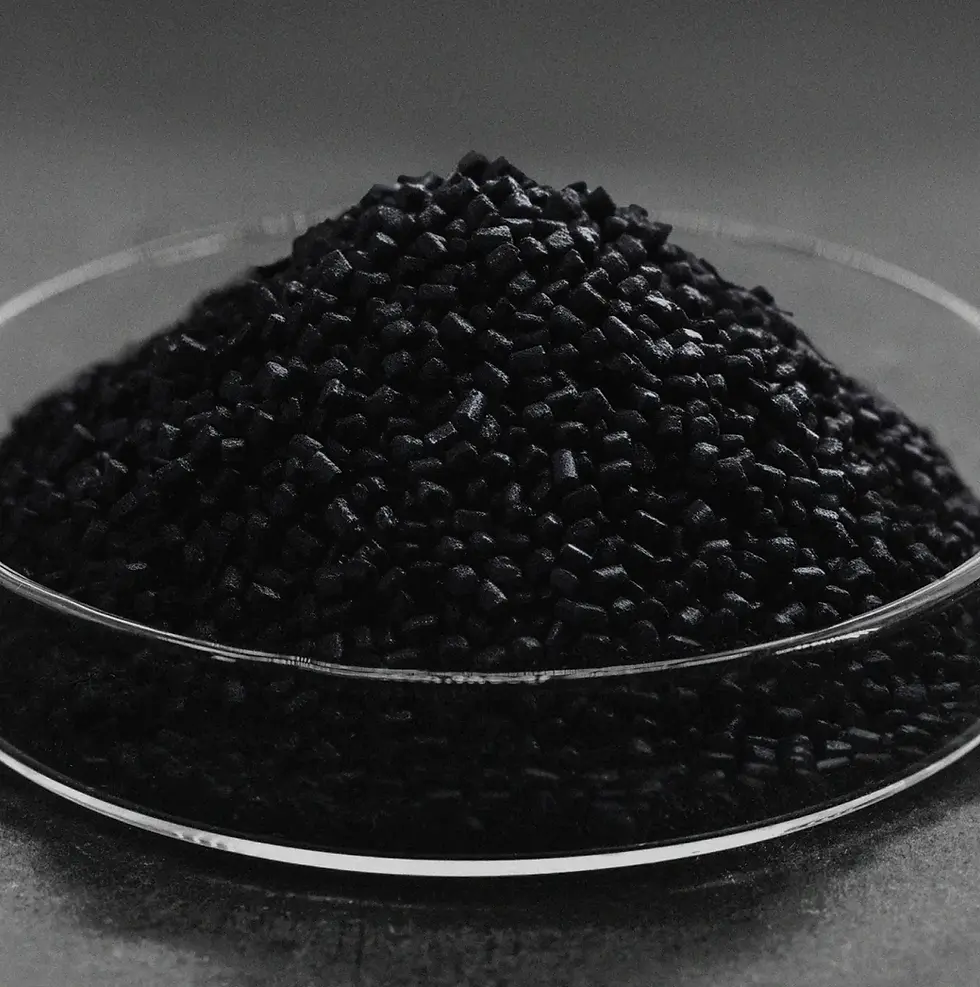
So, carbon nanotubes are here to stay. And if you remember a couple of weeks ago I wrote about a company, Cecelia Materials, that is taking waste plastic and turning it into a particulate carbon that has a lot of nanotubes that can be easily separated out and sold, so the supply of these things is only going to increase. I hope that the leadership of Cecelia reads this post and takes note of the industries they should target not only for sales of their product but also potentially funding to help scale up their process.
So, that’s it for this week’s post. As always, I hope everyone that reads these posts enjoys them as much as I enjoy writing them. And I hope people who are interested find something they can use in their lives or at least some ideas that they might be able to put into practice. At least I hope that these make people think a bit about sustainability and some of the major issues looming before us. I also hope people think of the piles of waste plastic not as waste but as raw material for conversion into precursors for materials that can be incorporated into very high end applications. We need sources of raw carbon in a usable product form without resorting to pumping it out of the ground.
I also wanted everyone to know that I intend to take two months off – July and August – I need a break and I’m sure that most people are on vacation those months with their families and don’t need to be reading stuff from me. I will write one more post before I take a couple months off, so I hope everyone has a great summer and after next week I will see you all again around Labor Day.
I will post this first on my updated website – www.nedpatton.com – and then on LinkedIn. And if anyone wants to provide comments to this, I welcome them with open arms. Comments, criticisms, etc. are all quite welcome. I really do want to engage in a conversation with all of you about composites because we can learn so much from each other as long as we share our own perspectives. And that is especially true of the companies and research institutions that I mention in these posts. The more we communicate the message the better we will be able to effect the changes in the industry that are needed.
My second book, which was released on April 6, is a roadmap to a circular and sustainable business model for the industry which I hope that at least at some level the industry will follow. Only time will tell. Maybe it will get noticed – as always that is just a crap shoot. I am seeing signs that the industry is coming around to a more circular point of view, but I also understand that it is going to take time and a lot of investment before composites can be truly circular and sustainable.
As usual, I’ve included a photo of the cover at the end of this post. Let me know whether or not you like the cover. Hopefully people will like it enough and will be interested enough in composites sustainability that they will buy it. And of course I hope that they read it and get engaged. We need all the help we can get.
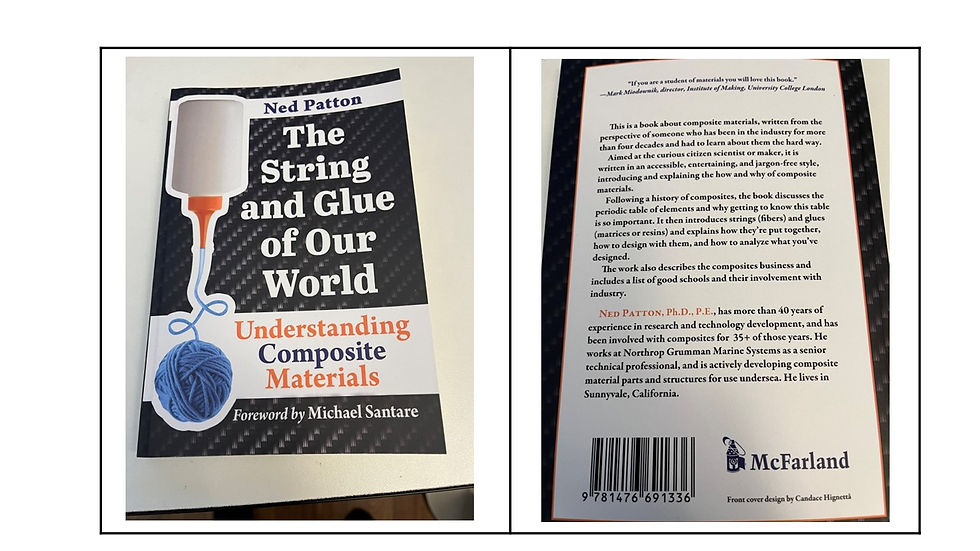
Last but not least, I still need to plug my first book. “The String and Glue of our World” pretty much covers the watershed in composites, starting with a brief history of composites, then introducing the Periodic Table and why Carbon is such an important and interesting element. The book was published and made available August of 2023 and is available both on Amazon and from McFarland Books – my publisher. However, the best place to get one is to go to my website and buy one. I will send you a signed copy for the same price you would get charged on Amazon for an unsigned one, except that I have to charge for shipping. Anyway, here’s the link to get your signed copy: https://www.nedpatton.com/product-page/the-string-and-glue-of-our-world-signed-copy. And as usual, here are pictures of the covers of both books.


Comments