Some News About Recycling Plastics to Make Carbon Nanotubes

I came across a company at work that one of our Senior VP’s ran across at a conference. This company has been able to recycle plastics that have little to no value and turn them into high value products in carbon particulate like carbon nanotubes and hydrogen gas. They apparently use a microwave source to get the process energy to do this.
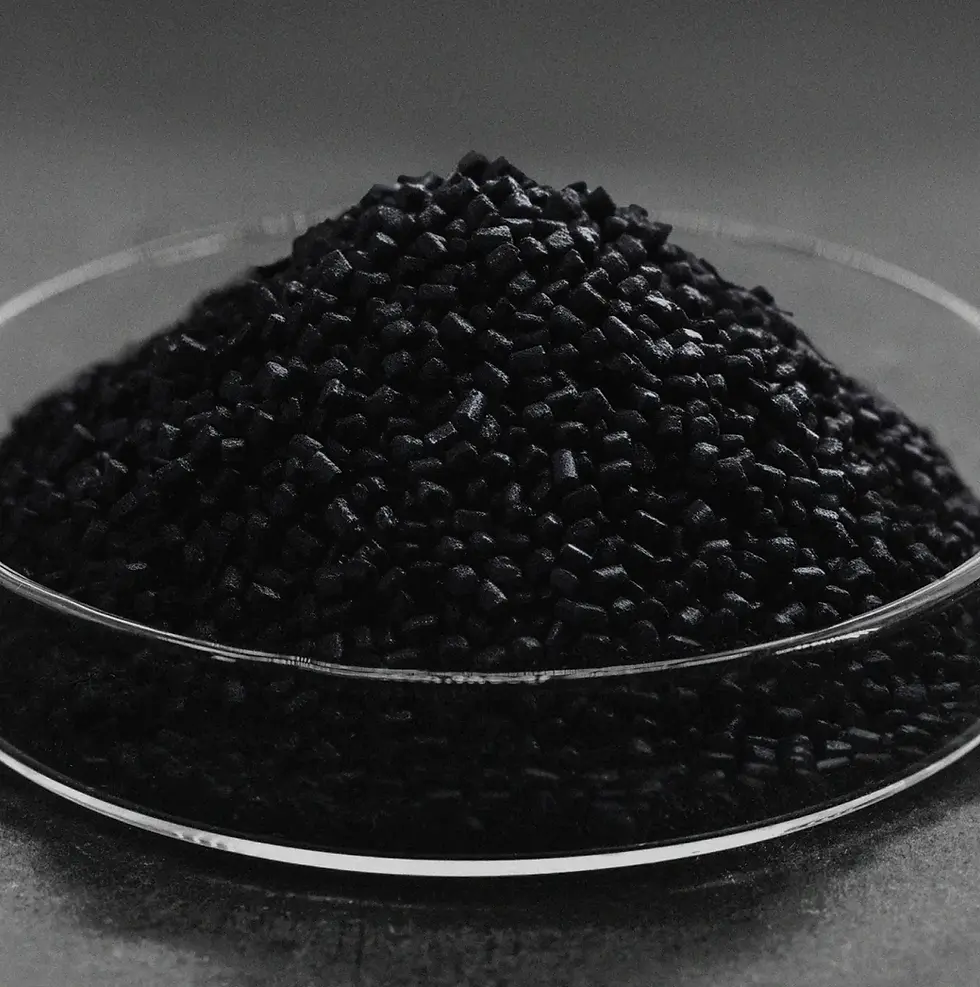
The company is Cecelia Materials, and they are headquartered in Newark, New Jersey. They were originally formed with funding from the Department of Energy to develop and demonstrate a new means of recycling high tonnage waste plastics that have little value and are difficult to convert into high value added products because of the mixed up nature of the waste plastic input stream to the recycling process. They now have NASA funding to further develop their technology to take “industrial-grade” plastic waste as their feedstock and convert that plastic into useful high-value material feedstock plus hydrogen using limited resources.
While this is a new technology and is still in laboratory to small scale development, it is interesting on several fronts. But first I need to talk about what I have been able to learn about the technology from what is on line and also from our brief introduction to the company where we were able to talk to the founder, Kathryn Carpenter, and her chief of staff, Lindsey Albano. A lot of what I’m about to write is guesswork on my part, but I think I should be mostly correct. We may find out when Kathryn reads this and can provide a bit more clarity about their process and how it works.
The process uses a fluidized bed reactor with a proprietary catalyst that is recoverable and reusable. The use of microwaves for process heat to recycle plastics into carbon and hydrogen is something that has not been successfully accomplished or probably even attempted at the sort of scale that Cecelia is planning. It is, however, completely feasible once you understand how the microwaves could heat up the plastic that you are trying to recycle. Your kitchen microwave doesn’t heat up plastic containers or melt them, but the microwaves used in Cecelia’s process do at least melt the plastics so that the catalyst can do its work.
The best I can do at this point is to make an educated guess at how Cecelia has been able to accomplish this feat. So I need to bring this back to one of the most common kitchen appliances in use today – the microwave oven. Your kitchen microwave works by emitting microwaves at a particular frequency – 2.45 gigahertz. This frequency keeps it in what is called an ISM band which is designated for Industrial, Scientific, and Medical devices. This frequency is also one of the resonant frequencies of the water molecule. All food has water in it, and what the microwave does is to cause the water molecules in food or your cup of cold coffee to spin and vibrate violently which causes friction heating of the food and makes your coffee hot again as well as warming up that slice of leftover pizza from last night.
The ISM radio frequency bands cover quite a bit of the electromagnetic spectrum that is not used for navigation, communication, or defense purposes, and 2.45 GHz just happens to be in one of the bands that is available to use. So, if I was to make a guess, I would say that the frequency of the microwaves in the Cecelia process are probably tuned to a resonance in the carbon-hydrogen bond since their end product is hydrogen gas and solid carbon nanoparticulate. And their catalyst is most probably an organo-metallic that works well for the types of plastics that Cecelia has been able to recycle. Mostly to date I believe these to be your high tonnage plastics like polyethylene and polypropylene – AKA polyolefins.

The reason that I believe that this is where the company started – with the breakdown of polyolefins – is that they received the Neptune Award at the 2025 Ocean Exchange Event in Fort Lauderdale, Fl. This award is given annually to “innovative startups and solutions that advance our understanding of the ocean and promote healthier, more resilient marine and coastal ecosystems.”
The problem that Cecelia’s technology can begin to deal with, and that the company has been focusing on, is what is called the “great garbage patch” that is floating around in the middle of the Pacific Ocean. There are estimated to be 1.8 trillion pieces of plastic weighing over 100,000 metric tons in a patch of the Pacific Ocean that is about five time the size of France. Most of this plastic is from the commercial fishing industry, but a lot of it is from food packaging and lots of other stuff. And since it is floating in the water, it is mostly polyethylene and polypropylene because these two polyolefin plastics are lighter than water. They are also the most ubiquitous plastics on the planet

So, why NASA you might ask. If you take a look at the picture above and know anything about NASA’s plans for a permanent human habitat on the moon, one of the large problems that comes up is where to get the materials to build and add on to the habitat. Another problem is what to do with the packaging of the foods and other goods that will have to be brought by supply ships from earth for at least the first several years to a decade or more until the moon colony can be made to be self-sustaining. I realize this is sort of science fiction at present, but NASA is actually putting plans together to be able to make this happen. Traditional methods of recycling plastics or disposing of plastic waste won’t work on the moon. But if the plastic waste can be turned in to hydrogen for fuel and useful carbon particulate that can be used as a structural material and this can be accomplished with very low energy input, that is essentially a game changer. Hence the NASA interest.
Now I need to bring this back to composites and the problem of sustainability and circularity of these materials that we have here on earth. If you look back at the first pic in this post, that is a picture of pelletized reinforced polyolefin plastic that can be made into a thermoplastic composite part like sheet molding compound or bulk molding compound. These pellets, which are available from Cecelia Materials, are 100% recycled content from plastics that have been broken down into carbon nanoparticulate and hydrogen and mixed into recycled polyolefin plastic (like polyethylene – grocery store bags, etc.). So this is essentially lots of soda bottles, grocery bags, children’s toys, etc., part of which has been subjected to Cecelia Materials microwave recycling process and part of which has been just melted down and mixed with the results from recycling of the original plastic waste. So these pellets are a composite material to start with and given that Cecelia can control the quality of the input waste stream and sort the material that they want to melt (cleaner waste) from the material that they recycle (less controlled but still plastic), these pellets could be qualified to some standards that make them useful to the automotive, aerospace, and marine industries.
First we have to talk a little bit about the particulate carbon that Cecelia’s process produces. The carbon nanoparticles that result from this microwave driven process are in large part carbon nanotubes which are not only one of the strongest materials known, they are also little magnetic dipoles. There is other carbon particulate that is more in a turbostratic form of carbon and not as ordered as the nanotubes. This makes them interesting and also makes the potential for inclusion of these carbon particulates into functional composites fairly realistic. The turbostratic carbon particulate could form the backbone of new turbostratic carbon fiber given that they could be included in a plastic that can be drawn into a fiber and then carburized into a turbostratic carbon fiber in the same way that PAN is drawn into a fiber and what results is a turbostratic form of carbon in a long and strong fiber – think Toray and Hexcel carbon fibers.

For the carbon nanotubes, given that they can be easily separated from the carbon particulate mix, what I am talking about of course are the electromagnetic and thermal properties of carbon nanotubes when they are part of a lightweight composite and are at a high enough volume fraction that the material has potentially interesting heat transfer and electromagnetic properties. This could be another reason that NASA is interested in what Cecelia is doing, and also why the Department of Defense might be interested. But that is for another post later on once Cecelia demonstrates scalability up to tons of plastic waste a month or even a day.
So, given that they are successful, that the technology is truly scalable, and that they begin to deal with things like the Pacific Great Garbage Patch, this company will be one to watch. I wish them all the success in their work to scale up their technology because this is one of those that is sorely needed right now when huge stacks of wind turbine blades and old fiberglass boat hulls dot the landscape in Texas, the Midwest, and in a few spots in Europe. While the resins in these used composite parts are primarily polyesters and vinyl esters, it is a fairly simple stretch to see how the Cecelia process could be tailored to handle these resins as well as bisphenol-A based epoxies. That would go a long way toward circularity of one of the largest tonnage composite material waste streams of today.
So, that’s it for this week’s post. As always, I hope everyone that reads these posts enjoys them as much as I enjoy writing them. And I hope people who are interested find something they can use in their lives or at least some ideas that they might be able to put into practice. At least I hope that these make people think a bit about sustainability and some of the major issues looming before us. And I hope that the right people take notice of what Cecelia Materials is doing and helps them become successful. Their recycling technology is one of the keys to the composite materials sustainability and circularity problem of today.
I will post this first on my updated website – www.nedpatton.com – and then on LinkedIn. And if anyone wants to provide comments to this, I welcome them with open arms. Comments, criticisms, etc. are all quite welcome. I really do want to engage in a conversation with all of you about composites because we can learn so much from each other as long as we share our own perspectives. And that is especially true of the companies and research institutions that I mention in these posts. The more we communicate the message the better we will be able to effect the changes in the industry that are needed.
My second book, which was released on April 6, is a roadmap to a circular and sustainable business model for the industry which I hope that at least at some level the industry will follow. Only time will tell. Maybe it will get noticed – as always that is just a crap shoot. I am seeing signs that the industry is coming around to a more circular point of view, but I also understand that it is going to take time and a lot of investment before composites can be truly circular and sustainable.
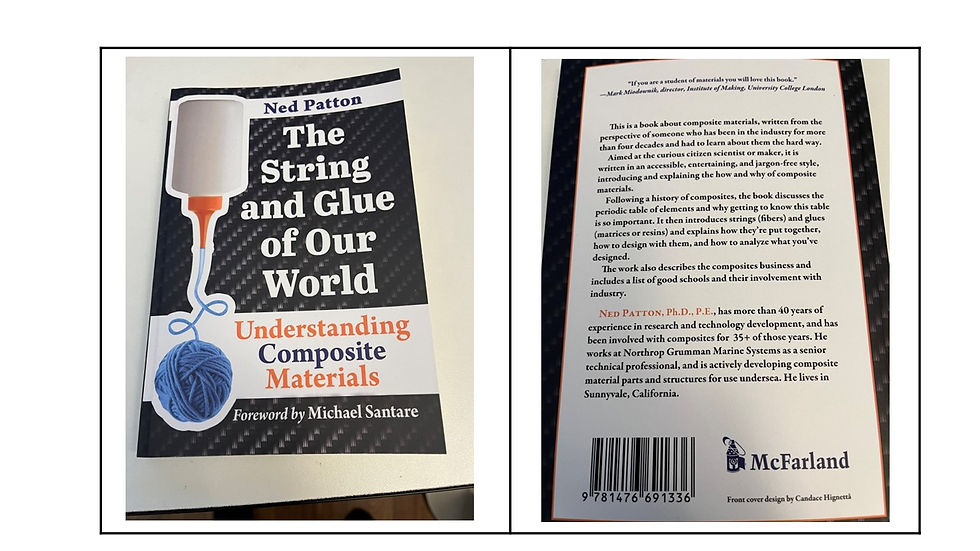
As usual, I’ve included a photo of the cover at the end of this post. Let me know whether or not you like the cover. Hopefully people will like it enough and will be interested enough in composites sustainability that they will buy it. And of course I hope that they read it and get engaged. We need all the help we can get.
Last but not least, I still need to plug my first book. “The String and Glue of our World” pretty much covers the watershed in composites, starting with a brief history of composites, then introducing the Periodic Table and why Carbon is such an important and interesting element. The book was published and made available August of 2023 and is available both on Amazon and from McFarland Books – my publisher. However, the best place to get one is to go to my website and buy one. I will send you a signed copy for the same price you would get charged on Amazon for an unsigned one, except that I have to charge for shipping. Anyway, here’s the link to get your signed copy: https://www.nedpatton.com/product-page/the-string-and-glue-of-our-world-signed-copy. And as usual, here are pictures of the covers of both books.


Comments