ORNL, Wind Energy, Strangely Shaped Carbon Fibers, and a Repair Robot

Article reposted from www.nedpatton.com
I saw a recent article in Composites World that had a micrograph of a section of cut carbon fibers. And this isn’t your typical micrograph that shows round fibers that have a sort of a messy outside surface and where you can sometimes see small defects in the surface. This one was completely different. So, since I’m the curious type I looked into this to see what was going on.

As it turns out, the DOE National Wind Energy Technologies Office funded a project at Oak Ridge National Laboratory’s Carbon Fiber Technology Facility that included participation from Sandia National Labs and Montana State University that they titled the Carbon Fiber Design Project. The idea was to change the shape of carbon fibers in order to give them better compression strength.
Carbon fibers are very strong in tension when they are being pulled, but their compression strength and stiffness, even when in a unidirectional laminate, is very low. This is not great for the use of carbon fibers in wind turbine blade spar caps. And to remind everyone what a spar cap is you need to think about a wind turbine blade as a long box beam with fairings on the leading and trailing edges. The “spar” is the box beam that runs down the long axis of the blade and the “spar cap” is the upper and lower surfaces of the box beam.

The problem with using carbon fiber in a unidirectional laminate for a spar cap is that when the wind turbine blade bends from the force of the wind, the downwind side of the spar is in compression. This actually is one of the limitations for using traditional carbon fiber for the downwind side of the spar cap. The upwind side is of course in tension, so that is fine.
What the members of the Carbon Fiber Design Project were doing was to change the shape of the carbon fibers to make them more resistant to compression failure. In other words, they wanted to change the cross section of the carbon fibers to something that was stiffer in buckling or compressive bending than the typical very thin, round fibers available commercially.
And since these fibers, if they were successful, would need to be made at the high rate of production of currently available fiber and in large quantities for the burgeoning wind energy industry, the best facility in the US for this project was the already established Carbon Fiber Technology Facility at Oak Ridge.

The researchers at Oak Ridge had been working for a decade or more on making lower cost, higher production rate carbon fiber by focusing on low cost textile technologies to make the PAN fiber to begin with and then trying different surface treatments and other inexpensive process improvements to significantly reduce the cost and increase the throughput of their industrial carbon fiber manufacturing process.
When DOE came to them to see what could be done to increase the compression stiffness and strength of their carbon fiber while keeping the cost of the fiber as low as possible, the easy choice for them was to start with their textile-based PAN fiber. They had already been working with this fiber as a carbon fiber precursor in their carbon manufacturing technology efforts that were aimed at a low cost, high production rate carbon fiber.
The textile PAN fibers are spun in a much lower cost, high production rate manner and don’t necessarily have a circular cross-section. The typical textile grade PAN fiber is sort of oblong or kidney bean shaped in cross section, and so when this project started in 2020 the researchers decided to try a couple of different means of increasing the compression stiffness and strength of their fiber as incorporated into a laminate. Two alternative approaches were made. One was fairly simple – just increase the diameter of the fiber. However, this poses all sorts of problems when you go to carburizing the fiber because all of the stuff that isn’t carbon toward the center of the fiber has a much longer path to get out of the fiber when it is put through the high temperature pyrolysis-like process to turn it from PAN to carbon. This makes the fibers considerably weaker because there is a lot of porosity in the fiber itself and there are many more inherent fracture initiators because of that porosity.

The other thing that ORNL and its partners in this project decided might be a good idea came from them looking carefully at the micrographs of their current textile PAN based carbon fiber to see if possibly a change in cross section shape might be a good idea. And as most people know, triangular shapes are inherently stable and a triangular cross section has a much higher what is called area moment of inertia (resistance to bending) than most any other prismatic structural shape.
What they came up with is what you see in the lead pic in this post, a three lobed sort of gear-shaped cross section for their fiber. I found it interesting that they settled on this shape first because they were able to change the bending cross section of the fiber substantially while keeping the path length short for the stuff in the PAN fiber that isn’t carbon when they went to the pyrolysis step in their manufacturing process. What this team found is that they could not only make the fiber from less expensive textile grade PAN, they could also increase their throughput by two or three times because of the short path in the fiber (called the diffusion path) for all of the non-carbon stuff to get out when they cooked it in their oxidation furnace (pyrolysis furnace) to drive off everything that wasn’t carbon.
Sorry for all of the technical stuff in this description, but what I’m trying to say is that the three lobed shape has much higher resistance to bending than nearly any other shape. And in another slight wrinkle in this, these little triangles will pack together much more densely than round shapes, so it is possible to get a higher fiber volume fraction out of them. And that is exactly what the ORNL team was able to do. According to the article in Composites World, the ORNL/Sandia/Montana State team was able to achieve a carbon fiber volume fraction of close to 70%. That is impossible to achieve with round fibers.
The result of all of this is that these folks have come up with a carbon fiber that they can make for a lot less than the currently available industrial grade carbon fiber. As of the writing of the article in CW, they were working with carbon fiber manufacturers and wind turbine blade manufacturers to scale this fiber up and commercialize it. Under a separate DOE program called I-Corps they are working to develop a formal commercialization strategy and also pulling in other interesting applications for this fiber in the automotive industry, building materials, offshore oil and gas platforms, and for non-primary structure in the commercial aerospace business.
All of this unfortunately comes at a somewhat fraught time politically in this country because of the current Administration’s efforts to do away with the wind industry. While this is most probably a temporary setback in the overall wind industry and only really has an effect on the US, it is still a setback and will most probably put the US behind the rest of the developed world in the application of renewable energy sources to our overall power grid. Unfortunately, however, for the next couple of years the wind energy industry in this country is most probably going to go silent in order to stay under the radar until we have a change of heart in Washington DC.
To that end, I wanted to show another new thing that I came across in my composites feeds (CW 5/20/2026) that has been developed in Europe and is going to have a positive impact on the overall safety of wind turbine maintenance.

This crazy looking device is the first demonstration of an entirely robotic repair of a wind turbine blade while it is still attached to its hub. This thing operates at several hundred feet off the ground and has demonstrated very effective repairs of these blades. It was created out of the European ROMAIN project (Robotic Operation and Automated Maintenance for Inspection of Wind Turbines). This project was coordinated by the Portuguese company EDP Renewables and built by Tecnalia in Spain.
The reason that Europeans did this was that apparently blade maintenance accounts for 15-25% of the total wind turbine maintenance costs and typically it involves trained technicians working at enormous heights using wet layup repair patches. So, the weather has to be just right, the people that do this have to be extremely well trained, and still it is so difficult that the repair quality is fairly spotty. This little beast you see in the pic is completely automated and it brings along with it all of the things needed to make an effective repair, cure the resins and fair the blade back out so that it is as good as new. It even has a rather novel application and curing process that entails a couple of membranes surrounding the patch where the inner one is in contact with the patch and the outer one has heating elements and a vacuum system. It is designed so that when the patch is applied and a vacuum is pulled between the two membranes the patch and membranes conform to the wind blade surface and the heating elements cure the patch.
Initial tryouts of this system were made on a decommissioned blade in Tecnalia’s laboratory and once they got it working well they tried it out on an actual operational wind turbine blade in the La Cabaña wind farm in Spain. They demonstrated that this system works well and provides not only a safe operation because no technicians were working at height but also consistent repair quality which is better than having technicians do the work. And they were able to make the repairs in 170 minutes versus 320 minutes for the manual method. This is almost twice as fast as a human can do it and nobody’s life was put in danger. This is going to be wonderful when the currently being built offshore wind farms need to have blade repairs. The offshore environment is far more difficult for humans to work in than is typically the case for land based operations like this. So this is quite an important development for the offshore wind industry and for the renewable energy industry at large.
So, that’s it for this week’s post. As always, I hope everyone that reads these posts enjoys them as much as I enjoy writing them. And I hope people who are interested find something they can use in their lives or at least some ideas that they might be able to put into practice. At least I hope that these make people think a bit about sustainability and some of the major issues looming before us.
I will post this first on my updated website – www.nedpatton.com – and then on LinkedIn. And if anyone wants to provide comments to this, I welcome them with open arms. Comments, criticisms, etc. are all quite welcome. I really do want to engage in a conversation with all of you about composites because we can learn so much from each other as long as we share our own perspectives. And that is especially true of the companies and research institutions that I mention in these posts. The more we communicate the message the better we will be able to effect the changes in the industry that are needed.
My second book, which was released on April 6, is a roadmap to a circular and sustainable business model for the industry which I hope that at least at some level the industry will follow. Only time will tell. Maybe it will get noticed – as always that is just a crap shoot. I am seeing signs that the industry is coming around to a more circular point of view, but I also understand that it is going to take time and a lot of investment before composites can be truly circular and sustainable.
As usual, I’ve included a photo of the cover at the end of this post. Let me know whether or not you like the cover. Hopefully people will like it enough and will be interested enough in composites sustainability that they will buy it. And of course I hope that they read it and get engaged. We need all the help we can get.
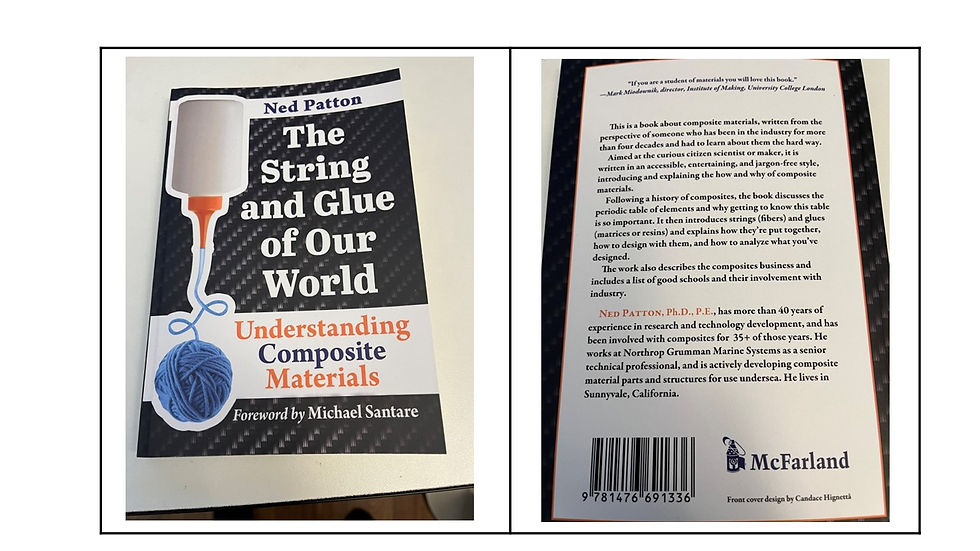
Last but not least, I still need to plug my first book. “The String and Glue of our World” pretty much covers the watershed in composites, starting with a brief history of composites, then introducing the Periodic Table and why Carbon is such an important and interesting element. The book was published and made available August of 2023 and is available both on Amazon and from McFarland Books – my publisher. However, the best place to get one is to go to my website and buy one. I will send you a signed copy for the same price you would get charged on Amazon for an unsigned one, except that I have to charge for shipping. Anyway, here’s the link to get your signed copy: https://www.nedpatton.com/product-page/the-string-and-glue-of-our-world-signed-copy. And as usual, here are pictures of the covers of both books.


Comments