There’s a New Entrant in the Sustainable Natural Fiber Composites Business

I’ve seen a couple of posts in Composites World about a company in Turkey that has developed a series of textile products using a mix of flax and hemp fibers specifically for use in composites. And this company, Bpreg, doesn’t just deliver the fiber product, they also pair it with a recyclable thermoplastic resin and sell their products in prepreg form – hence the name Bpreg. I wanted to highlight this company in this week’s post because not only are they an up and coming sustainable composite material provider, they also have a formation story that I think is interesting and bodes well for the composites industry at large.

This company was formed in 2017 as a result of the Ph.D. research done by its founder, Dr. Burcu Karaca Uğural, when she teamed up with an industry veteran, Erhan Sessizoglu. Dr. Uğural was working on natural fiber thermoplastics for her doctorate with an eye to turning her research into having a real world impact. Their collaboration apparently went from a modest prototype line to full width prepregs in a fairly short span of years, and by 2020 they had an industrial capacity prepreg line ready to go.
They were able to put it to the test with the regulatory bodies in the EU that certify the quality and consistency of these types of new materials and demonstrated that their product could meet current industry standards. That garnered them recognition from JEC as well as introducing them to a number of industry partners with whom they could collaborate and begin to integrate their materials into new, inherently sustainable products.

Bpreg has also joined a couple of industry consortia and collaborations to provide their natural fiber thermoplastic prepreg materials for demonstration and for integration into products for the automotive industry and others. Most notable among those is the reECONIC sustainability initiative led by Mercedes-Benz trucks that has 33 partners including FAUN Group and TSR Group. For that consortium Bpreg supplied a flax fiber reinforced with bio-based polylactic acid (PLA) matrix that is 98% bio-based. This was a different matrix than where they started and is a testament to the nature of this company in that they are entirely focused on providing sustainable and circular prepregs using natural fibers and bio-based resins to the industrial base of Europe.

And in a more recent collaboration with a startup by the name of fibionic (Götzens, Austria) Bpreg and fibionic demonstrated the development of an automotive part using Bpreg natural fiber prepregs in a tailored fiber placement scenario. A deep-tech startup in the composite materials business, fibionic has developed a system to place fiber exactly where it is needed in a composite design using what they call a bionically optimized fiber placement process. Interestingly it appears that the founders of this company have very diverse backgrounds from material science to automation engineering to investor relations and marketing.
The part that you see in the above pic is bicycle tire lever for road bicycles that is lightweight enough to be carried by an elite cyclist (think Tour de France here) yet strong enough to be able to be used to quickly change a tire when the cyclist gets a flat. For those of you that ride road bikes out there, this is for clinchers and not sew-ups. The old sew-up tires (or as the Europeans spell it tyre) have gone by the wayside in recent years in favor of high pressure clinchers. This is predominantly because of the difficulty of changing a tire in a road race when the cyclist picks up a thorn or a tube blows out.
In the pic above it is obvious that this tire lever is directly out of whatever fiber placement and injection molding process these two companies used to make it. It still needs to have what in the forging industry is called “flash” which is that translucent material on the edges of and between the two arms of the lever. And there is apparently a metallic button on the bottom that probably attaches an extra handle to this thing to provide leverage to break the bead of the tire off of the rim quickly. But what this does show is that the fibers are placed exactly where they are needed to provide stiffness and strength to the lever handle(s). From the fibionic website, how they work is to have an initial discussion about what you want to make, then you send them a solid (CAD) model of what you want to make, and they use their optimization technology to develop a manufacturable automated fiber placed optimized part as a prototype.
While I didn’t initially want to delve into automated fiber placement and new manufacturing technologies in this post, I found this one interesting because it demonstrates that there is a fully bio-based raw material product that meets industry standards in the Bpreg natural fiber and bio-based thermoplastic products that lends itself well to automated production processes for composite parts. Like I said at the outset in this post, this bodes well for the future of the composites industry and gives me hope that as a whole the industry is on the right track toward becoming truly circular.

I wanted to go back to something that I wrote about earlier in this post where Bpreg was using a mix of flax and hemp fibers in their prepreg tapes and fabrics for the composites industry as a whole. Hemp fibers have of course been used for several centuries in marine ropes and even to make sailcloth for the early sailing ships that plied the Atlantic and Pacific oceans at the beginnings of the merchant marine industry. Since Bpreg is based in Europe which does not have the historic restrictions on the growing of hemp that we have in the US, they have ready access to this fiber. Hemp is actually not only a better fiber than is flax as a composite reinforcement, it is also easier to grow, the plants are much taller, and growing hemp for fiber takes less acreage than growing flax. And hemp seed is more nutritious and has a higher protein content than flax seed has, so it is a better source of nutrition for our rapidly growing worldwide population.
It is interesting that this pic above also has a characteristic Ganja leaf placed on top of it, and it comes from a publication devoted to the recreational and/or medicinal use of the flowers of a particular strain of hemp rather than the actually more valuable fiber and seeds of the less narcotic agricultural hemp that is in use in the natural fiber industry.

Fortunately, the composite materials industry, as well as the European auto industry are basically ignoring what’s going on in the US with regard to the regulation of hemp and have fully embraced the use of hemp fiber in automotive products. Case in point is the pic above from Revoltech GmBH which is working with Volkswagen Group to develop a natural leather like fabric for their seats using hemp fiber. This is an entirely bio-based leather alternative made using hemp fiber that is probably going to be hitting the market in the 2028 model year in Volkswagen products. Volkswagen has made sustainability and circularity of all of the parts of their automotive products a priority for the company. That is why they came up with the electric vehicle platform that they are thinking is going to become their main product line in a short span of time. When they introduced the ID.4 SUV to the market in the US it sold very well and you see them all over the place, especially on both coasts where there are more people interested in going electric. And while the ID.Buzz did not sell as well in its first year in the US (2025), they are going to come back in 2026 with a vengeance and even with a camper van that may eventually replace the Westphalia.
All of this development of natural fiber composites and their introduction into mainstream industrial products in the automotive and marine industries (Greenboats comes to mind) is an enormous step forward for the composites industry as a whole. When I first started writing about this subject a little over four years ago, very little had been done in this space. It is heartening to see that so much progress has been made in such a short span of time. What this means is that the composites industry is taking to heart what I and several others have been saying for a while. The industry needs to transform itself from a linear economy model to a circular model to sustain the industry and meet the needs of humanity in the advanced materials business of tomorrow.
So, that’s it for this week’s post, and it’s about time I got off of my soap box. As always, I hope everyone that reads these posts enjoys them as much as I enjoy writing them. And I hope people who are interested find something they can use in their lives or at least some ideas that they might be able to put into practice. At least I hope that these make people think a bit about sustainability and some of the major issues looming before us.
I also wanted everyone to know that I gave a webinar hosted by SAMPE this morning. This is the one I mentioned on LinkedIn and in my post last week. I presented a simple roadmap for the industry to take to achieve a circular business model in their part of the industry. This is the stuff I have been writing about now for about the last two years, and since I was named chair of the Sustainability Technical Committee at SAMPE this year, I thought that it would be appropriate to set the stage for the sustainability webinars that my partner in this, Cecile Grubb, are going to host for the next couple of years. Please take a look for it on the SAMPE website if you missed it. If you are a SAMPE member, you can download it from SAMPE Connext - https://connext.sampe.org/closing-the-sustainability-circle-for-composites-simple-roadmap-1/.
I will post this issue of my newsletter first on my updated website – www.nedpatton.com – and then on LinkedIn. And if anyone wants to provide comments to this, I welcome them with open arms. Comments, criticisms, etc. are all quite welcome. I really do want to engage in a conversation with all of you about composites because we can learn so much from each other as long as we share our own perspectives. And that is especially true of the companies and research institutions that I mention in these posts. The more we communicate the message the better we will be able to effect the changes in the industry that are needed.
My second book, which was released on April 6, is a roadmap to a circular and sustainable business model for the industry which I hope that at least at some level the industry will follow. Only time will tell. Maybe it will get noticed – as always that is just a crap shoot. I am seeing signs that the industry is coming around to a more circular point of view, but I also understand that it is going to take time and a lot of investment before composites can be truly circular and sustainable. And I will keep giving talks at conferences and webinars on this same soap box until the industry as a whole starts to follow either my roadmap or one that they come up with that ends up with the same result.
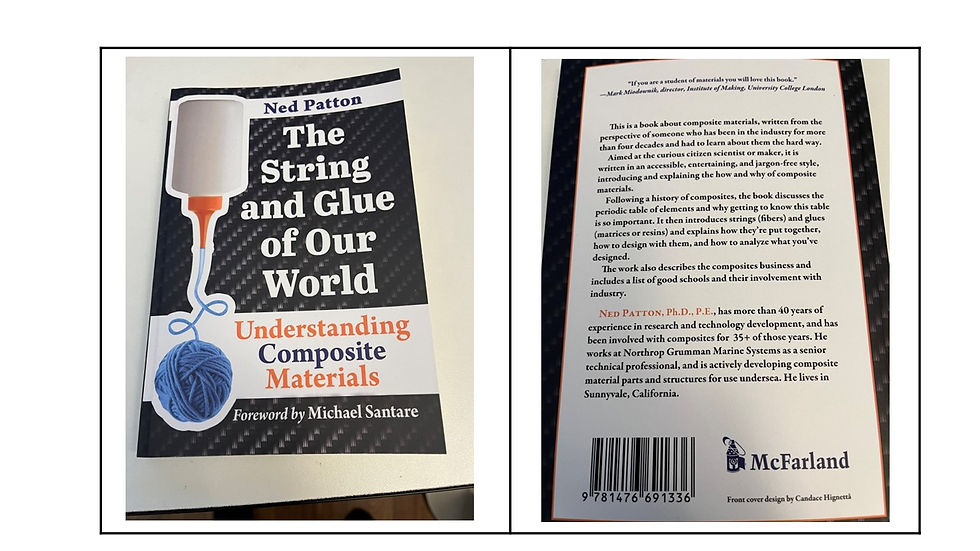
As usual, I’ve included a photo of the cover at the end of this post. Let me know whether or not you like the cover. Hopefully people will like it enough and will be interested enough in composites sustainability that they will buy it. And of course I hope that they read it and get engaged. We need all the help we can get.
Last but not least, I still need to plug my first book. “The String and Glue of our World” pretty much covers the watershed in composites, starting with a brief history of composites, then introducing the Periodic Table and why Carbon is such an important and interesting element. The book was published and made available August of 2023 and is available both on Amazon and from McFarland Books – my publisher. However, the best place to get one is to go to my website and buy one. I will send you a signed copy for the same price you would get charged on Amazon for an unsigned one, except that I have to charge for shipping. Anyway, here’s the link to get your signed copy: https://www.nedpatton.com/product-page/the-string-and-glue-of-our-world-signed-copy. And as usual, here are pictures of the covers of both books.


https://zbet68.pro/ mình lướt vào do thấy bạn bè nhắc, kiểu tò mò bấm thử thôi chứ không định ngồi đọc kỹ. Vừa mở ra cái thấy giao diện nhìn sáng sủa, hiện đại, màu với bố cục khá dễ chịu nên mắt không bị rối. Mình thích nhất là mấy phần giới thiệu về nền tảng được chia thành từng khối rõ ràng, đọc lướt vài dòng là hiểu họ đang nói về hệ thống vận hành với trải nghiệm người dùng kiểu gì. Không có cảm giác bị nhồi chữ, cuộn xuống vẫn thấy mọi thứ tách bạch. Nói chung trang này làm phần hiển thị ổn, tiêu đề và các ô nội dung nhìn gọn gàng, dễ theo…
https://gg88.black/ ban đầu mình cũng hơi lăn tăn vì mấy trang kiểu này đôi khi bày biện rối và chữ nghĩa dễ làm người ta nản, nhưng mở ra lướt thử thì thấy cách họ chia nội dung theo từng khối khá gọn nên đọc không bị đứt mạch, phần giới thiệu có nhắc tới tiêu chuẩn quốc tế với bảo mật nên ít nhất mình biết họ đang muốn nói gì. Mình chỉ xem sơ qua thôi. Thông tin đặt theo từng đoạn. Tiêu đề nhìn rõ. Menu cũng dễ thấy. Đọc vài phút là nắm được khung nội dung, nhất là mấy đoạn mô tả về kho game và các đối tác được tách riêng thành các khối…
Nói về bài giải mã giá trị thương hiệu thì nghe hơi “to tát” nên mình cũng bán tín bán nghi, kiểu không biết có nói chung chung không (ai viết nội dung giới thiệu cũng hay vậy mà). jw88com mình vào thử chủ yếu để xem họ trình bày có dễ theo dõi không, và lạ là đọc lướt vẫn nắm được ý chính khá nhanh. Trên trang họ chia các khối nội dung theo tiêu đề rõ ràng, có đoạn nhắc nền tảng phát triển nhiều mảng giải trí như game bài tới casino trực tuyến nên mình không bị lạc khi kéo xuống. Mình cũng để ý họ tách riêng phần thông tin giấy phép PAGCOR thành…
https://keonhacai5.ws/ dạo này thấy bạn bè nhắc hoài nên mình cũng bấm vào coi thử cho biết, kiểu xem giao diện thôi chứ không ngồi đọc kỹ hay làm gì. Vừa vào là thấy trang sắp xếp khá thoáng, nhìn không bị rối mắt như nhiều chỗ khác. Mình để ý nhất là cách họ chia nội dung thành từng khối rõ ràng nên lướt xuống vẫn dễ theo dõi, không bị “trôi” hết vào một cục. Với lại mấy phần thông tin trình bày theo dạng bảng/cột nên liếc nhanh là hiểu ý, đỡ phải đọc dài dòng. Menu đặt ngay chỗ dễ thấy nên chuyển qua lại cũng tiện, không phải mò. Nói chung mình thấy ổn ở…