Sustainable Composites are Becoming a Thing in the Auto Industry

First, I’m back with another edition of this newsletter after taking most of the summer off. I had initially thought that there would not be much action in the industry in terms of sustainability over the summer months. Well, I was wrong – lots of stuff has happened and there are fun and interesting things to write about.
The first fun thing I discovered and that I want to highlight is that the automobile industry as a whole is making announcements even in the summer months about new things that they are doing, new collaborations with natural fiber producers, recycled and recyclable plastics producers, and organizations that provide sustainable composite fibers and resins in sufficient quantity for the automotive industry.
Case in point is the collaboration between BMW and Bcomp that has been brewing for a while now has finally gone mainstream. The lead pic in this post is of BMW’s new M series Neue Klasse (New Class) all electric high performance 4 door sedan. This car incorporated Bcomp flax fiber composites into the roof, front splitter, hood air outlet, side skirts, mirror caps and rear diffuser (that panel below the rear bumper that controls airflow under the vehicle).

This partnership between BMW M and Bcomp was announced in 2025 and won a JEC World 2026 Innovation Award. This is quite an accomplishment and a testament to the engineers and designers at BMW for staying on the leading edge of innovation in sustainable automotive manufacture.
As for another German car maker, Volkswagen has also gotten on the sustainable materials and composites bandwagon. Their new leather-like seat material, implemented on the 2025 and newer electric vehicles (ID4 and ID Buzz) is a bio-based material that they created in partnership with a company in Germany by the name of Revoltech GmbH that is made using industrial hemp leftovers. Hemp is grown commercially in several parts of Europe because they did not have the restrictions on growing hemp that were instituted here in the U.S., but that’s another story in and of itself. And in addition to that VW uses a plastic yarn made from recycled PET bottles and recovered marine plastic (thick mid-Pacific garbage patch) to make a yarn that is woven into all of the carpeting and headliners of their newer vehicles, including the ID Buzz. The rear sliding doors and liftgate of the ID Buzz is also made using recycled materials as well as flax fiber all bound together with plant-based polyester resins.

Not to be outdone by their German competitors, Mercedes is also getting into the sustainable composites in their automotive line. I put a pic of their M16 Formula 1 race car up here just because I thought it was a cool picture, but the bottom line is that Mercedes is also moving into using recycled PET in their interior components and has even developed a sandwich composite system that uses recycled PET as its only plastic. The idea behind this sandwich is that they use a foamed PET for the core and a composite consisting of PET fibers (most probably stretched to align the benzene rings that make up the backbone of the plastic) embedded in a PET matrix. And most of the PET that they use is recycled soda bottles, which lowers their carbon footprint by more than 70%.

And that brings us onshore here to the U.S. where Ford is taking the lead in developing bio-based composites and bioplastics for use in their new vehicles. Ford inked an agreement with Jose Cuervo, the largest tequila maker in the world to develop a light weight agave fiber based biocomposite for use in their automotive interiors. As it turns out, once you make tequila out of the agave plant, there is lots of high quality plant fiber left over. Several artisans in the Southwest U.S. have used this fiber for any number of things but even with this use there is so much of this fiber left over that it becomes a sustainable ready to use source of materials to use in a biocomposite. At present this is just an initiative, but Ford has been incorporating agricultural waste products into their vehicles since 2008 when they introduced soy foam. This is now the standard foam in seat cushions and headrests in every Ford vehicle. Ford has also introduced wheat straw fiber based thermoplastic composites for storage bins and other non-primary structural components, rice hulls for wiring harness reinforcement and under-hood plastic components, cellulose fiber from forest products waste as a replacement for glass fiber in armrests and headliners, and recycled marine plastics (again, that Great Pacific Garbage Patch) for wiring brackets as well as visible components in vehicles like the Bronco where the part is intended to take a beating.
The thing about all of these developments that I have noticed is that these major manufacturers of vehicles have all made a commitment to lower their carbon footprint to as low a level as they possibly can. The other thing that this also drives is all of the second tier companies that supply all of the materials and parts for the automotive industry also taking on the challenge of reducing their carbon footprint. An example of this is Kautex Textron, a fairly major second tier to both the automotive and aerospace markets, developing battery trays using glass fiber and polyamide plastic derived entirely from recycled fishing nets. Another example is Mayco International in Sterling Heights, Michigan that is using recycled plastics reinforced with hemp and flax fibers to create new light weight, low carbon footprint materials and components for interior door panels, headliners, and all manner of other traditionally plastic parts for several of the major automotive manufacturers.
All in all this trend and the development work that is being done by the automotive industry, including even second tier suppliers, bodes well for the future where even the transportation sector can lower its carbon footprint in a substantial way. And, with the transition to electric cars and the rapid advances in battery technology, it may be possible to very nearly eliminate the carbon footprint of the transportation sector of the world’s economy. We can only hope.
So, that’s it for this week’s post. As always, I hope everyone that reads these posts enjoys them as much as I enjoy writing them. And I hope people who are interested find something they can use in their lives or at least some ideas that they might be able to put into practice. At least I hope that these make people think a bit about sustainability and some of the major issues looming before us. I also hope people think of the piles of waste plastic not as waste but as raw material for conversion into materials that can be incorporated into very high end applications. We need sources of raw carbon in a usable product form without resorting to pumping it out of the ground.
I will post this first on my updated website – www.nedpatton.com – and then on LinkedIn. And if anyone wants to provide comments to this, I welcome them with open arms. Comments, criticisms, etc. are all quite welcome. I really do want to engage in a conversation with all of you about composites and sustainability in the composites industry because we can learn so much from each other as long as we share our own perspectives. And that is especially true of the companies and research institutions that I mention in these posts. The more we communicate the message the better we will be able to effect the changes in the industry that are needed.
My second book, which was released on April 6, is a roadmap to a circular and sustainable business model for the industry which I hope that at least at some level the industry will follow. Only time will tell. Maybe it will get noticed – as always that is just a crap shoot. I am seeing signs that the industry is coming around to a more circular point of view, and even write about those in these posts, but I also understand that it is going to take time and a lot of investment before composites can be truly circular and sustainable.
As usual, I’ve included a photo of the cover at the end of this post. Let me know whether or not you like the cover. Hopefully people will like it enough and will be interested enough in composites sustainability that they will buy it. And of course I hope that they read it and get engaged. We need all the help we can get.
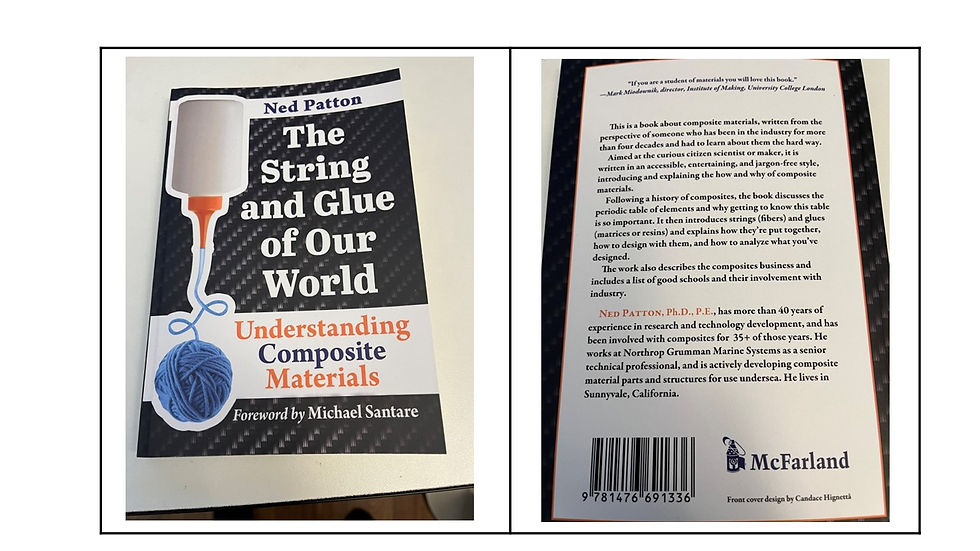
Last but not least, I still need to plug my first book. “The String and Glue of our World” pretty much covers the watershed in composites, starting with a brief history of composites, then introducing the Periodic Table and why Carbon is such an important and interesting element. The book was published and made available August of 2023 and is available both on Amazon and from McFarland Books – my publisher. However, the best place to get one is to go to my website and buy one. I will send you a signed copy for the same price you would get charged on Amazon for an unsigned one, except that I have to charge for shipping. Anyway, here’s the link to get your signed copy: https://www.nedpatton.com/product-page/the-string-and-glue-of-our-world-signed-copy. And as usual, here are pictures of the covers of both books.


Comments