Sustainability Tidbits and a Note about Defense vs Non-Defense Composites

#composites, #sustainability, #glassfibers, #bioacn, #defense, #infrastructure,#plantbased
There were a couple of articles and brief notes in the latest Composites World magazine and on-line newsletter about sustainability that I need to mention. And there was also an editorial in the latest (April) edition of Composites World that I want to talk a bit about.
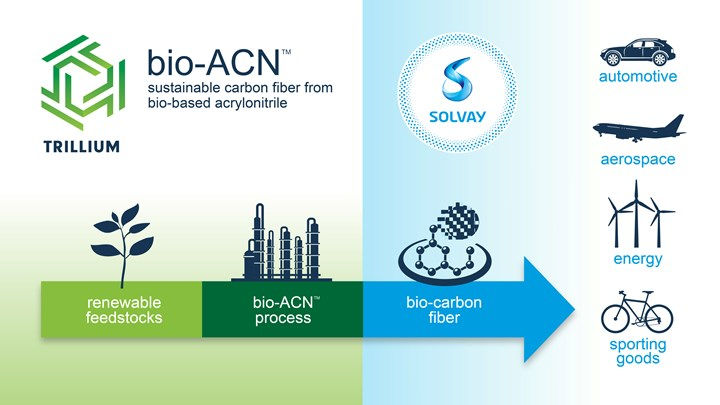
First up is a company that I have talked about in previous posts, Trillium Renewable Chemicals in Knoxville, TN. These are the folks that have been able to convert plant-based precursors into acrylonitrile for making carbon fibers as a drop-in replacement for petroleum-based acrylonitrile. Their bio-ACN™ is chemically identical to the petroleum based acrylonitrile and has already been demonstrated by Solvay to create a carbon fiber that has identical properties to the petroleum based carbon fiber that Solvay produces.

As it turns out, Trillium has had an ongoing project that they called Falcon that was intended to scale up their bio-ACN™ ale where it could be used to make an entirely plant-based carbon fiber at industrial production rates.
The big news is that they very recently closed a $13M Series B investment round for their Project Falcon which is the industrial scale up of their bio-ACN™ plant-based acrylonitrile. This new funding builds on a $10.5M Series A funding round that allowed Trillium to complete its Falcon project as well as a $2/5M award from the Department of Energy. Trillium has decided to install their production line in the INEOS Nitriles’ Green Lake plant along with the INEOS petroleum-based acrylonitrile. This new $13M funding round will take the Trillium plant-based acrylonitrile from demonstration to industrial production. Trillium expects that they will have product to ship to commercial customers by the end of this calendar year. This is the first time that a plant-based carbon fiber precursor has been offered at industrial scale to the commercial carbon fiber manufacturers.
A second sustainability topic I saw in the latest issue of Composites World magazine comes from none other than Owens-Corning Fiberglass. Apparently in 2021, the parent company Owens-Corning decided to focus on residential and commercial glass products – i.e. windows, patio doors, fiberglass insulation, and the like because that business is booming right now. So they spun off their glass fiber composites business to Owens-Corning Glass Reinforcements so that the composites business could flourish in a completely different market than the residential and commercial construction industry.
This has allowed the glass fiber composites side of Owens-Corning to also focus on sustainability of glass fiber composites as well as improving yields and also improving their entire glass fiber reinforcement product line with new fibers and more rigorous controls over their manufacturing processes.
And, since they are also focused on sustainability, they have been working on developing processes to convert recycled glass fiber reinforcements, like what Composite Recycling and Fiberloop create using their processes, to virgin high performance glass fiber for making new composites.

This has also caused Owens-Corning Glass Reinforcements to form and join in consortia that are focused on recycling and reusing end-of-life fiberglass parts like used wind turbine blades and old recreational boat hulls. One that I wrote about several weeks ago is the one formed by none other than Beneteau, the high end French sailing yacht builder. That consortium includes Owens-Corning, Composite Recycling, Fiberloop, Arkema, Chomarat, and Veolia and is focused on the recycling and reuse of glass fiber from used up boat hulls.
And, since Owens-Corning Glass Reinforcements has decided that they needed to focus on circularity, they have also worked on the glass fiber manufacturing side of their business. What they have been able to accomplish so far is the conversion of their glass furnaces to run on hydrogen instead of fuel oil or natural gas. And they source their hydrogen from renewable sources like electrolysis of seawater using wind and solar for electricity rather than the cracking of natural gas to get hydrogen.
The one thing that stood out to me as I read this article in Composites World is that Owens-Corning Glass Reinforcements clearly understood that they couldn’t do this alone, and that they would have to team with other companies that had the remainder of the specialties and technologies that they needed to become a truly circular and sustainable glass fiber reinforcement manufacturing business. The Owens-Corning folks for this article even said, “you have to be brave and prepared to spend money”.
Bottom line – Ownes-Corning Glass Reinforcements get it, and my prognostication is that they have a long, stable, and profitable future ahead of them. My hat is off to them.
Finally, for this post I wanted to talk a little bit about a sentiment expressed by Scott Francis, the Editor-in-Chief of Composites World. I know Scott and he is not only a great editor he is also what I like to call a “stand-up” guy. He was at JEC World in Paris as he wrote the editorial for the April edition of the magazine, and he wrote about the “altruistic potential of composites”.

What Scott sees is that most of the technology advances in composites have come from investments made by the Department of Defense and not from the use of composites in repairing or building infrastructure. This has meant that circularity and sustainability have taken a back seat to material performance and the next new higher performance material. He even says that JEC World has always been about sustainability and circularity, but the conference was very heavily defense based. This is because all of the manufacturers of the fibers, resins, etc. that are at the JEC World exhibit know that their most profitable customer base is defense related where cost is less of a concern and material performance is the major driver.
I understand Scott’s lament, and even share it to some extent, but there is another way to look at this technology and its further development. Development of new fibers, resins, manufacturing methods, etc. for composites is very expensive and time consuming, so companies that are in this business need to make products at a price point that will allow them sufficient capital to make the next best thing. This is largely true with the carbon fiber business, where the major players are all developing ever higher performance carbon fiber. Toray’s T1100 and Hexcel’s IM11 come to mind immediately. These are the latest commercially available high performance carbon fiber and the demand for these products is very nearly entirely from defense related businesses.
I also need to temper this a little bit because even these high end carbon fiber producers are looking toward and actually spending money on sustainable raw materials, sustainable manufacturing processes, and inherently recyclable materials. So, while the focus is on defense, especially at conferences like JEC World and SAMPE, the real story of sustainability in the industry is rather more nuanced.
In addition to that, what happens when a company like Hexcel or Toray produce the next new high performance fiber, their lower performance products, which are much higher volume anyway, become less expensive. What this means is that these materials which used to be too expensive for large infrastructure projects where orders of magnitude more material is required – meaning a bridge deck vs an F-35 – the older materials that already have high performance become affordable for infrastructure projects. This is actually good for the industry.
It is possible that Scott was lamenting the fact also that infrastructure projects take years to decades to go through all of the politics, designs and redesigns, environmental assessments and reports, etc. before a single shovel goes into the ground. So, from idea to buying material and using it for an infrastructure project like a new bridge, at least in this country, can take a decade or longer. Add to that the fact that civil engineers are inherently conservative and unwilling to take risks on new technologies before they have done extensive life and environmental testing on the material or the technology. This only adds to the time it takes to actually apply a new material to a bridge deck. And look how long it took for fiberglass rebar to be adopted for roadways and bridges. While it is taking off in high rise construction because of the weight of steel above about 25 stories, fiberglass rebar still isn’t ubiquitous in new road construction.
It isn’t that we won’t get there, all of us that are like Scott and in this rapidly evolving business head first commonly lack the patience required to see composites being applied generally like steel, aluminum, and concrete.
So, that’s it for this week’s post. As always, I hope everyone that reads these posts enjoys them as much as I enjoy writing them. And I hope people who are interested find something they can use in their lives or at least some ideas that they might be able to put into practice. At least I hope that these make people think a bit about sustainability and some of the major issues looming before us.
I will post this first on my updated website – www.nedpatton.com – and then on LinkedIn. And if anyone wants to provide comments to this, I welcome them with open arms. Comments, criticisms, etc. are all quite welcome. I really do want to engage in a conversation with all of you about composites because we can learn so much from each other as long as we share our own perspectives. And that is especially true of the companies and research institutions that I mention in these posts. The more we communicate the message the better we will be able to effect the changes in the industry that are needed.
My second book, which was released on April 6, is a roadmap to a circular and sustainable business model for the industry which I hope that at least at some level the industry will follow. Only time will tell. Maybe it will get noticed – as always that is just a crap shoot. I am seeing signs that the industry is coming around to a more circular point of view, but I also understand that it is going to take time and a lot of investment before composites can be truly circular and sustainable.
As usual, I’ve included a photo of the cover at the end of this post. Let me know whether or not you like the cover. Hopefully people will like it enough and will be interested enough in composites sustainability that they will buy it. And of course I hope that they read it and get engaged. We need all the help we can get.
Last but not least, I still need to plug my first book. “The String and Glue of our World” pretty much covers the watershed in composites, starting with a brief history of composites, then introducing the Periodic Table and why Carbon is such an important and interesting element. The book was published and made available August of 2023 and is available both on Amazon and from McFarland Books – my publisher. However, the best place to get one is to go to my website and buy one. I will send you a signed copy for the same price you would get charged on Amazon for an unsigned one, except that I have to charge for shipping. Anyway, here’s the link to get your signed copy: https://www.nedpatton.com/product-page/the-string-and-glue-of-our-world-signed-copy. And as usual, here are pictures of the covers of both books.


Comments