Sustainability in the Composites Raw Material Supply Chain

I’m going back to what I wrote about a couple of weeks ago – the recommendations for the composites industry that I have in my upcoming book. I promised that I would deal with each part of the industry in turn until I got all the way to the recyclers, talking about where we are today and what I see as a path to sustainability that each piece of the industry can take.

While this image is from a medical products company I do like it because it sort of wraps up sustainability of the composites raw materials supply chain issues in one graphic. The bottom line in all of this is that the composite materials business needs to, and is actually beginning to, transition off of petroleum products for the raw materials to make both fibers and resins.
So, I’m going to start here with the initial raw materials that are used to make the composite material products and devices (vehicles?) that are made today. As it turns out, this story has a pretty positive ending to it which is one reason that the book I wrote about this has a fairly optimistic tone to it. I have written about this in the past in these posts in smaller snippets, but since I make such a big deal about it in my new book, it does bear repeating here to tie everything to the circularity or sustainability challenges that the industry is dealing with today.
What, exactly do I mean when I talk about the precursors for composite materials? That’s a good question so I’ll start there so that I can bring everyone along on this journey and they won’t get lost. What I’m talking about is the fact that, as I have mentioned repeatedly, these raw organics that are eventually made into things like carbon fiber and epoxy resins have their origins in crude oil. Essentially what we are using today to make our composite fibers and resins is the remains of the plants that the dinosaurs were eating when the asteroid hit. The way we know this comes from the abundance of 6-sided benzene rings in a high percentage of the different gases, oils, and waxes that make up crude oil. This may be understandable to those of you that have read some of my past posts on this topic because the most abundant organics on the planet today as well as at the time of the dinosaurs are cellulose and lignin, nature’s string and glue. Suffice it to say that the biology of our planet or life as we know it today prefers this 6-sided carbon ring structure for nearly all of its requirements for structural material. It is even in the backbone of the DNA molecule, so it is the stuff of life itself.
The fact that we get our composite fibers and resins from crude oil is really only the beginning of the sustainability challenge with composite material precursors, but it is arguably the largest one. Some of the other challenges are based in the chemistry of the fibers and resins themselves and the story of why those particular chemistries were chosen in the first place.
Let’s start with the most recognizable and arguably most important fiber in advanced composites, carbon fiber. I want to remind everyone a bit about where this stuff came from and how it is made and what the precursor organic is for carbon fiber. Modern carbon fiber is made using an organic called acrylonitrile.

This seemingly simple molecule is typically made using propene (aka propylene), which is a gas that is easy to get from either the natural gases that come out of an oil well or the very light oils that can be fairly easily extracted from light crude. Propene is simply three carbons all double bonded together like the two in the middle of acetonitrile with hydrogens attached to all of the carbons. To make a fiber that you can stretch out of a solution or a melt, what is done is to make a long chain of these like the following:

This is the structure of polyacrylonitrile where there are as many repeats of this center molecule as you need to make a fiber. This is the PAN fiber that created the entire carbon fiber industry and is the precursor of choice for all industrial carbon fiber today.
The issue with sustainability of the precursors to carbon fiber then has more to do with the fact that not only is the infrastructure in place to make millions of tons of this stuff from crude oil, there isn’t the same infrastructure yet in place to make this stuff using other sources like plants or plant waste. That fact is compounded by the fact that propene is more difficult (read as more expensive) to get from plants or even from agricultural or forest products waste than it is from the existing petroleum distillation processes that are the industrial supply of propene.
So what is to be done? Fortunately there are a few organizations that are working on this problem, and they have taken two different tacks. One that has made some headway in Europe is to make propene from agricultural and forest products waste. There are two companies that are doing this in Europe, a Belgian company by the name of INEOS that makes a product they call Vioneo, and a company in the Netherlands, AnQore that uses primarily forest products waste to make their propene and ammonia (the other thing required to turn propene into acrylonitrile). What both of these companies provide is a version of propene that the plastics and fiber manufacturers in Europe can claim is 100% bio-based, so it can be used to meet the new green standards for composite materials in the EU. And none other than Dow Chemical is also involved in this with a propylene glycol that they are starting to make using entirely plant waste sources. Still, this stuff is more expensive than petroleum derived propene even though the starting material is essentially free. The catalysts that are available to do this are relatively expensive and the process has yet to be scaled up to where it can make as much of this stuff as needed for the same or less cost than just getting it from crude oil.
The other route that some have taken that may be more promising is being scaled up now by Trillium Renewable Chemicals here in the US. Trillium uses plant waste derived glycerol rather than propene. Their process uses some reportedly inexpensive catalysts that take plant waste (agricultural and forest products) glycerol and turn it into what they call bio-ACN™. They have teamed up with Solvay to scale up production of this stuff, and it appears that it is either equivalent in cost to petroleum based acrylonitrile or possibly less expensive. This one feels to me like it has more commercial potential just based on its cost versus the bio-propene acrylonitrile manufacturing process, but both have applications in their respective markets.
The other way to make the precursors for carbon fiber is to go back to the source of the carbon in today’s world rather than in the prehistoric world. That means lignin and cellulose. And also fortunately, there are people who have been working on this route as well for making carbon fiber. As yet there are no commercial fibers made using these organics as precursors, but there have been some demonstrations in laboratories, including one at NREL that I have written about in the past, but to date nobody is scaling up carbon fiber from either lignin or cellulose.

Now to the resin systems that are used for modern composites. Mostly I talked about epoxies in the book, and the problem that we have with taking apart the bisphenol-A based epoxy resins that are the standard in the advanced composite materials business. This is one of the larger hurdles in making thermoset resin based composites sustainable – they are really hard to get back apart when they come to the end of their useful life.
There are a couple of strategies that resin suppliers have adopted to make their resins more sustainable. First is to add some bio-based resin to their existing petroleum based resin products and epoxy hardener products so that they have at least lowered their overall carbon footprint. To that end there are a few notable commercial resins that have varying percentages of bio-based resin mixed into their overall epoxy and epoxy curing agent formulations.
Huntsman resins has some bio-based casting and laminating resins that are commercially available on the market. They use glycerol from plant waste to make their resin precursors and mix in as much as 50% of the bio-based resin into their petroleum-based resin to make a more carbon neutral resin product. They are more focused on the building products, marine, and recreational vehicle industries so their resin systems do not have to be qualified to aerospace standards.
Another notable bio-based resin system is Entropy resin. The company that makes this stuff was very recently acquired by Gougeon Brothers’ West System Resins. The European manufacturer of West System epoxies has been Wessex Resins and Adhesives, Ltd. since the early 1980’s so that business relationship has been quite well established. In late 2025 there was a consolidation of Wessex, West, and Entropy under the existing PRO-SET Formulated Resin Systems. The effect of this is that the entire business of West System, Wessex, and Entropy has been consolidated into one entity that connects the US and European ends of this large epoxy resin manufacturing conglomerate.

There was also a European project that I wrote about a couple of months ago and that I also wrote about in the book that developed a completely bio-based epoxy resin system. The Ecoxy project was a Pan-European effort to develop a suite of epoxy precursors based on wood waste, algae, and plant oils that mostly are either waste products from an industry or that can be sustainably sourced from plant materials. This was a very successful project and one of the partners in the project has stood up a company, Specific Polymers, to commercialize the results. Note in the figure above (to the right) that one of the things that this project did was to rethink the use of bisphenol-A as the precursor for their epoxy resin. They used some naturally occurring organics that have very similar properties to BPA and also to the backbone of polyester and vinyl ester resins.
Finally, I have to mention a resin system developed here in the US by the National Renewable Energy Laboratory – PECAN resin (Poly-Ester Covalently Adaptable Network). This resin system is an epoxy-anhydride based resin system derived from plant sugars that is inherently recyclable. It was developed for wind turbine blades to make them inherently recyclable at the end of their useful life. The PECAN resin can be easily de-crosslinked using fairly mild organic acids and therefore easily separated from the carbon fiber that it was originally bonded with. And once the resin is removed, both the carbon fiber and the recycled PECAN resin can be reused to make new wind turbine blades. This is a tremendous achievement by NREL and now the only thing that needs to be done is to have a company come in and scale this process up to the point that sufficient quantities of the resin can be made at a price competitive with standard epoxies. This is a fairly new result from a DOE lab, so I for one am going to stay tuned to this to see where it goes. I did make a fairly big deal about this in my book.
So, that’s it for this week’s post. As always, I hope everyone that reads these posts enjoys them as much as I enjoy writing them. And I hope people who are interested find something they can use in their lives or at least some ideas that they might be able to put into practice. At least I hope that these make people think a bit about sustainability and some of the major issues looming before us.
I will post this first on my updated website – www.nedpatton.com – and then on LinkedIn. And if anyone wants to provide comments to this, I welcome them with open arms. Comments, criticisms, etc. are all quite welcome. I really do want to engage in a conversation with all of you about composites because we can learn so much from each other as long as we share our own perspectives. And that is especially true of the companies and research institutions that I mention in these posts. The more we communicate the message the better we will be able to effect the changes in the industry that are needed.
I do have some good news about my second book. It is officially printed, and my author copies are on their way to me scheduled to arrive this Friday (March 27). The official release date is April 6 so I will have my copies before the book is officially released. As a reminder, this book is a roadmap to a circular and sustainable business model for the industry which I hope at least at some level the industry will follow. Only time will tell. Maybe it will get noticed – as always that is just a crap shoot.
As usual, I’ve included the approved cover at the end of this post. Once I get my copies I will take photos of front and back covers and will put the combined image (like the image I have for my first book) at the end of each post. Let me know whether or not you like the cover. Hopefully people will like it enough and will be interested enough in composites sustainability that they will buy it. And of course I hope that they read it and get engaged. We need all the help we can get.
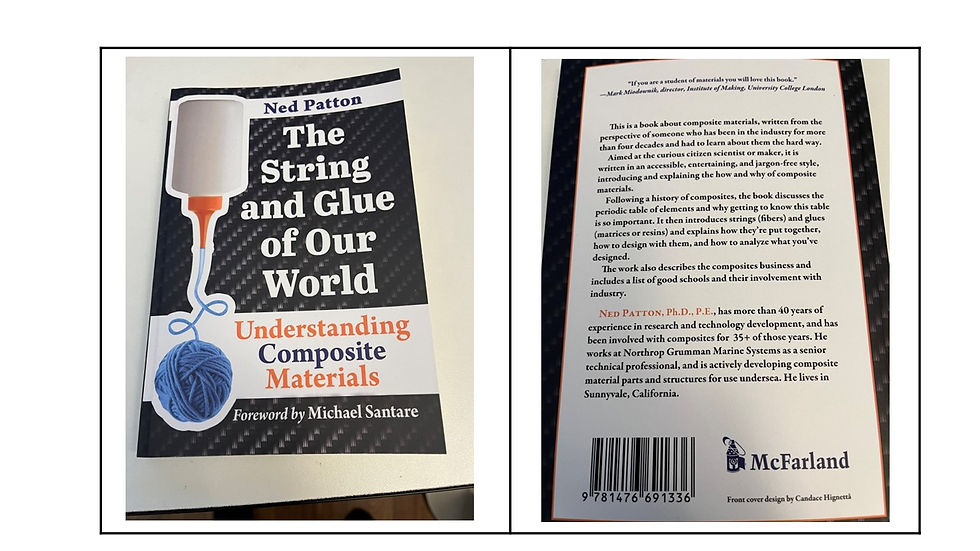
Last but not least, I still need to plug my first book. “The String and Glue of our World” pretty much covers the watershed in composites, starting with a brief history of composites, then introducing the Periodic Table and why Carbon is such an important and interesting element. The book was published and made available August of 2023 and is available both on Amazon and from McFarland Books – my publisher. However, the best place to get one is to go to my website and buy one. I will send you a signed copy for the same price you would get charged on Amazon for an unsigned one, except that I have to charge for shipping. Anyway, here’s the link to get your signed copy: https://www.nedpatton.com/product-page/the-string-and-glue-of-our-world-signed-copy. And as usual, here are pictures of the covers of both books.


Comments