Owens-Corning Glass Reinforcements and Good News in Glass Fiber Sustainability

Article reposted from www.nedpatton.com
There is some news about the glass fiber reinforcement business that is pretty substantial that I need to talk about this week, primarily because it just became official. You may already know this, especially if you have read my posts in the past, but Owens-Corning fiberglass is the largest glass fiber manufacturer in the world – by far. This of course isn’t entirely about composites because as most everyone knows, Owens-Corning is the largest manufacturer of glass fiber for insulation in the world, and the largest manufacturer of residential, commercial, and even defense-related thermal insulation in the world. Their glass reinforcements business was a relatively small part of the overall glass fiber business, but they were still the largest by far in the world.

Apparently this deal had been in the works for some time. In mid-April Owens Corning Glass Reinforcements announced a sale of the business to Praana Group, an Indian conglomerate focused on materials and specialty chemicals. That sale was finalized on May 5 of this year, and the business was renamed “The Original Composites Company”. This change in the business was made because Owens-Corning had decided in 2021 to focus on the residential and commercial building products business which was the complete opposite of what the glass fiber composite reinforcement business needed to grow into the markets that they had penetrated. The Praana group is perfectly situated to be able to go after the more global market that Owens Corning Glass Reinforcements was already heavily penetrating and is the real growth market for glass fiber composite reinforcement.
In other words, this realignment of the glass fiber reinforcements business cements Owens Corning Glass Reinforcements as the global standard and global leader in glass fiber reinforcements for composite materials. The fact that Praana Group essentially took on the role of holding company while retaining all of the talent, people, and manufacturing prowess of the original Owens Corning glass fiber business means that The Original Composites Company now has not only the freedom but also the resources of a global holding company focused on the materials business to rapidly expand and capitalize on their already world-leading manufacturing and R&D footprint. Currently they have manufacturing, fabric weaving, and R&D facilities in 12 countries spread throughout North and South America, Europe, and Asia.

Interestingly there has been a bit of chatter on sites like LinkedIn about the name they picked for themselves. From what I saw that name came from inside the original Owens Corning glass reinforcements business because some of the leadership of the company that had come up through the technical ranks still remembers some of the history of glass fiber composites and the fact that Owens Corning E-Glass was the first commercially available composite material reinforcement that got made by the mile and sold by the pound. It was Owens Corning fiberglass fabric that Ray Greene made arguably the first fiberglass daysailer from in 1942. And of course, since then fiberglass has been the material of choice for the recreational boating industry.

One thing that the Owens Corning glass reinforcement folks have not forgotten about and may even have been part of what pushed them away from the building materials side of the business is that the glass fiber reinforcements business had already been focusing on sustainability and making glass fiber composites truly circular. I have written about this previously, but they are a major partner in the Beneteau-led circular glass fiber composites consortium in the EU that Composite Recycling, Arkema, Veolia, and Chomarat are all involved in to take used wind turbine blades and fiberglass boat hulls and develop a completely circular and sustainable business model for glass fiber composites.

Owens Corning had already been involved in sustainability measures in their business, including installing multi-megawatt solar installations in their parking lots in Toledo OH, Camden NJ, and Delmar NY. What they have done is to contract with an industrial solar company to install and operate these facilities while giving Owens Corning lower rates on the electricity that these installations generate. And Owens Corning has for the last several years been placed in the top 1% of corporations in sustainability in the S&P index.
This is in addition to a circular glass fiber initiative that they formed in June of 2025 with Composite Recycling that they call SUSTAINA LOOP fiber. From that collaboration, Owens Corning has successfully introduced glass fiber recycled by Composite Recycling into new glass fiber production in their L’Ardoise, France glass fiber furnaces creating a glass that is identical to their E-CR Glass (low corrosion). Those furnaces are powered by Hydrogen, further reducing the carbon footprint of the glass produced.
And in another collaboration with Gjenkraft, a waste management service in Norway, Gjenkraft has used a process similar to Composite Recycling to produce nearly virgin quality glass fiber that Owens Corning has also introduced back into their glass fiber production facilities.

In other news about glass fiber and sustainability, I saw a recent post in Composites World (May 13, 2026) about a company in the UK – Far-UK Ltd. – that used recycled glass fiber and Arkema’s Elium® resin to make composite support brackets for a Mercedes truck. These support brackets meet all of the structural requirements of the metallic brackets at a lower cost and lighter weight. The fact that the Arkema resin was used also makes them inherently recyclable, so this is a demonstration of a completely circular part made from recycled material for an application in the long haul trucking industry.
And just so that everyone knows about it, the Arkema resin is a thermoplastic that is liquid when it is delivered, so it can be used in a resin transfer molding process in the same manner as epoxies. It will crosslink at room temperature rather quickly when the resin kicks off, so it can be used in common automated composites manufacturing processes. And it is also recyclable both chemically using the appropriate solvents and thermally by melting it so that it can be reformed into a new part.
All of these fairly recent developments bode well for the eventual solution to the largest problem that the composites industry is facing right now, what to do with the millions of tons of used wind turbine blades that are already piling up in the US, the EU, China, and India. And it is a looming problem in Australia and on the horizon in Africa and South America. So this is eventually going to be a worldwide problem as more installations of wind turbines age past where blades need to be replaced or get repowered and upgraded with new blades.
Having ready made solutions that allow for circularity of the glass fibers and resins that originally made up these fiberglass parts is good news indeed. And as Composite Recycling and others like Carbon Rivers have shown, there is enough demand for recycled glass fiber that these companies can make real and sustainable businesses out of supplying the major glass fiber composites manufacturers with recycled glass fiber.

Before I go I want to let everyone know that I will be the speaker in a webinar on May 27 at 10:00 AM Pacific hosted by SAMPE (Society for the Advancement of Materials and Process Engineering) about circularity and sustainability in the composites business. Cecile Grubb and I head up the Sustainability Technical Committee of the Society and will be putting on several of these over the coming months highlighting different aspects of the sustainability challenge and featuring several different speakers. I’m just doing the first one to kick the whole series off.
So, that’s it for this week’s post. As always, I hope everyone that reads these posts enjoys them as much as I enjoy writing them. And I hope people who are interested find something they can use in their lives or at least some ideas that they might be able to put into practice. At least I hope that these make people think a bit about sustainability and some of the major issues looming before us.
I will post this first on my updated website – www.nedpatton.com – and then on LinkedIn. And if anyone wants to provide comments to this, I welcome them with open arms. Comments, criticisms, etc. are all quite welcome. I really do want to engage in a conversation with all of you about composites because we can learn so much from each other as long as we share our own perspectives. And that is especially true of the companies and research institutions that I mention in these posts. The more we communicate the message the better we will be able to effect the changes in the industry that are needed.
My second book, which was released on April 6, is a roadmap to a circular and sustainable business model for the industry which I hope that at least at some level the industry will follow. Only time will tell. Maybe it will get noticed – as always that is just a crap shoot. I am seeing signs that the industry is coming around to a more circular point of view, but I also understand that it is going to take time and a lot of investment before composites can be truly circular and sustainable.
As usual, I’ve included a photo of the cover at the end of this post. Let me know whether or not you like the cover. Hopefully people will like it enough and will be interested enough in composites sustainability that they will buy it. And of course I hope that they read it and get engaged. We need all the help we can get.
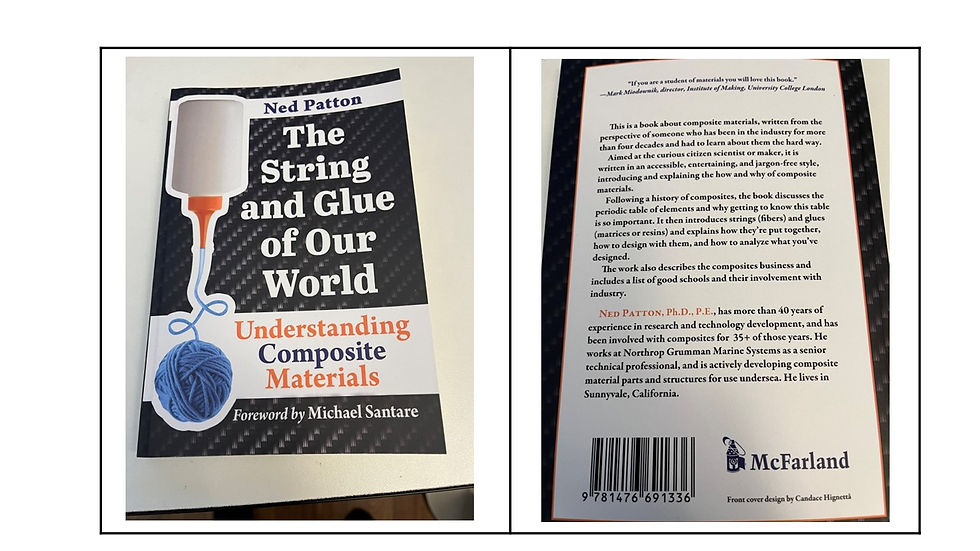
Last but not least, I still need to plug my first book. “The String and Glue of our World” pretty much covers the watershed in composites, starting with a brief history of composites, then introducing the Periodic Table and why Carbon is such an important and interesting element. The book was published and made available August of 2023 and is available both on Amazon and from McFarland Books – my publisher. However, the best place to get one is to go to my website and buy one. I will send you a signed copy for the same price you would get charged on Amazon for an unsigned one, except that I have to charge for shipping. Anyway, here’s the link to get your signed copy: https://www.nedpatton.com/product-page/the-string-and-glue-of-our-world-signed-copy. And as usual, here are pictures of the covers of both books.


soicauxsmb.com mình thấy bạn bè nhắc mấy lần nên cũng bấm vào coi thử cho biết, kiểu tò mò giao diện thôi. Vào trang cái là thấy họ làm bố cục khá thoáng, không nhồi chữ dày đặc nên nhìn đỡ mệt mắt. Mình để ý cách họ chia nội dung theo từng khối rõ ràng, lướt xuống vẫn biết mình đang ở đoạn nào chứ không bị rối. Cái menu đặt ngay chỗ dễ thấy nên chuyển qua lại cũng nhanh, không phải mò nhiều. Nói chung cảm giác dùng khá nhẹ nhàng, nhất là mấy phần trình bày theo dạng cột nhìn gọn và dễ theo dõi trên màn hình. Mình thích nhất là các khối thông tin…
sunwin mình vừa lướt thử chút vì thấy mọi người nhắc hoài, kiểu vào xem giao diện ra sao thôi. Ấn tượng đầu là trang nhìn khá “thoáng”, nội dung chia theo từng mảng nên mắt bắt nhịp nhanh, không bị dồn chữ làm ngợp. Mình dùng điện thoại là chính, kéo lên xuống với chuyển mục thấy mượt, chắc họ có tối ưu cho mobile như họ hay nói. Cũng thấy họ giới thiệu hệ sinh thái trò chơi phong phú, nhưng mình không bấm sâu, chỉ xem cách họ đặt tiêu đề và sắp xếp thông tin. Nói chung cảm giác thân thiện cho người mới, không phải mò lâu mới biết chỗ nào là gì. Mấy khối…
https://soicau247.com/du-doan-xsmb-c59.html bữa lướt thấy cái này nên mình bấm vào xem thử cho biết, kiểu tò mò thôi. Mình không ngồi đọc hết từng đoạn đâu, chủ yếu coi họ trình bày có dễ theo dõi không. Thấy ổn ở chỗ nội dung chia thành từng khối rõ ràng, kéo xuống không bị rối mắt. Có mấy mục dự đoán theo ngày (kiểu 25/06/2026) nên nhìn phát biết đang nói về ngày nào, khỏi phải tìm lâu. Mình cũng để ý phần thống kê/bảng số liệu nhìn gọn, các cột tách ra rõ nên lướt nhanh vẫn nắm được ý. Nói chung giao diện không màu mè, chữ nghĩa vừa phải, đọc trên màn hình thấy nhẹ mắt. Mấy tiêu…
keo nha cai 5 bữa trước thấy mấy ông bạn share nên mình vào coi thử cho biết, kiểu xem có gì hay ho không. Vào trang cái là đập vào mắt cái bảng kèo bóng đá trực tuyến, trình bày theo dạng cột nên nhìn khá dễ, không phải căng mắt tìm từng dòng. Mình thích nhất là phần tỷ lệ kèo cập nhật theo các trận trong ngày, refresh lại vẫn thấy số liệu thay đổi chứ không đứng yên. Mình không rành mấy thuật ngữ kèo châu á hay tài xỉu gì lắm, nhưng cách họ đặt tiêu đề và chia khối nội dung nhìn cái là hiểu đang nói về phần nào. Nói chung lướt nhanh…