What do I Mean when I Say Roadmap

As promised, this post will be about the roadmap that I keep talking about for the industry, and what exactly I mean when I say roadmap. And this will be the sixth and final blog that is from my newly released book, “Sustainable Composite Materials: A Roadmap to a Circular Economy”. I wanted to leave my audience with a sense of what my new book is about to make sure that everyone that reads these posts understands not only what it is about but why I wrote it in the first place. I have written about this before, but my sense is that the industry is in a major transformation moving away from the use of petroleum for raw materials to using plant derived organic compounds for all of the raw materials to make precursors for more industrialized fibers like carbon fiber and also for making the epoxy and epoxy-like resins to stick the fibers together.
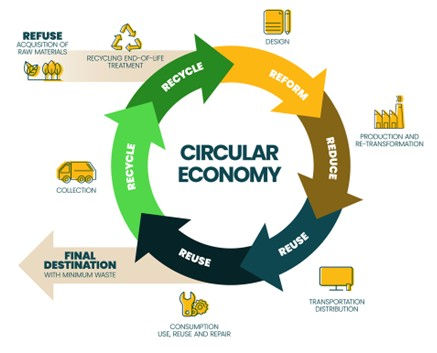
This graphic portrays where the composites industry must go and where it seems like the industry is headed today. My horizon is probably a bit longer term than most because I’ve been around longer than most and have seen several transitions from one technological state to the next. The internet is the classic example of the slow early adoption of a brand new technology to the eventual and commonly rapid worldwide adoption of that technology. From its meager beginnings in the 1960’s with ARPANET, and the unification of this network and adoption of the TCP/IP protocol that drives all on-line and digital today, the internet has become this new technology that is used today by the entire developed world and most of the underdeveloped world to connect the entire world with high speed communications, satellite clusters that act as communications nodes, optical fiber directly to your home, etc. All of that took about 50-60 years from its meager beginnings as a small experimental US DoD secure communications platform to become the indispensable worldwide lightning speed communications network that it is today.
Plant-based composites got their start a long time ago as well, and if you look back in history, the mudbrick that ancients used to build their huts for shelter in prehistoric times were actually plant-based composites. But to take a more modern look at it, flax fiber composites got their start in the late 1930’s to early 1940’s. At the time, linen fabrics aka flax fiber fabrics were in use for clothing but not for composites. In fact, flax fiber has been used as a fabric since ancient times, In the late 1930’s these ancient fabrics started to be used as structural materials for early aircraft, primarily for wing skins, but also for other structural purposes. Flax of course was largely replaced in the 1950’s with the development of glass fibers which were much more consistent in mechanical properties and also did not biodegrade or rot. And of course for wing skins the newer aluminum alloys became the material of choice. This change from initial meager beginnings of using flax fiber for wing skins in old biplanes to glass fiber and polyester resin (fiberglass) is of course what actually sparked the initiation of the modern age of advanced composites.

What I want to talk about here is the resurgence in natural fiber composites in the last 20-30 years. Flax has recently been used with high performance resins to make things that are just as strong and stiff as glass fiber composites at less than half the weight, and that are not biodegradable because the flax has been treated chemically or coated with a very thin metal oxide coating so that it does not uptake water.
The impetus for use of natural fibers versus fiberglass has come primarily from the transportation sector for non-primary structural parts like door panels, dashboards, body parts, sound insulation, trunk liners, etc. primarily to save weight and enhance fuel economy. Natural fibers have even been used for enhancing aesthetics. If you use a transparent resin and a natural fiber the end result is a warm colored, natural looking part that is nearly as pleasant as the polished wood interior parts of high end cars – at a cost equivalent to inexpensive plastic. Natural fibers that are stabilized against environmental degradation are also important in the recreational marine and aerospace industries where weight is critical.
While all of this is well and good, just the use of natural fibers does not make a composite truly circular. The definition of circularity really means that what comes from the earth must eventually be returned to the earth to grow more of what came from the earth to begin with. As in the lead pic in this post, that is the definition of a truly circular materials economy.
Obviously, a truly circular economy for today’s composite materials or what have been called advanced materials is quite a way off into the future. We have only talked so far about the natural or plant-based fibers, so there is also the resin that is currently made from petroleum byproducts. There are some bright spots here and there like some of the plant-based resins that West System is selling now that they have acquired Entropy Resins, Sicomin’s GreenPoxy, EcoPoxy, Arkema, and a handful of others. All of these are still small companies and have not scaled up their production to meet the overall demand for high performance epoxies that are currently being made using petroleum.
But at least these initial plant-based fibers and resins, most of which are easily recyclable, will give us some perspective of how long this transition is going to take. It won’t be a single decade, or even two, but if you think of it having started 20-30 years ago, it looks to me like we have about another 20 to 30 years before the transition is complete. This actually follows the timeline of the original example that I started this post with, the internet. And it is going to be messy and difficult all along the way, but that is how these things happen. It certainly happened with our on-line world, which is still a messy place. New companies will get started and eventually either take over the larger companies in this industry or be swallowed up by them as the large companies come to grips with the fact that they need to change to survive. Like I said – it’s going to be messy, and it is going to take time. But I know that we will get there, which will go a long way toward helping to save the planet for our descendants.
And, don’t get me wrong, I don’t really think that petroleum-based composites will completely go away. There are some things that petrochemical organics can provide that you just can’t get from plants. These will be more of the specialty materials in the future than Toray’s T300 and Hexcel’s AS4, or even T700 and IM7. These are today’s industrial grade carbon fiber, and plant-based carbon fiber of this quality and strength has already been demonstrated. These are the high tonnage fibers that will eventually be replaced by plant-based carbon fiber. It’s a lot more difficult to get to the properties of a T1100 or IM11 carbon fiber with a plant-based precursor. These fibers, for those that are not in this business, are the high end aerospace grade carbon fibers that are going into the latest spacecraft, high performance fighter aircraft and high pressure Type 4 hydrogen storage tanks. At some point they will probably be the major structural materials for the next generation single aisle passenger get. Think of a Boeing 737 New Technology or a new A321NEO New Technology aircraft that is largely carbon fiber. Sorry about the aside here, but the new single aisle aircraft was quite a bit of the buzz at the SAMPE conference I went to last week. All of the big players in the business are eagerly awaiting Boeing or Airbus to announce a new mostly composite version of their highest volume passenger jets.
All of that being said, and to get back to the subject of this post, the roadmap that I provided in the book was a series of suggestions for each of the sectors of the industry to follow to get to true circularity. The sectors of the industry I have talked about before, but I should probably highlight them once again here. They are (as I see it):
· Raw material suppliers
· Fiber manufacturers
· Resin manufacturers
· Processing equipment manufacturers
· Composites fabricators
· End users
· Recyclers
There are of course many smaller segments of each of these, and a lot of them were represented at the SAMPE conference in the Exhibit Hall. But the industry does break down along these rather broad lines. In the book I give recommendations to all of these sectors of the industry and describe how they can make their piece of this puzzle become part of the circular economy that is portrayed in the graphic at the start of this post.
So, what are my general recommendations for each of these sectors? I have several that I need to talk about here that make sense to me and that I have presented to audiences of technologists in this industry and gotten general agreement that this is what has to happen.
Recommendation 1. Create Sustainable Strategies – Create sustainable strategies that will work for your business model and that would work in your sector of the industry. For example, a petrochemical company might want to ease their way off of petroleum feedstocks and work to develop plant-based feedstocks for making the precursors for all manner of industrial organics. For composites this means the precursors for fibers and resins, as in plant based acrylonitrile from propanol and plant-based epoxy precursors like that made by Entropy Resins.
Recommendation 2. Partner with Startups – Small entrepreneurial companies and research laboratories are where you will find interesting technologies in your piece of the composites industry that you can adopt and that may even be less expensive for you in the long run, potentially making you more cost competitive as a business. This isn’t rocket science either, it is just good detective work and development of relationships with entrepreneurial companies. It does require a rather well thought out strategy for vetting the ideas of the startups, but all that takes is to have some smart and well experienced chemists and engineers leading your search staff.
Recommendation 3. Take Some Risk – I can’t harp on this point enough. You have to risk some capital to make more in the long run and to stay in the high technology business that you are in. All of the folks in this industry are smart people and can see the future as well. The smartest ones of them understand that you have to take some risk now in order to prosper in the future. It could be said that if you don’t heed this warning you run the risk of a competitor taking away your business from you. There are far too many sad stories about companies that had great ideas but were unwilling to take the risk and eventually fell behind competitors that took the risk and became the big dogs in their respective markets.
Recommendation 4. Work with Others and with National Societies and Not for Profits (501.c.3 companies) – There is a wealth of talent and great ideas in Universities, Societies like SAMPE, ASME, ACS, etc., as well as ACMA and EUCIA. And you should never ignore the large and small R&D establishments because they also have very smart people who love to make the next new thing. I know, I have been one of those at a few research institutions over my career and those experiences were some of the most rewarding times in my career. It’s hard to get as many patents as I have without being able to work with companies and institutions that came to us looking for ideas for how to solve a problem that they had.
Recommendation 5. Seek Government Funding for Transformative Technologies – There are multiple federal agencies that have R&D funding that are interested in developing technologies that will help them perform their mission. The Department of Defense is arguably the largest of these with the most money to spend, so that is a good place to look. And since the Baye-Dole Act was enacted in 1980, even if the government funds the development of a technology, the company that develops it can keep the intellectual property and all of the commercial rights to it while the government keeps the government rights.
Recommendation 6. Final Recommendation / Strategic Imperative – Don’t go out of business while changing the business. A clear eyed approach to transforming your business and a clear understanding of not only the risks but the opportunities that taking that risk can net you will keep you focused on what is your ultimate goal – to grow and be successful into the far future. Losing sight of your core business during the transition is a great way to go out of business, and I can’t count the number of companies that have failed to heed this warning. Many of them no longer exist. And, while this is easier for smaller companies, large companies with large bureaucracies can still make this transition as long as the leadership of the company understands how to steer their ship into the wind so to speak.
I do sincerely hope that the decision makers in this industry take this risk and opportunity seriously because they will ignore it at their potential peril. And I for one don’t want any of the companies in this business to fail just because they couldn’t see the light of the oncoming train.
So, that’s it for this week’s post. I hope that at least some of the leadership of this industry takes note of this. Fortunately, from what I see, the transformation is beginning to happen in the industry. Just in the past few years the industry has gone from denial to actually taking concrete steps to make their businesses sustainable. While this is yet to become universal, just like the definition of sustainability in this industry is different depending on who you are talking to, at least it is starting to happen. I’m optimistic.
As always, I hope everyone that reads these posts enjoys them as much as I enjoy writing them. And I hope people who are interested find something they can use in their lives or at least some ideas that they might be able to put into practice. At least I hope that these make people think a bit about sustainability and some of the major issues looming before us.
I will post this first on my updated website – www.nedpatton.com – and then on LinkedIn. And if anyone wants to provide comments to this, I welcome them with open arms. Comments, criticisms, etc. are all quite welcome. I really do want to engage in a conversation with all of you about composites because we can learn so much from each other as long as we share our own perspectives. And that is especially true of the companies and research institutions that I mention in these posts. The more we communicate the message the better we will be able to effect the changes in the industry that are needed.
My second book, which was released on April 6, is a roadmap to a circular and sustainable business model for the industry which I hope that at least at some level the industry will follow. Only time will tell. Maybe it will get noticed – as always that is just a crap shoot.
As usual, I’ve included a photo of the cover at the end of this post. Let me know whether or not you like the cover. Hopefully people will like it enough and will be interested enough in composites sustainability that they will buy it. And of course I hope that they read it and get engaged. We need all the help we can get.
Last but not least, I still need to plug my first book. “The String and Glue of our World” pretty much covers the watershed in composites, starting with a brief history of composites, then introducing the Periodic Table and why Carbon is such an important and interesting element. The book was published and made available August of 2023 and is available both on Amazon and from McFarland Books – my publisher. However, the best place to get one is to go to my website and buy one. I will send you a signed copy for the same price you would get charged on Amazon for an unsigned one, except that I have to charge for shipping. Anyway, here’s the link to get your signed copy: https://www.nedpatton.com/product-page/the-string-and-glue-of-our-world-signed-copy. And as usual, here are pictures of the covers of both books.


Comments