Are Plants the Future of Composites?

This week will be the fifth tied to what I wrote in my new book, “Sustainable Composite Materials: A Roadmap to a Circular Economy”. In this post, I am going to try to answer this question based on today’s markets and today’s technologies. That means that I want to talk through the potential of plant-based precursors for both fiber and resin and biocomposites in general to transform the composites industry and get off of the petroleum bandwagon. From where I sit in this industry it appears to me that the long term future of the industry will be plant based, so my answer to the question in the title of this post is a definite yes. The price of oil is only going to go up and there is only so much of the stuff that we can extract from what our prehistoric ancestors left for us to take out of the ground. And, depending on how long the latest oil price crisis goes on with our tenuous geopolitical state, it might be sooner than most of us in this industry thought it might.
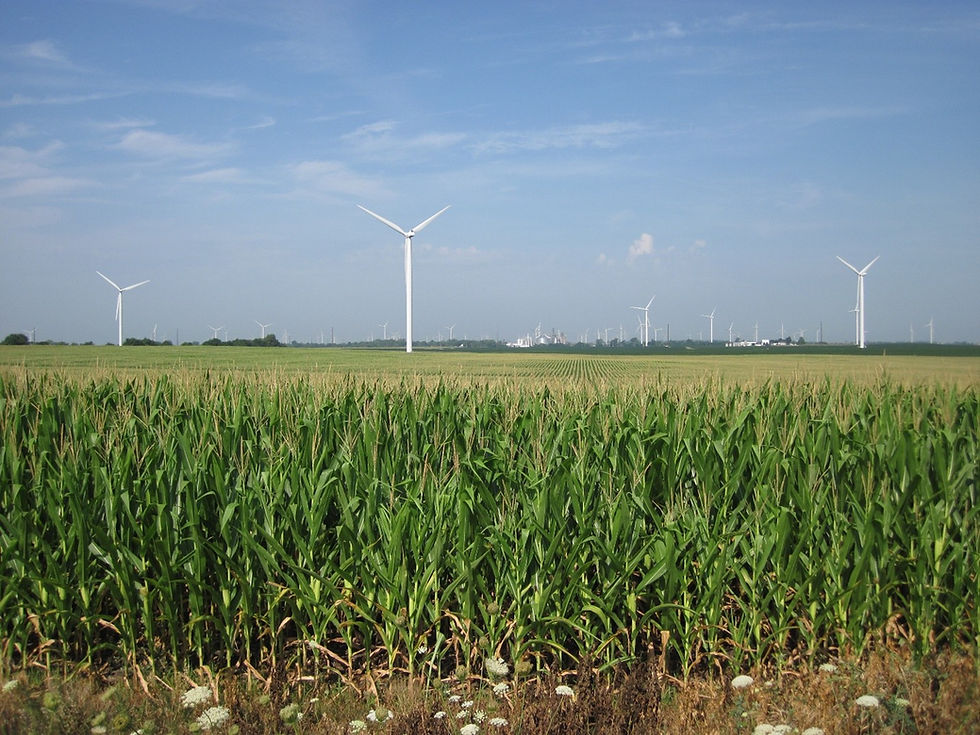
I like this picture because it tells the story of plant based composite materials in a very real application, applied right where the plants grow. This is a field in the Midwest corn belt that has not only the land where things like corn are grown, it also has a wind energy installation that does not take up or shade the land area where the corn is grown. This is the interesting intersection of the potential precursors for the fiber and resin that make up the composite wind turbine blades being grown right under where the wind turbine blades are being used. The story behind this picture is ubiquitous across the Midwestern US because of the reasonably steady wind resource in the Great Plains. Wind energy companies are inking deals with farmers and ranchers with large tracts of land to install wind farms right in the middle of corn fields, cattle pastures, soybean fields, etc. In fact, Texas has more installed wind energy capacity than any other state. Mostly that is in the plains in North Texas and quite a bit of it is completely integrated with agricultural land. This benefits both the farmer and the wind energy company because they can live in harmony and have dual use for the land. The farmers lease spots for the wind turbine installations and the wind energy companies get to site their turbines in locations that have a lot of wind resource.
The pic from last week’s post about composites recycling with the pile of used wind turbine blades is from Sweetwater, Texas which is in Texas, west of Abilene and south of Lubbock. This is sort of the south edge of the great plains and is known as the gateway to the Permian Basin, one of the most oil rich areas of the West Texas Plains. Sweetwater is actually known as the “Wind Turbine Capital of Texas”. It is also well known as the area of probably the highest friction in the US between agricultural interests and those of oil and gas production since it sits right on top of the highest producing part of the West Texas oil shale deposits.
All of that aside, what I want to talk about in this post is the growing field of plant based composites and their potential to eventually take over from petroleum based sources of the organics that make up the resins (glues) and the precursors for carbon and other organic fibers for the composites industry.
First let’s talk a little about carbon fiber. The common petroleum-based precursor for this fiber is acrylonitrile, which is polymerized into polyacrylonitrile (PAN) and spun into a fiber from the gelatinous mix of acrylonitrile and some organic solvents with long names and then dried into PAN fiber. This is the acrylic fiber that is still popular for making winter sweaters and hats. It is made by what is called an amoxidation process where propylene (aka propene – 3 carbon atoms double bonded together) and ammonia and some other stuff are put together over a fluidized bed catalyst at 400-500 degrees C (750-900° F) in what is called the Sohio process because it was developed by Standard Oil of Ohio in the 1950’s.

This picture of the INEOS plant based acrylonitrile plant in Green Lake, Texas is indicative of the amount of capital that is being expended to scale up plant-based acrylonitrile. The process that INEOS (Cologne, Germany) uses is from a partnership with Trillium Renewable Chemicals and their Bio-ACN™. I have written about this process in the past which was originally developed as a consortium between Southern Research and This process starts with glycerol created as a by-product of the production of biodiesel which INEOS also produces. What is most telling about this is that INEOS already controls roughly 75% of the worldwide acrylonitrile production, so the introduction of this new chemistry into the production process for acrylonitrile is a good fit for the company. It is pretty obvious from the size of this facility that INEOS is betting big on plant-based acrylonitrile. And as petroleum becomes more scarce it appears that INEOS and Trillium have made good bets.
In addition to that, Trillium has joined forces with none other than Solvay. Headquartered in Brussels, Solvay is one of the world’s leading chemical companies, and their 2023 spinoff of their materials business to form a new company called Syensqo became also another leading sustainable carbon fiber manufacturer. While their core business is still industrial chemicals, to form Syensqo, Solvay included their 2015 acquisition of the Cytec Engineered Materials business. I can’t tell you how many times this sort of thing has happened in this industry, but as innovative and successful companies like Cytec grow, they become targets for much larger innovative and growing companies like Solvay. The upshot of all of this is that since the mother company is European, they have taken the long view of their industry and have seen the same things that a few others have seen. They need to move toward the use of plants for their raw materials and off of petroleum.

This image is another example of a plant-based carbon fiber composite developed by the National Renewable Energy Laboratory (NREL) that uses a new plant-based carbon fiber from the DoD sponsored BioMADE institute and their own PECAN plant-based resin developed in 2021. The BioMADE process converts lignin from forest products and agricultural waste into precursors for spinning fibers that can then be turned into carbon fiber. While this fiber is most likely on the lower end of the strength/stiffness spectrum, fortunately that is where the largest market is for carbon fiber at present. This is the fiber that goes into cars, wind turbine blades, sporting equipment, and all of the rest of the high tonnage applications for the fiber. The leadership of the BioMADE program estimate that once this process is scaled up – which they are doing right now – the BioMADE carbon fiber will be 20-30% less expensive than the industrial carbon fibers in use today. And, since it is funded largely by the Department of Defense as a hedge against petroleum supply chain disruptions like what is happening today, the likelihood of this being a successful endeavor is quite high.

Now to the development and application of biological sources to making the resin that sticks the fibers together. This suite of technologies has been around a bit longer than has the technology to make acrylonitrile from plant waste, but it is just now being scaled up because there are a few companies that have been able to make this stuff at less cost than traditional petroleum based bisphenol-A epoxies. This pic is from an article published in 2024 by the American Chemical Society where they highlight efforts to convert forest products and agricultural waste into precursors for epoxy resins.
The most notable of the companies that have focused solely on the epoxy and polyester plant-based resins are Entropy resins which has recently been acquired by West System, Scott Bader and their Crestapol® resin, Puro Renewables of Miami Beach and their Agaveplast™ resin made from sugars extracted from the agave plant (different species of agave from the one used to make Tequila so never fear your margaritas are safe), Polynt with their plant based polyester, and PlantSwitch that makes their bioplastic resins from byproducts of wheat, flax, corn, and hemp. These are just the few that have made news with their plant-based resin systems that have focused solely on the resin itself. There are others that have gone more toward the natural fiber realm that produce entirely plant-based composite materials using flax, hemp, bamboo, wheat straw, etc. And all of these companies have developed drop-in replacements for petroleum-based resins and can use existing composites processing equipment and processes. Their cure cycles may be somewhat different, but that is true of every version of epoxy or polyester that is out there already, so these are true drop-in resin systems.

I want to close with this image because I will be attending SAMPE in Seattle next week, and I have a book signing lined up for Tuesday midday in the SAMPE Spotlight Theater at the conference. Anyone that reads this post that is also attending the conference can get a signed copy of my new book, “Sustainable Composite Materials: A Roadmap to a Circular Economy” at the book signing, or there will be a flyer at the SAMPE booth that will let you know how to get a signed version if you can’t make the book signing. This is pretty exciting for me since the book only came out on April 6 of this year. I got my author copies in the mail just before that and ordered 50 with my author discount that I can sell. So I have a rather large box with 50 books in it that are for sale on my website.
So, that’s it for this week’s post. As always, I hope everyone that reads these posts enjoys them as much as I enjoy writing them. And I hope people who are interested find something they can use in their lives or at least some ideas that they might be able to put into practice. At least I hope that these make people think a bit about sustainability and some of the major issues looming before us.
I will post this first on my updated website – www.nedpatton.com – and then on LinkedIn. And if anyone wants to provide comments to this, I welcome them with open arms. Comments, criticisms, etc. are all quite welcome. I really do want to engage in a conversation with all of you about composites because we can learn so much from each other as long as we share our own perspectives. And that is especially true of the companies and research institutions that I mention in these posts. The more we communicate the message the better we will be able to effect the changes in the industry that are needed.
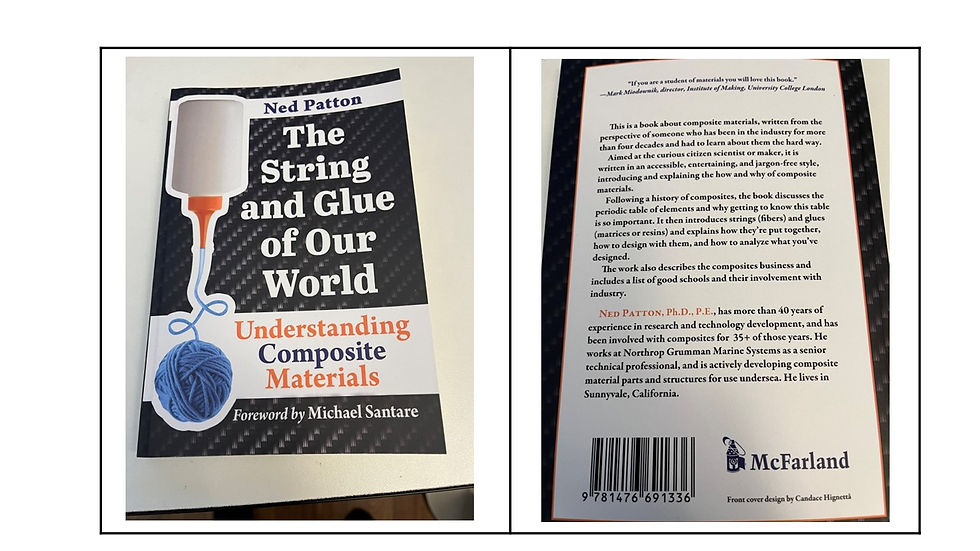
My second book, which was released this month, is a roadmap to a circular and sustainable business model for the industry which I hope that at least at some level the industry will follow. Only time will tell. Maybe it will get noticed – as always that is just a crap shoot. As usual, I’ve included the cover at the end of this post. This time, however, it is a photo of the front and back of the book. Let me know whether or not you like the cover. Hopefully people will like it enough and will be interested enough in composites sustainability that they will buy it. And of course I hope that they read it and get engaged. We need all the help we can get.
Last but not least, I still need to plug my first book. “The String and Glue of our World” pretty much covers the watershed in composites, starting with a brief history of composites, then introducing the Periodic Table and why Carbon is such an important and interesting element. The book was published and made available August of 2023 and is available both on Amazon and from McFarland Books – my publisher. However, the best place to get one is to go to my website and buy one. I will send you a signed copy for the same price you would get charged on Amazon for an unsigned one, except that I have to charge for shipping. Anyway, here’s the link to get your signed copy: https://www.nedpatton.com/product-page/the-string-and-glue-of-our-world-signed-copy. And as usual, here are pictures of the covers of both books.


Hi88 mình thấy bạn bè nhắc hoài nên cũng bấm vào coi thử cho biết, kiểu tò mò giao diện thôi chứ không có ngồi đọc hay chơi gì nhiều. Vừa vào là thấy trang nhìn khá thoáng, chữ không bị dồn dập nên mắt đỡ mệt. Mình để ý họ chia nội dung thành từng khối rõ ràng, nhìn lướt một cái là biết chỗ nào là thông tin chính chỗ nào là phần phụ, không phải kéo qua kéo lại tìm. Cái mình thích nữa là mấy bảng dạng cột canh thẳng hàng, nhìn gọn và dễ so, nhất là lúc cuộn xuống vẫn không bị rối. Menu cũng đặt dễ thấy nên chuyển mục khá nhanh, bấm…
https://kuwin.baby/ ừ mình cũng chỉ mở lướt trên điện thoại cho biết thôi, chứ không có ý đào sâu gì. Mấy trang kiểu này thường dễ làm rối mắt, nhưng ở đây nhìn qua lại thấy cũng ổn. Thanh menu để ngay phía trên nên tìm mục chính khá nhanh, bấm qua bấm lại không bị loạn hướng. Phần nội dung bên dưới chia thành từng khối rõ ràng, khoảng cách chữ vừa phải nên đọc lướt không bị căng mắt. Mình để ý tốc độ tải cũng khá đều, cuộn xuống không bị giật nhiều. Nói chung cảm giác họ làm theo kiểu ưu tiên cho người mới vào xem cho gọn. Nhìn tổng thể thì bố cục dạng…
https://qqs8889.com/ mình thấy người ta nhắc hoài nên bấm vô coi thử cho biết chứ cũng không định ngồi lâu. Vừa vào cái là thấy giao diện làm khá “dễ thở”, chữ không bị dồn dập nên lướt nhanh vẫn nắm được mình đang ở đâu. Mình thích kiểu họ chia nội dung thành từng khối rõ ràng, nhìn qua là biết phần nào là thông tin chính, phần nào là phụ, không phải căng mắt tìm. Cái menu cũng đặt chỗ dễ thấy nên chuyển qua lại giữa mấy mục không bị lạc, cảm giác thao tác khá mượt. Nói chung chỉ xem sơ sơ thôi mà vẫn thấy bố cục canh hàng gọn và các khối nội dung…