Methanolysis – A Solution for Polyester Waste that Might Work with Composites

I saw an interesting post this week from an unlikely source that piqued my curiosity. Of all the industry publications (rags?) that I get pushed, a lot of them are from Gardner, the publishers of Composites World. I of course know the Composites World folks well and have spoken at their Carbon Fiber Conference in prior years. This publication is “Plastics Technology” and I commonly very briefly look it over to see if there is anything of interest – there’s usually not much.
But one that I received today did get me started looking into the recycling of polyesters. As it turns out, Eastman Chemical has not only developed a process for breaking apart polyesters into their original constituents, they have actually brought a plant on line in Kingsport Tennessee.

This is the same Eastman that brought us Kodak film (Kodachrome for those of you that still remember the Simon and Garfunkel tune) as well as lots of cellulose (celluloid) products and myriad other chemicals. They have given up on their film business now and I think Fuji is the only company that still makes 35mm color photographic film.
Anyway, Eastman Chemical took about 10 years to develop and perfect this process to the point where they can take in chopped up polyester plastics, divert them from landfills, push them into the front end of their methanolysis process and out comes monomers (mostly dimethyl terephthalate and ethylene glycol) that are ready to turn back into polyester plastics.
The plastics that Eastman deals with are mostly things like PET (soda bottles) that are in the polyester family which is the same family as the thermoset plastic most commonly used in fiberglass construction. So it isn’t such a long jump to go from the ethylene glycol and dimethyl terephthalate to add a bit of a styrene backbone to get a thermosetting resin that you can use to build your boat. And it also isn’t too much of stretch to wonder if Eastman’s methanolysis process or something very similar could be used on old wind turbine blades and retired boat hulls.
At any rate, Eastman’s Tennessee plant came on line in March 2024 and now is recycling 110,000 metric tons of polyester a year. This facility is one of the largest methanolysis plants in the world and is integrated into Eastman’s Tennessee integrated chemical manufacturing facility. So, that’s a good start and it is 110,000 metric tons of plastic that did not go into a dump or end up floating in the Pacific Ocean.

The great thing about this is that Eastman has gone into this business full bore. They have even separated their recycling and reuse (circular) strategy into a carbon renewal and a polyester renewal segment so that each segment can focus on building up their capability and facilities in both of what Eastman thinks are critical areas for the future of their business. According to Eastman just their Tennessee recycling facility is expected to contribute $75M to $100M in EBITDA (read profit before taxes and all of the interest payments). That’s a pretty healthy bottom line.
In addition to the Tennessee plant, Eastman was adding on to their Longview Texas chemical plant until the current administration suspended their $375M DOE grant. There isn’t much news about whether or not that facility which was to cost on the order of $1.2B, so the DOE grant would have helped quite a bit but Eastman was going to go a long way to footing the bill.
But the good news is that they are building a facility in Normandy, France and have another planned in Germany to do the same thing they are doing in Tennessee. And since Eastman is adding on to their current global manufacturing sites, this ability to take in used polyester plastics and create precursors for the rest of their operations will reduce their need to source raw materials from the petroleum commodity markets.
In searching to see if there were more companies involved in this business, I came across LyondellBasell Industries which now has its worldwide headquarters in Houston, but was founded in Rotterdam, the Netherlands. They are also a chemical company that has a large recycling business and has bought up a number of smaller recyclers to become one of the larger plastics recyclers in the world.

And, while their European business is booming, their planned upgrade to their Houston facility has been put on hold. They had another one of the same DOE grants that Eastman had that were set up by the previous administration under the Infrastructure Act that got terminated by the current administration. So both of these plants, the Eastman plant in Longview and the LyondellBasell plant in Houston will just have to wait for a few more years. Both companies have adopted a long term vision and strategy for their businesses because they both see the coming of circular economies for the petrochemical and plastics industries.
That’s about it for this week, even though I realize this was not necessarily a post about composites, it was about sustainability in the plastics industry which is part of the composites industry as you all well know. As always, I hope everyone that reads these posts enjoys them as much as I enjoy writing them. I will post this first on my website – www.nedpatton.com – and then on LinkedIn. And if anyone wants to provide comments to this, I welcome them with open arms. Comments, criticisms, etc. are all quite welcome. I really do want to engage in a conversation with all of you about composites because we can learn so much from each other as long as we share our own perspectives. And that is especially true of the companies and research institutions that I mention in these posts. The more we communicate the message the better we will be able to effect the changes in the industry that are needed.
My second book, which may be out in the late fall, is a roadmap to a circular and sustainable business model for the industry which I hope that at least at some level the industry will follow. Only time will tell. At least McFarland announced it in their Fall Catalog. And this time it is under a bit different category – Science and Technology. Maybe it will get noticed – as always that is just a crap shoot.
As I have said before, my publisher and my daughter have come to an agreement about the cover. So, I’ve included the approved cover at the end of this post. Let me know whether or not you like the cover. Hopefully people will like it enough and will be interested enough in composites sustainability that they will buy it. And of course I hope that they read it and get engaged. We need all the help we can get.
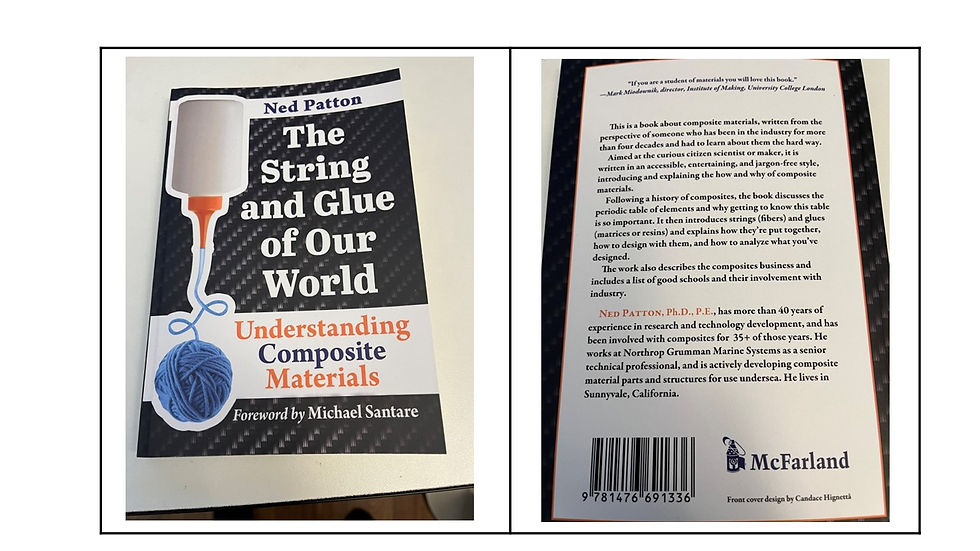
Last but not least, I still need to plug my first book. “The String and Glue of our World” pretty much covers the watershed in composites, starting with a brief history of composites, then introducing the Periodic Table and why Carbon is such an important and interesting element. The book was published and made available August of 2023 and is available both on Amazon and from McFarland Books – my publisher. However, the best place to get one is to go to my website and buy one. I will send you a signed copy for the same price you would get charged on Amazon for an unsigned one, except that I have to charge for shipping. Anyway, here’s the link to get your signed copy: https://www.nedpatton.com/product-page/the-string-and-glue-of-our-world-signed-copy. And as usual, here are pictures of the covers of both books.


Comments