A Bit of Sustainability News and Some Other Stuff

There has been a bit going on since my last post in 2025, so I thought this week I would catch everyone up with the sustainability initiatives across not only the composites industry itself, but in industries and sectors of the economy that are making heavy use and initial use of composites.

First I want to talk a bit about the maritime (shipping) industry and their efforts to not only cut down their greenhouse gas emissions but also make shipping more sustainable by using less fossil fuels. What this means of course is going back to the use of wind, the way shipping was before the invention of these big marine diesel engines.
The lead pic in this post is just the latest example of the use of a newer type of sail that is enabled by lightweight, stiff, strong, corrosion resistant composite materials. I have written about these in previous posts, but I thought that I ought to mention this because there are two of these 18,500 DWT (dead weight ton) chemical tankers being built right now in the Wuhu Shipyard in China, for Union Maritime Ltd. in Glifalda, Greece. The rotor sails are from Anemoi Marine Technologies Ltd. in London. There are two of them that will be installed on each of the two new build chemical tankers. They are 3.5 meters in diameter (a little over 11 feet) and one is 20.5 meters tall (about 65 feet) and the other is 24 meters tall (a bit over 75 feet).
Anemoi’s rotor sails, based on an old concept invented by Anton Flettner, have a steel spar in their center that carries all of the bending load from the wind, and a rotor made of lightweight composites that rotates in the wind, using an aerodynamic force (lift) that is caused by a rotating cylinder and is called the Magnus effect, to provide thrust to the ship. The rotors are powered by an electric drive that is driven by generators attached to the ship’s main engines. The rotor sails work best in a hybrid diesel-electric drive which is what most modern large cargo ships have gone to, for a number of reasons, but primarily because they are more efficient than direct drive systems. And the higher the wind speed, the more thrust the rotors provide and the more fuel is saved. Of course there is also a normal propellor below the waterline for main propulsion as well as maneuvering in harbors.
Anemoi has perfected this technology through the use of a hybrid of glass composites and carbon composites, using each where it is most critical. Since carbon fiber is used in areas that are highly loaded in this optimized hybrid design, these rotors can operate in wind speeds up to 70 knots. They even have an automatic shutdown if the wind speeds exceed their design capacity. But with a 70 knot blow out in the open ocean, the captain of the tanker ship has a lot more to worry about than whether or not his rotor sails are generating electricity.
Finally, since these rotor sails are going on a chemical tanker that is transporting potentially explosive or highly flammable cargo, they are what is called EX rated, meaning that all of the components are non-sparking and are all rated for use with flammable liquids.
The motivation for all of this is two-fold. First, these sails will save the shipping company lots of operating cash because they are at least partially using the available wind to power the ship. The other motivation is that the International Maritime Organization (IMO) has made it a requirement that maritime cargo shippers reduce their carbon footprint by 20% by 2030. These two ships will come on line this year and will help Union Maritime meet the IMO regulatory mandate.

In other news, this time about composite material sustainability and what quite a few companies are doing in making their products more sustainable, there is a new internationally accepted rating system for material sustainability called an Environmental Product Declaration or EPD. This declaration is basically a nutrition label if you will for materials of all types.
There is an article in Composites World about EcoVadis, a French ESG (Environmental, Social, Governance) organization that has offices worldwide and is in the business of providing sustainability performance assessments for any company. They have just recently adopted an improved labeling system for manufactured products called an Environmental Product Declaration (EPD). This declaration is sort of like an Underwriters Laboratories type sustainability certification and is apparently pretty difficult to get. The EPD is a cradle to grave product or material sustainability ranking, meaning it includes not only the raw materials and process energy savings, it also has to do with the use and recyclability or circularity of the product. This ranking is used by companies in all industries, from heavy industry to food and beverage to construction and even to the services industry and Professionals.
So, what does this have to do with composites? It turns out that several composite materials companies, both suppliers and manufacturers, have updated their EPDs to the newer standards which are of course significantly harder to meet, and require 6 to 12 months to get. Companies like Pultron Composites in New Zealand that makes the pultruded fiberglass rebar (GreenBar) I wrote about several weeks ago, GKN Automotive in London which has achieved the highest rating or Platinum, Songwon Industrial in South Korea which has achieved a Gold EPD rating, and CTP Advanced Materials in Germany that has also received a Gold rating.
All of these companies have focused considerable resources into their corporate sustainability programs and also considerable effort to achieve these EPD rankings. Since this is an ESG ranking as much as it is a sustainability ranking, both the social aspects of the companies that apply for this as well as their corporate governance, HR policies, how they interact with their supply chain partners, and how they interact with their customers all count and are examined by EcoVadis in achieving these ratings. Of course, in the composites business one of the more important facets of this ranking is the sustainability of their products from cradle to grave as well as their own waste and energy reduction in the manufacture and processing of these materials, and whether or not they track their products to the end of their life to ensure that they are properly recycled. All of this is good news for the composites industry and shows that the bulk of the industry and most of its sectors are focused on the sustainability of their products.
In one last little bit of news, the finale of the EuReComp project will be held in March of this year at Dallara headquarters in the Province of Parma Italy (sort of half way between Genoa and Venice and home of the cheese you can get shaved onto your pasta at a good Italian restaurant). This is the EU led project that focused on the reuse and recycling of composite materials. They are the ones that built the ROCCA Cabin demonstrator that I wrote about several weeks ago that uses nearly 100% recycled composite material parts to make a livable cabin complete with wall and roof insulation.

This final workshop of the EuReComp project will focus on the project results (like the ROCCA Cabin above), an exchange of ideas about how to surmount the numerous obstacles still in the way of true circularity, and some strategic discussions about the path forward and the future of the composite materials industry in Europe. It appears that they are holding it in Dallara for a couple of reasons. First is that Dallara Group is the sole manufacturer of the IndyCar as well as NASCAR’s Next Gen car, both of which are extensive users of high performance composites. The fact that this is also the home of Parmigiano-Reggiano cheese (or parmesan if you buy the stuff that isn’t made there) is most probably going to attract quite a few participants from all over Europe.
This project has been very successful and has demonstrated in a large manner and in a manner that can be put into practice immediately. The project has, at least according to the article I read in Composites World, moved beyond theoretical discussions of how circularity can be accomplished to actual real world demonstrations using recycled materials to make useful structures. This is a tremendous accomplishment and the leadership of this project should be given due credit for their work and their results.
So, that’s it for this week’s post. As always, I hope everyone that reads these posts enjoys them as much as I enjoy writing them. And I hope people who are interested find something they can use in their lives or at least some ideas that they might be able to put into practice. At least I hope that these make people think a bit about sustainability and some of the major issues looming before us. And if you have any of the normal orthopedic issues that come with aging if you have had an active lifestyle, stay tuned to this newsletter and I will be giving you some more info in future posts.
I will post this first on my updated website – www.nedpatton.com – and then on LinkedIn. And if anyone wants to provide comments to this, I welcome them with open arms. Comments, criticisms, etc. are all quite welcome. I really do want to engage in a conversation with all of you about composites because we can learn so much from each other as long as we share our own perspectives. And that is especially true of the companies and research institutions that I mention in these posts. The more we communicate the message the better we will be able to effect the changes in the industry that are needed.
My second book, which will be out sometime next year, is a roadmap to a circular and sustainable business model for the industry which I hope that at least at some level the industry will follow. Only time will tell. At least McFarland announced it in their Fall Catalog. And this time it is under a bit different category – Science and Technology. Maybe it will get noticed – as always that is just a crap shoot.
Just so that everyone is reminded, I’ve included the approved cover at the end of this post. Let me know whether or not you like the cover. Hopefully people will like it enough and will be interested enough in composites sustainability that they will buy it. And of course I hope that they read it and get engaged. We need all the help we can get.
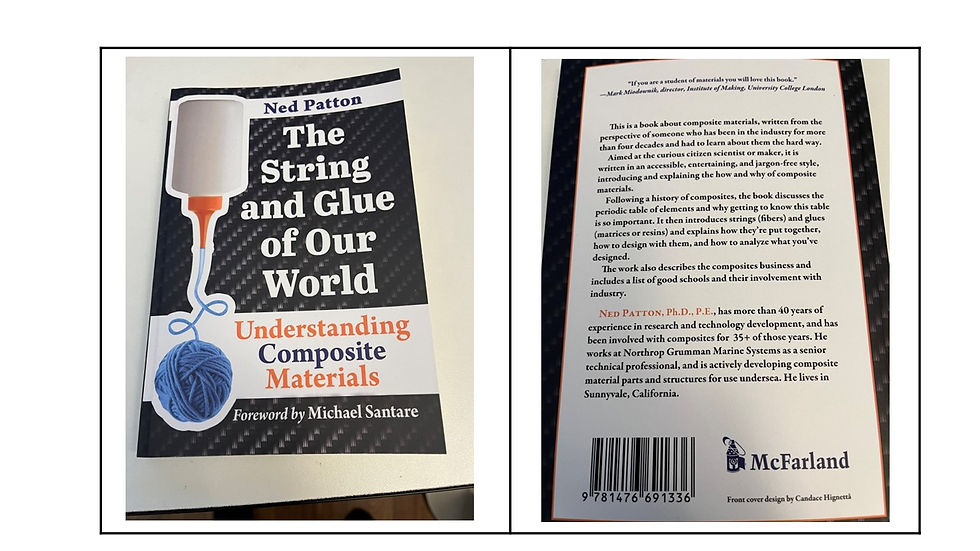
Last but not least, I still need to plug my first book. “The String and Glue of our World” pretty much covers the watershed in composites, starting with a brief history of composites, then introducing the Periodic Table and why Carbon is such an important and interesting element. The book was published and made available August of 2023 and is available both on Amazon and from McFarland Books – my publisher. However, the best place to get one is to go to my website and buy one. I will send you a signed copy for the same price you would get charged on Amazon for an unsigned one, except that I have to charge for shipping. Anyway, here’s the link to get your signed copy: https://www.nedpatton.com/product-page/the-string-and-glue-of-our-world-signed-copy. And as usual, here are pictures of the covers of both books.


Comments