Read Any Good Books Lately?

I read a really good book this last week about the history of textiles. The title of the book is “The Fabric of Civilization, How Textiles Made the World” by Virginia Postrel. This book is a number one bestseller that my wife bought for all of us in the family to read. It was recommended by John and Hank Green, the Vlog Brothers who also are the creators of the Crash Course series of educational YouTube posts that they provide for free. Both of these brothers are successful in their own right; John is a best selling author that has one of his books, “The Fault in our Stars” being made into a film in 2014, and Hank has founded several companies, including EcoGeek, VidCon and others which have finally coalesced into a company called Complexly. They are also the very well known brothers that created SciShow which has garnered international acclaim.
But this post and Virginia Postrel’s book is about textiles and how the history of textiles is really the history of mankind. All of what we call the advancements in technology, chemistry, engineering, machinery, since the beginning of recorded history and even a bit before that, all have their roots in how human beings produced textiles to clothe themselves, build weather resistant structures for shelter, bind together stone tools, make hunting weapons, and basically make all of the things that they needed to survive.

I wanted to draw attention to this book and the historical nature of fibers, organic chemistry, and the development of mechanized devices to simplify what was initially hand labor. As I was reading the book it struck me that the history of what we today call advanced composite materials and man’s use of them is intimately tied to the history of textiles. There would not have been fibers or cloth without the development of textiles.
And the dyeing of textiles and figuring out how to make a colorfast dye created what we understand today as organic chemistry, which also begat the resins or glues that we use today to stick the fibers together to make our wind turbine blades and aircraft wings. It turns out that the very first colorfast dyes were made from plant colors, starting with a plant called Indigo. Early peoples in what is now India figured out how to extract a pigment from this naturally occurring plant and turn it into the colorfast blue dye that is used to make your Levis blue. The extract is not soluble in water and requires some of what is today common organic chemistry to enable the dye molecules to bind to the cellulose molecules in a cotton fiber. Of course it was not known at the time these dyes originally came into use, but what the ancients who did this created was an organic acid-base reaction product that was useful to them. In other words, they created the first of what eventually became our modern industrial petrochemical and polymer chemistry. This is the origins of what we understand today as the fundamental chemistry of all resins, and all plastics. And it is the origins of the chemistry that begat Nylon, Rayon, Polyester, Kevlar, Twaron, Spectra, etc. man-made textile fibers that are in common use today. It is even the chemistry that produced acrylonitrile which is the building block of most carbon fiber today.

According to a blog post from Acme Mills (old archival photo above) the word textile is a Latin word derived from texere which means “to weave”. In the blog post that this picture is from it is mentioned that the spinning of cotton fibers into thread and yarn traces back to at least 3000 BC, or more than 5000 years ago. And in ancient Egypt they were spinning and weaving linen (flax fiber) as early as 3400 BC. This was the beginning of the use of machines to make products that were useful to them. The machines were very crude to begin with, and even stone tools were used with holes bored in them to pass a thread through so that the weaver could run the stone back and forth through an array of threads (the warp threads of a fabric) to make a two dimensional product out of one dimensional fibers.

The ancient peoples of course first had to spin the filaments into threads or yarns depending on how coarse or fine they wanted their cloth. Then they had to weave it into a fabric that was useful for them. And of course innovation began right away, like how do you make a garment have more than one color or how do you make a pattern on a garment without painting or dyeing the finished fabric. A lot of this was invented in what is now India and China, and these fabrics very quickly became very valuable. It did take quite a bit of hand labor to make them, and initially only the royals or elite would get something like a cotton gown with an intricate pattern woven into it. The peasants were wearing flax (linen) or hemp.
What this also begat was the beginnings of the age of machines, which was quite a bit before our own industrial revolution. But the real story is that it was the demand for more and more textiles that started the machine age, and also really started the trading systems that are in place today that we call international commerce. Commerce in the past before actual money systems and banks came into being was done by traders that had primarily textile goods to exchange for other things of value. This whole commerce in textiles had all of the hallmarks of money changing hands, except that the money was textile goods. And the traders traveled back and forth primarily early on between Asia and Europe (including what is today Western Russia). Trading routes were also established across and up and down the Americas, similarly in Africa, and between Africa and Europe across the Mediterranean. This was also the beginning of the cargo shipping industry where tons of fabric could be loaded into the hold of a ship, transported in less than a month to its destination either across an ocean or up or down a major coast, only to be filled with goods at the ship’s destination and sail back to where the ship came from with new goods. This all created a standard for commerce and also created the system of double entry bookkeeping that we use today for all businesses that produce and/or sell products.
This book was very enlightening for me to read, and I hope that everyone that has an interest in this and would like to see how human commerce and technology was created through the lens of the pair of jeans you just bought at the store or the carbon fiber or glass fiber fabric you are laying in a mold and impregnating with resin to make your glider wing or wind turbine blade. It all had to start somewhere. And if you follow the narrative in this book, humans have been at this for several thousand years. So, it is no wonder to me at all that we are where we are today. Who can tell where we will be a thousand years from now if we survive that long as a species.
So, that’s it for this week’s post. It is about time I got off this topic anyway, but I thought that this book was worthy of a complete post. Hopefully you will agree with me. The book is a pretty quick read. I was able to read it on the airplane flying between California and Maryland last week, a bit more than half on the way there for work and the rest on the way back home at the end of the week.
As always, I hope everyone that reads these posts enjoys them as much as I enjoy writing them. And I hope people who are interested find something they can use in their lives or at least some ideas that they might be able to put into practice. At least I hope that these make people think a bit about sustainability and some of the major issues looming before us. And if you have any of the normal orthopedic issues that come with aging if you have had an active lifestyle, stay tuned to this newsletter and I will be giving you some more info in future posts.
I will post this first on my updated website – www.nedpatton.com – and then on LinkedIn. And if anyone wants to provide comments to this, I welcome them with open arms. Comments, criticisms, etc. are all quite welcome. I really do want to engage in a conversation with all of you about composites because we can learn so much from each other as long as we share our own perspectives. And that is especially true of the companies and research institutions that I mention in these posts. The more we communicate the message the better we will be able to effect the changes in the industry that are needed.
My second book, which will be out sometime next year, is a roadmap to a circular and sustainable business model for the industry which I hope that at least at some level the industry will follow. Only time will tell. At least McFarland announced it in their Fall Catalog. And this time it is under a bit different category – Science and Technology. Maybe it will get noticed – as always that is just a crap shoot.
Just so that everyone is reminded, I’ve included the approved cover at the end of this post. Let me know whether or not you like the cover. Hopefully people will like it enough and will be interested enough in composites sustainability that they will buy it. And of course I hope that they read it and get engaged. We need all the help we can get.
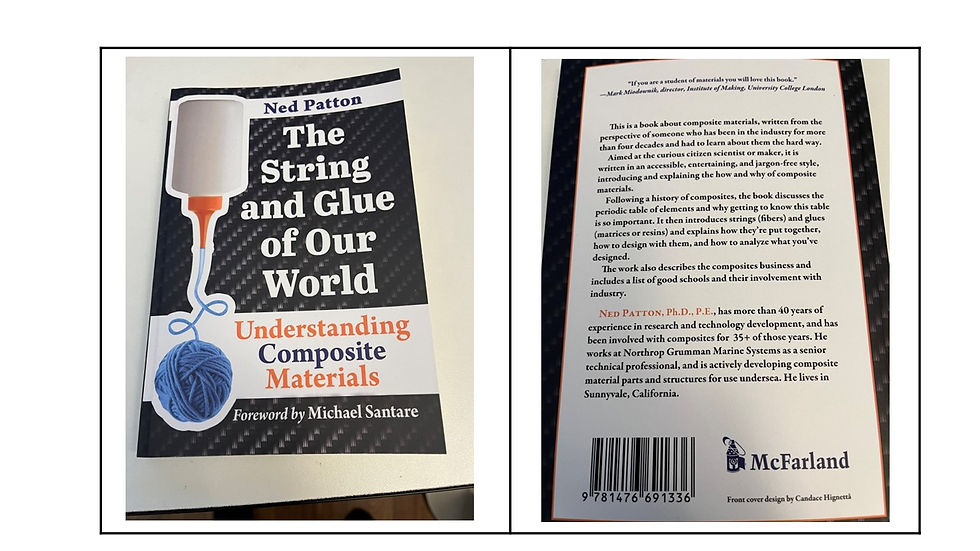
Last but not least, I still need to plug my first book. “The String and Glue of our World” pretty much covers the watershed in composites, starting with a brief history of composites, then introducing the Periodic Table and why Carbon is such an important and interesting element. The book was published and made available August of 2023 and is available both on Amazon and from McFarland Books – my publisher. However, the best place to get one is to go to my website and buy one. I will send you a signed copy for the same price you would get charged on Amazon for an unsigned one, except that I have to charge for shipping. Anyway, here’s the link to get your signed copy: https://www.nedpatton.com/product-page/the-string-and-glue-of-our-world-signed-copy. And as usual, here are pictures of the covers of both books.


Comments