Lots of Carbon Fiber in Winter Olympics Equipment
- Ned Patton

- Feb 18
- 8 min read
I have been watching the Olympic Games going on in Italy like most of the rest of us. Sunday a week ago was the men’s Luge competition and thankfully there weren’t any horrible accidents. That sport is not only exciting it is also nerve racking to watch. Eighty miles an hour on a little sled barely long enough to hold the slider, going around high banked turns where the smallest mistake could be disaster. Fun to watch but scary all the same.

This pic is of Matthew Griner in one of his runs at the Luge facility in Cortina, Italy. While he didn’t make the podium (came in 20th in Men’s Single) he was a total of 4.681 seconds off the gold medal winner, Max Langenhan of Germany. That means that for each of the four runs that gets combined he was only a little more than a second behind the gold medal winner. Also note that the time reported is down to the millisecond. Apparently luge is the most precisely timed sport in the Olympics.
But that isn’t what I wanted to talk about. As I was watching these daredevils go down the luge course, it appeared to me that all of the sleds were black, and since weight, strength, and stiffness have to be critical in that tiny thing that these athletes ride, it had to be made of carbon fiber. So, I looked it up and sure enough, all of the luge sleds are carbon fiber, and all of them have to be within a certain weight (not much). Together with their rider and the rider’s uniform, all luge participants with their equipment have to be within a fairly narrow weight band. Luge is apparently sort of a big man’s sport, since the sled weighs about 50 pounds, and the maximum weight of each rider is 200 pounds. In fact, if the luger weighs a bit less than 200 pounds with uniform, they are allowed to add some lead weights until they get to the 200 pounds exactly. And the sled has to be steerable, so there are a couple of arms that stick up in the front of the luge sled that are extensions of the carbon fiber rails that the luge rider uses to make minor adjustments (slight bending) to the sled rails to steer the sled. And all of this happens at about 80 miles an hour down a steep track with nearly hairpin turns. It takes a lot of strength and stiffness in the material of the sled in order to withstand all of the accelerations through those turns. The best riders pull about 5-6 g in the turns. That’s like a fighter pilot in a really tight turn. And the sled is taking all of that force – a 200 pound rider going through a tight turn and pulling 5 g makes the sled have to withstand a half a ton without collapsing or being distorted very much. Carbon fiber composites are the only material capable of making a sled that light that can withstand all of that force.

And if you think that the luge is dangerous, don’t even get me started about skeleton sled racing. Headfirst down an icy, curvy course at 80+ miles an hour on a sled the size of a dinner napkin isn’t my idea of safe.
Anyway, all of this got me to thinking of other equipment that the Olympic athletes use. And what I discovered is that in all of the speed sports and sliding sports the material of choice is carbon fiber composite. This means luge sleds, skeleton sleds, bobsleds (2 man and 4 man), skis (downhill, slalom, and cross country), snowboards, ski boots, even parts of ice skates. And even ice hockey sticks are now made of carbon fiber because they are lighter, stiffer, and stronger than their wood counterparts.

And, fortunately, even the safety equipment is made of carbon fiber. The helmets that the sliders wear in luge, bobsled, skeleton, downhill and slalom ski events, all of the snowboard events, are all carbon fiber as well. That makes the helmet light enough to be comfortable for the athlete while also protecting them from serious injury. Even ski poles are carbon fiber composite, wound on a mandrel very much like the way golf club shafts are made.
All of this makes a lot of sense because of the demands that Olympic sports put not only on the athletes themselves, but also the equipment they use to go that fast downhill, make those incredible moves on half pipe, steer tiny sleds at 80+ miles an hour, and all of the other daredevil feats and physically demanding events they participate in. The equipment that is used has evolved over the last few decades as well as the training of the athletes so that in today’s Winter Olympic games there are several Olympic and even World Records that have been broken. It makes for exciting watching for those of us that can only be spectators, and it demonstrates that it takes more than just strength and stamina to win, ingenuity and attention to detail in the equipment that is used counts for a great deal of the success of Olympic athletes.
One thing I don’t want to lost sight of is that with all of this carbon fiber composite being used in these events – some estimates put the number at about 85% of the equipment used especially in the fast sliding events – that equipment has a life expectancy which can be rather short because all of this stuff is constantly being improved by some very smart people. Fortunately, there are answers to what gets done with the snowboard when it breaks or when a new design comes out and the old one becomes useless.
In Europe, used carbon fiber sports equipment is being recycled and reclaimed through the Carbon Fibre Circular Alliance. This is a partnership among countries from the UN that was put in place by the International Olympic Committee to focus on sustainability in all of the equipment that is used in both Summer and Winter games. The World Sailing Trust was one of the first participants in this consortium, closely followed by the International Tennis Federation, the International Biathlon Union, and the Union Cycliste Internationale (think Tour de France).
This organization has taken it upon themselves to scale up the University of Bristol’s High Performance Discontinuous Fiber (HiPerDif) recycling technology that takes chopped up carbon fiber composites from sports equipment and turns it back into high performance reusable unidirectional carbon fiber tape. The binding resin used is a thermoplastic, so this stuff can be reused multiple times, making it a circular solution for used carbon fiber composites.

Once this alliance was formed, several sporting goods manufacturers stepped up to the plate and have started implementing this recycled carbon fiber in their commercial goods. Wilson Sporting Goods (of Tom Hanks fame), SCOTT Sports (one of the larger manufacturers of summer and winter sports equipment) and OneWay are collaborating with the Alliance to integrate the recycled carbon fiber composites into some of their new high end sports equipment.
As a result of this, or perhaps because it was the right thing to do, the International Olympic Committee has mandated that from 2030 onwards, all Olympic hosts follow strict what they call “climate-positive” guidelines. This means that these technologies to recycle and circularize the materials that make up most of the equipment used in the Winter and Summer games will be climate friendly, circular, and sustainable. I think that is a very good thing, and it appears that the majority of the sporting community agrees.
So, that’s it for this week’s post. As always, I hope everyone that reads these posts enjoys them as much as I enjoy writing them. And I hope people who are interested find something they can use in their lives or at least some ideas that they might be able to put into practice. At least I hope that these make people think a bit about sustainability and some of the major issues looming before us. And if you have any of the normal orthopedic issues that come with aging if you have had an active lifestyle, stay tuned to this newsletter and I will be giving you some more info in future posts. I did talk to my orthopedic surgeon a week or so ago, and apparently the carbon fiber distal end of the hip implant – the part that goes down into the femur and binds with the bone – hasn’t made it to prime time yet. But apparently the newer design titanium distal ends, which is what he is going to use for me, don’t have the stress shielding issue that some of the earlier implants did, so that’s a good thing. The rest of what he is going to use is what I talked about in my orthopedic post a few weeks back, a delta ceramic ball and an ultrahigh molecular weight polyethylene liner that the ball rotates on. That combination has to date been the most successful for active people like myself. So, I’m looking forward to getting to the other side of this so that my hip stops hurting.
I will post this first on my updated website – www.nedpatton.com – and then on LinkedIn. And if anyone wants to provide comments to this, I welcome them with open arms. Comments, criticisms, etc. are all quite welcome. I really do want to engage in a conversation with all of you about composites because we can learn so much from each other as long as we share our own perspectives. And that is especially true of the companies and research institutions that I mention in these posts. The more we communicate the message the better we will be able to effect the changes in the industry that are needed.
My second book, which will be out sometime next year, is a roadmap to a circular and sustainable business model for the industry which I hope that at least at some level the industry will follow. Only time will tell. At least McFarland announced it in their Fall Catalog. And this time it is under a bit different category – Science and Technology. Maybe it will get noticed – as always that is just a crap shoot.
Just so that everyone is reminded, I’ve included the approved cover at the end of this post. Let me know whether or not you like the cover. Hopefully people will like it enough and will be interested enough in composites sustainability that they will buy it. And of course I hope that they read it and get engaged. We need all the help we can get.
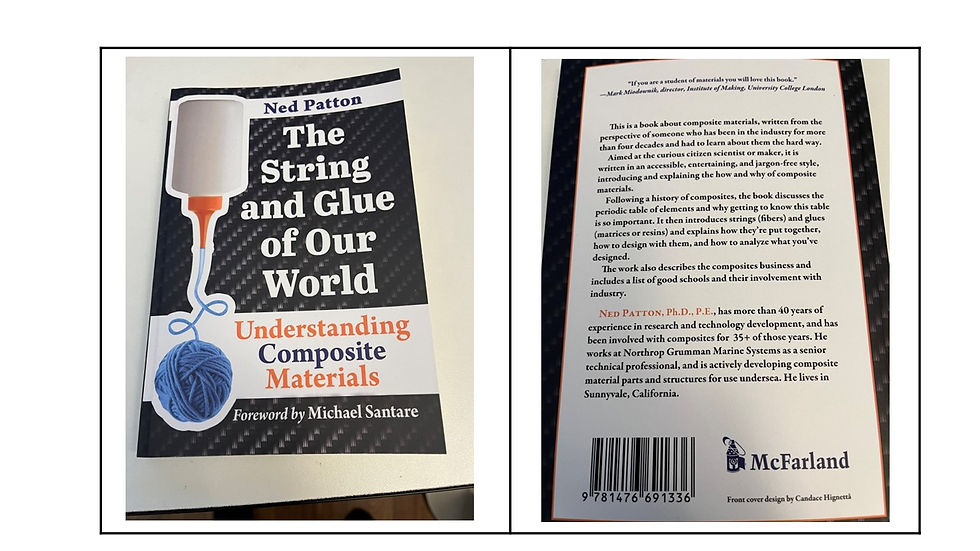
Last but not least, I still need to plug my first book. “The String and Glue of our World” pretty much covers the watershed in composites, starting with a brief history of composites, then introducing the Periodic Table and why Carbon is such an important and interesting element. The book was published and made available August of 2023 and is available both on Amazon and from McFarland Books – my publisher. However, the best place to get one is to go to my website and buy one. I will send you a signed copy for the same price you would get charged on Amazon for an unsigned one, except that I have to charge for shipping. Anyway, here’s the link to get your signed copy: https://www.nedpatton.com/product-page/the-string-and-glue-of-our-world-signed-copy. And as usual, here are pictures of the covers of both books.


Comments