Natural Carbon Fiber Precursors – How About Thin Air?

Yes, in fact, a company in Houston called Mars Materials, Inc. which is a public benefit corporation incorporated in Texas, teamed up with the Textile Innovation Engine of North Carolina and NC State University to take CO2 captured from the atmosphere and ammonia/bio-based feedstocks and turn it into acrylonitrile. The Textile Innovation Center at NC State tested the Mars material and found it to be chemically identical to acrylonitrile from petroleum precursors. And the folks at the Textile Innovation Engine actually made a polyacrylonitrile (PAN) fiber that also had identical chemical and physical properties to the petroleum based standard that is used in the aerospace business. This fiber passed all of the tests to certify it for use to make high performance carbon fiber.

This materials startup had already developed a suite of water soluble polymers using captured CO2 from the air with bio-based feedstocks. Originally formed in California, they were looking to find space to scale up their products and had a hard time not only finding affordable space to do it but also dealing with the Los Angeles / Orange County area air pollution regulations. They actually found a willing partner in a Shell facility in Houston that was not only affordable but that already had all of the required environmental permits, so they moved operations to Texas. This saved them millions of dollars in facility development and gave them access to a bevy of petrochemical experts in the Houston area as well as a ready development partner in Shell. The facility in Houston is already working on scaling up their water soluble polymers and now that they have proven that they can make acrylonitrile and polyacrylonitrile (PAN) fiber that is chemically and physically identical to the petroleum based fiber using their combination CO2 capture and ammonia/bio-based feedstock processing technology, they are seeking investors to help them scale this product up to address the looming boom in demand for carbon fiber. And this is a domestic source of aerospace grade carbon fiber precursor, so they have an enormous market potential. In one article I read it appears that once the fiber reaches industrial scale in production capacity, they will be able to address a market valued at $11 Billion. Best of all, this stuff appears to have a relatively easy path to being less expensive than its petroleum-based competition, and in addition it is carbon negative quite unlike traditional carbon fiber. This puts them in the running to capture a very large portion of this market because the composites industry is trying to move in the direction of lowering or eliminating their carbon footprint. It appears that even Bill Gates is interested in what they are doing, most probably because of his focus on the environment. There is a video on LinkedIn of him touring their facility, and several news agencies, especially in the Houston area, have made a big deal of this.

At the Shell facility in Houston, they have been able to scale this stuff up from the gram scale to the kilogram scale rather quickly. Once the facility is in full production the process apparently is scalable up to the industrial scale required to manufacture polyacrylonitrile fiber in commercial quantities. And from what I was able to find in a search, the folks at Shell are excited about the possibility of the fiber that results from this to become part of their product mix. Only time will tell whether or not they get funding to scale this process beyond the kilogram scale to the tens to hundreds of tons a year that they will need to make their creation a truly commercial fiber.

In other news, there is an article in Composites World about a biocomposite material being used as a drop-in replacement material for the interiors of over-the-road trucks. It appears that the heavy truck subsidiary of Volvo is doing trials of interior materials made from the shells of oysters. These are of course the oyster shells that are discarded outside of restaurants and oyster processing facilities, of which there are many, both in the US and in Europe, primarily along the cold water coasts where oysters thrive. Volvo has been working with Forvia Group (Nantere, France and Auburn Hills, Michigan since 2024 to reimagine their truck interiors to make them safer and more comfortable for long haul drivers.
Volvo has a keen interest in bio-based and recycled materials to use in these interiors, and, according to the article I saw in CW, thanks to Forvia’s connections with its sustainable materials subsidiary Materi’Act (Villerbanne, France and Dallas, Texas) they have developed a material that uses ground up oyster shells rather than mined talc as a reinforcement particle. The ground up oyster shells are used to reinforce recycled polypropylene and molded into the right shapes for use in the instrument panels of these trucks. And, interestingly, what they found is that while mined talc and other types of particulate reinforcement tend to degrade the plastic, since oyster shells are mostly calcium carbonate held together with chitin, they do not degrade the plastic and make a much more robust material. And they also found that this material with the oyster shells worked in their current process and processing machines without any process alterations at all. As you can see from the samples in the pic above, they can make this stuff in any color and the oyster shells make for an interesting and sort of organic looking material which also makes it more pleasant for the drivers. From the looks of it, this is going to make long haul trucking a lot more comfortable and pleasant than it has been in the past. I think the people who drive these things deserve a bit of comfort, I know I would.
So, that’s it for this week’s post. As always, I hope everyone that reads these posts enjoys them as much as I enjoy writing them. And I hope people who are interested find something they can use in their lives or at least some ideas that they might be able to put into practice. At least I hope that these make people think a bit about sustainability and some of the major issues looming before us. And if you have any of the normal orthopedic issues that come with aging if you have had an active lifestyle, stay tuned to this newsletter and I will be giving you some more info in future posts. My first visit with an Orthopedic Surgeon is this Friday. I’ll let everyone know how that turns out.
I will post this first on my updated website – www.nedpatton.com – and then on LinkedIn. And if anyone wants to provide comments to this, I welcome them with open arms. Comments, criticisms, etc. are all quite welcome. I really do want to engage in a conversation with all of you about composites because we can learn so much from each other as long as we share our own perspectives. And that is especially true of the companies and research institutions that I mention in these posts. The more we communicate the message the better we will be able to effect the changes in the industry that are needed.
My second book, which will be out sometime this year, is a roadmap to a circular and sustainable business model for the industry which I hope that at least at some level the industry will follow. And on the second book news front, I heard from an editor from my publisher with some questions about the text and one figure in the manuscript, which I answered. That means that it is probably about 2-3 months from publication. We’ll see how long it takes them, but at least I did hear from them. And as a reminder, McFarland announced it in their Fall Catalog. This time it is under a bit different category – Science and Technology. Maybe it will get noticed – as always that is just a crap shoot.
Just so that everyone is reminded, I’ve included the approved cover at the end of this post. Let me know whether or not you like the cover. Hopefully people will like it enough and will be interested enough in composites sustainability that they will buy it. And of course, I hope that they read it and get engaged. We need all the help we can get.
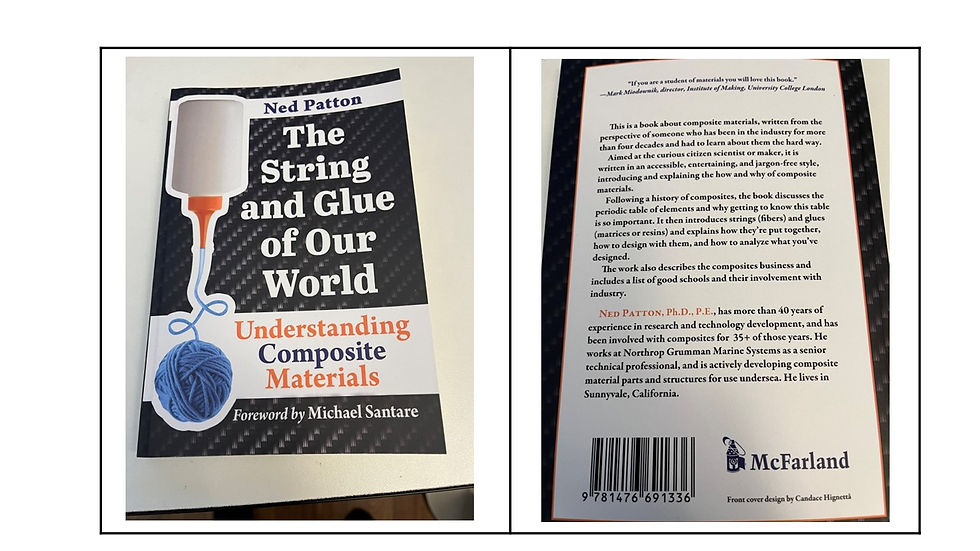
Last but not least, I still need to plug my first book. “The String and Glue of our World” pretty much covers the watershed in composites, starting with a brief history of composites, then introducing the Periodic Table and why Carbon is such an important and interesting element. The book was published and made available August of 2023 and is available both on Amazon and from McFarland Books – my publisher. However, the best place to get one is to go to my website and buy one. I will send you a signed copy for the same price you would get charged on Amazon for an unsigned one, except that I have to charge for shipping. Anyway, here’s the link to get your signed copy: https://www.nedpatton.com/product-page/the-string-and-glue-of-our-world-signed-copy. And as usual, here are pictures of the covers of both books.


Comments