DARPA is Looking to Convert Ag Waste into Useful Stuff

I know I promised to talk about my upcoming book in this and the next few posts, but I saw such an interesting article on LinkedIn on March 2 (last Monday) from DARPA of all places that I had to write about it. I’ll weave the book back in a bit later in this post after I describe what I saw from DARPA.

The article is about an upcoming DARPA Project that they are calling “Fleetwood” that aims to convert the lignin in waste biomass (read as agricultural waste or forest products waste, etc.) into high value added industrial chemicals ready for “advanced materials”.
This pic intrigued me immediately and sent me to digging into what DARPA is planning with their Fleetwood Project. As it turns out what they intend to do is to use waste biomass, most probably directly from agricultural waste, extract the lignin from this stuff, and develop “robust” catalysts that can convert the lignin they have extracted into high value added industrial feedstocks for “advanced materials”.
I read that last bit as composite materials, and what struck me about this is how similar it is to what I have been advocating for some time, both here and at conferences over the last few years. And it is also what I advocate in my upcoming book.
One more thing that struck me is the similarity of this approach to the approach taken by Composite Recycling and Fiberloop with their fiberglass recycling facility in a 40’ ISO container. I have of course written quite a bit about that in the past, so this DARPA program I had to look into.

This pic is just to remind everyone of what Composite Recycling of Lausanne, Switzerland and Fiberloop of Sävedalen, Sweden originally had in mind for recycling of fiberglass wind turbine blades and end of life boat hulls. Since the time I wrote about this of course, Composite Recycling and Fiberloop have built a couple of these units, and now they are in a consortium with Beneteau and Owens Corning along with others to begin to tackle the looming fiberglass waste problem and turn the used up, end of life materials back into useful precursors to make new composites.
This DARPA program intends to take the next step in building the circular economy for engineered materials by removing the requirement for the use of petroleum as the precursor to both resin and fiber for engineered materials. The fact that they are focusing on lignin is certainly not lost on me. And to tie this to my book that is about to come out, I need to show a diagram I drew for the book of the structure of lignin and then talk about what Dr. Mounfield of the Biological Technologies office sees in lignin.

The thing to notice, and this is what I put in my book, is the 6-sided carbon rings or benzene rings. This is the most ubiquitous carbon structure in nature and makes up the backbone of all carbon and organic fibers and all composite resin systems. It is these stiff, flat, and very strong 6-carbon rings that make up the stuff of plants and trees. Lignin is the glue that holds together the cellulose strings in Mother Nature’s ultimate high performance, light weight composite material – wood and the stems and branches of woody plants. It even makes up the structural part of leaves of softer plants by having the lignin and cellulose just have fewer of these benzene ring structures all tied together.
The issue that the DARPA program faces is that lignin isn’t one chemical, it is an entire range of polyphenols that have more or fewer of these rings with the OH groups attached. Another issue that the DARPA program faces is that the lignin, since it is naturally occurring and mixed with a whole host of other stuff, is inherently difficult to separate from the rest of the plant tissue, which is mostly cellulose. Of course the papermaking industry figured this out long ago, but their byproduct which is called “kraft lignin” also has a bunch of other stuff in it and it is this black tarry stuff that burns quite nicely, rendering its use in the past to being fuel to run the paper plant.
The approach that DARPA is taking is arguably the best shot at actually developing something that might be the key that unlocks the doorway to this abundant resource. The solicitation rightly points out two problems with lignin: (1) it is notoriously difficult to separate into a pure form from waste biomass because of the mixture of other stuff that comes with it since it at one time was alive and growing, and (2) once you get it separated from the other stuff in waste biomass, it is difficult to break it apart into the simpler aromatics (short chain polyphenols) that are industrially useful. This last issue is one that folks have been struggling with for some time, primarily because as I said before, lignin isn’t one compound, it is a range of different length polyphenol polymers with nearly an infinite array of branched structures. This makes coming up with a catalyst to take these chains apart an incredibly difficult task.
There have been some lab scale successes in this whole realm of organic chemistry, and I talk about a couple of them in the book, so I sincerely hope that what DARPA funds is something that has a good chance of working. The fact that they plan to start with the development of catalysts to handle the two biggest challenges in extracting useful industrial chemistry from waste biomass in a cost effective enough manner that someone could make a business out of this I think bodes well for the eventual success of the program.
To that end, of course I have contacted Dr. Mounfield who is going to be the DARPA PM, and so we will hopefully see what he has to say. I am certainly heartened to read what the DARPA view is on this because it is what I have been talking about now for a couple of years. Lignin is the key to the future because all plants make the stuff in one form or another. And what they make, given that we can figure out how to break it down effectively into useful precursors for our advanced materials, is inherently circular because plants take carbon dioxide right out of the atmosphere and turn it into useful polyphenols. And of course, from what we have seen at lab scale, the chemistry that we create is most probably inherently biodegradable when we are done using it, so the carbon can go back into the soil and grow more plants.
So, that’s it for this week’s post. As always, I hope everyone that reads these posts enjoys them as much as I enjoy writing them. And I hope people who are interested find something they can use in their lives or at least some ideas that they might be able to put into practice. At least I hope that these make people think a bit about sustainability and some of the major issues looming before us.
I promised that I would give everyone an update on my hip surgery, so here it is. I had my left hip joint replaced yesterday and I got one of the new porous titanium inserts that are a better stiffness match with the bone and that the bone knits well with and actually grows into the pores in the implant.

If you look closely at this picture you will see that the part that is sticking down into my femur is porous. This is by design so that the bone will knit well and actually grow into the pores in the titanium. These are the newer design implants that have seen more positive successes and longer life than pretty much any previous designs. The rest of the materials here are a titanium cup that is attached to my hip bone that has a high density polyethylene bearing surface attached to the inside of the Titanium cup. Then at the top end of that arm (they call it a distal arm) is a “Delta Ceramic” ball that fits up into the polyethylene socket. Delta ceramic is a Zirconia ceramic with little Strontia (Strontium oxide) crystals in it to toughen the ceramic. The ceramic can be made to have an extremely smooth surface so the polyethylene bearing surface never wears out. They have come a long way in these implants over the last decade or so, so I’m glad I am one of the ones that has benefited from decades of research into these prostheses.
And as far as pain goes, all of the pain I have now is just from the surgery, not from the hip itself. And that will go away pretty quickly. I guess I’m fortunate that I have kept in pretty good physical shape because so far today (day after surgery) I haven’t had to take any of the oxycontin (opiod pain killer) that they prescribed for me. Since I’m sort of a no pain medication if I don’t need it sort, that works for me. The Celebrex they gave me is working just fine.
I will post this first on my updated website – www.nedpatton.com – and then on LinkedIn. And if anyone wants to provide comments to this, I welcome them with open arms. Comments, criticisms, etc. are all quite welcome. I really do want to engage in a conversation with all of you about composites because we can learn so much from each other as long as we share our own perspectives. And that is especially true of the companies and research institutions that I mention in these posts. The more we communicate the message the better we will be able to effect the changes in the industry that are needed.
My second book, which is coming out in a week or two, is a roadmap to a circular and sustainable business model for the industry which I hope that at least at some level the industry will follow. Only time will tell. At least McFarland announced it this time under a bit different category – Science and Technology. Maybe it will get noticed – as always that is just a crap shoot.
Just so that everyone is reminded, I’ve included the approved cover at the end of this post. Let me know whether or not you like the cover. Hopefully people will like it enough and will be interested enough in composites sustainability that they will buy it. And of course I hope that they read it and get engaged. We need all the help we can get.
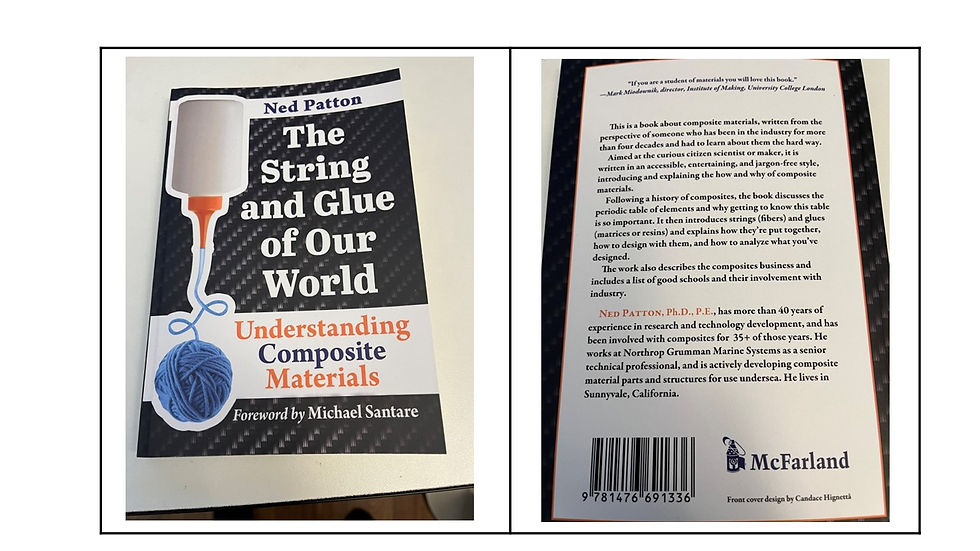
Last but not least, I still need to plug my first book. “The String and Glue of our World” pretty much covers the watershed in composites, starting with a brief history of composites, then introducing the Periodic Table and why Carbon is such an important and interesting element. The book was published and made available August of 2023 and is available both on Amazon and from McFarland Books – my publisher. However, the best place to get one is to go to my website and buy one. I will send you a signed copy for the same price you would get charged on Amazon for an unsigned one, except that I have to charge for shipping. Anyway, here’s the link to get your signed copy: https://www.nedpatton.com/product-page/the-string-and-glue-of-our-world-signed-copy. And as usual, here are pictures of the covers of both books.


Comments