Sustainable Composite Materials, A Roadmap to a Circular Economy

I got the proofs for my book last week, and over the weekend I put together the index and got it back to my publisher. That is the last task I have to do before it goes to print. I did look over the proofs, found a couple of typos (best to find those now) and suggested moving some figures around so that they line up with the text better, so now it is up to my publisher. The book is 200 pages long, so it’s about the size of my first book. So, since the book is going to be coming out, and since in it I am advocating a particular path for the industry to become sustainable and carbon neutral, I thought what I would do is to roll out the roadmap in a series of posts over the next couple of months so that everyone that reads this will have an idea of what I am advocating, so when they read the book they will be able to potentially put practices in place in their respective companies to help the industry through this enormous challenge.

Of course I’m going to start off with the mountain of used wind turbine blades sitting outside of Sweetwater, Texas where they have been since 2017 or so. This is the first pic in my second book, so I thought I would start here. This pile of what some would call junk is just the most visual reminder of the looming problem that the composites industry is beginning to face. What do we do with this stuff when it comes to the end of its useful life? And why, after GE, who owns and operates the wind farm these came from, paid a company on the order of a million dollars just to get rid of them, are they still there?
That is just one of the many questions that I tried to answer in this book. And rather than just complaining about it, which doesn’t do anyone any good anyway, what the book provides is what I hope is a well thought out roadmap for all parts of this industry to deal with this particular problem head on and also to make sure that it doesn’t become worse before it gets better.
The people of Sweetwater of course are looking not just to find someone to blame, they are looking for someone or some company to come in and take care of this problem before it gets worse. However, as it happens, on February 18 of this year, four people were indicted in Nolan County, Texas as a result of the dumping of these used wind turbine blades. There has been an ongoing investigation for a few years now and the company that owns the blades is also facing civil penalties and orders for immediate removal that they have not complied with. The four that were indicted do not live in Texas and are associated with the company that owns the blades. At least that’s what the news reports about this have stated.
But that’s not what I really wanted to talk about in this post. It is disheartening to say the least, and it demonstrates that there really is a problem that needs to be faced and faced now before more of these dumps and lawsuits and indictments occur in other jurisdictions in the country.
What I want to present in the next few weeks to a couple of months is a roadmap for the industry to follow to avoid this sort of problem in the future. What I do in the book is to break down the industry into reasonable functions, primarily in a timeline sequence starting at where the raw materials come from and ending with the composite parts coming to the end of their useful life. The business as I see it breaks down along the following lines or functions:
1. Raw material suppliers for both fiber and resin. This means not only the petroleum and petrochemical companies that provide the starting organics for most fibers and resins, as well as the oil and natural gas to provide process heat, it also includes some of the plant-based material suppliers like farmers and farm cooperatives. There are a lot of different pieces even in the supply of raw materials to this industry, and they are changing almost on a weekly basis.
2. Fiber manufacturers – with a focus on carbon fiber but also including glass fiber manufacturers (e.g. Owens-Corning and others) as well as other organic fiber and thermoplastic fiber manufacturers. This also runs the gamut from companies like Toray and Hexcel in the carbon fiber business, to Owens-Corning in the glass business, to DuPont for Nomex and Kevlar, to Honeywell and DSM in the Spectra/Dyneema business.
3. Resin Producers and Manufacturers – with a focus on epoxies but including a number of different types of epoxy both for aerospace and for recreational and marine and of course including polyester and vinyl ester resins and thermoplastics. Lots of different glues to choose from and each has its own place in the industry.
4. Processing equipment manufacturers – companies like ElectroImpact, Thermal Equipment Corporation, and a whole host of other companies large and small that make all sorts of industrial equipment for large aerospace composites manufacturing facilities all the way down to mom and pop type one off shops. Everyone has a stake in the equipment that they use to make stuff to sell.
5. Composites fabricators large and small, who have a lot of the power of the purse because they buy all of the raw materials and equipment to make stuff for their user base.
6. Users who have the ultimate power of the purse since they are the ones that drive what gets made and how much it can cost. And of course the user base for composites is enormous and quite varied and includes not only Governments like our own Department of Defense, but also the small high performance bike shop with that graphite frame road bike in the window you’ve been eyeing.
7. Finally, at the end of the line are the recyclers. How do they make any money recycling composites at the end of their useful life. And as it turns out, there are some good news stories here as well as the bad news story out of Sweetwater, Texas. I decided in the book to only give Sweetwater mention to make the point that we need to act now and did not focus on the negative but instead focused on some bright spots as well as some new ideas for how to deal with this problem in a constructive way.
Of course, this roadmap had to come at the end of the book because I had to describe the problem, give examples of how it is being dealt with and possibly offer some ideas to help this move along more quickly, and provide some background information about what is being done and what can be done now that will bear fruit in the near term as well as down the road. And before we get to the roadmap, there are some recommendations that I want to provide to the industry and to the users, and even to the general public to provide awareness of the problem and potentially help all of us manage this transition to a circular economy for composites.
RECOMMENDATION 1 – Create Sustainable Strategies – I can’t stress this enough. Basically what I’m recommending is to stop thinking that you need to do this one day and actually start doing something about it. Make a plan, take a look at your business and see where the inefficiencies are. Figure out where you can make the largest impact and improvement immediately and start doing that as you plan to transform your business into a sustainable business model.
RECOMMENDATION 2 – Partner with Startups – Since most of the companies that are in this business are fairly large, primarily because they have to be to enable them to build airplanes, boats, satellites, wind turbine blades, etc., and have typically been in this business for a while, bureaucracy may have already set in and there is less opportunity for fresh ideas to surface. In larger companies there is also a higher overhead burden and a risk aversion that typically doesn’t exist in small entrepreneurial companies. Be selective with the small company you partner with but try out some new things anyway. Even if you fail, you will have learned more than if you tried to do this yourself.
RECOMMENDATION 3 – Take Some Risk – This goes with recommendation 2, but I do need to hammer this one home. If you do not try you will not succeed. You may fail, but you will gain more from trying and failing than not trying at all.
RECOMMENDATION 4 – Work with Others and with National Societies and Not-for-Profits – Most of the smaller not-for-profit organizations (501.3.C in the tax code) have some very smart people working for them with typically more than just academic experience, so this is a great place to find great ideas and try them out. And these organizations probably even have small test cells and definitely have good engineers and material scientists that are good in the lab and can try out several ideas quickly to find something that works.
RECOMMENDATION 5 – Seek Government Funding for Transformative Technologies – The Federal Government has not only small business set asides like the SBIR program, a few of the agencies even have deep pockets for funding truly transformative ideas. The Department of Defense has a number of agencies that have money for good ideas. DARPA and the Navy are both very good sources of funding for ideas that can transform entire industries. And the Department of Energy also has a tremendous amount of money to spend on good ideas for our energy future. The other Departments – Agriculture, Commerce, Transportation, etc. – all have large budgets to spend on good ideas to help the US stay competitive into the future and enhance the standard of living for all Americans.
My final recommendation to the industry as a whole is for each and every company in the industry to manage this transition to a sustainable future without going out of business in the process. This is probably the greatest challenge and the most difficult thing to do in the oncoming transition, but to be in this business long term you have to evolve your mindset to understand that there is an oncoming train and you will either be on it and ride it into the future, or it will run you over.
OK – off my soapbox for this week. Over the next few weeks what I plan to do is to focus on each of the segments of the industry one at a time to let everyone know what the current state of the art is and where I think each sector of the industry needs to go. I also need to provide some hints about how to get there as I unfold all of this, but I will leave all of that to future weeks. And for next week I have a bit of a surprise - at least it was a surprise to me when I saw what I'm gong to report on in a LinkedIn post.
So, that’s it for this week’s post. As always, I hope everyone that reads these posts enjoys them as much as I enjoy writing them. And I hope people who are interested find something they can use in their lives or at least some ideas that they might be able to put into practice. At least I hope that these make people think a bit about sustainability and some of the major issues looming before us. And just as an update on my orthopedic issue, I am scheduled for surgery on my hip on March 10, so I’ll let everyone know how that goes.
I will post this first on my updated website – www.nedpatton.com – and then on LinkedIn. And if anyone wants to provide comments to this, I welcome them with open arms. Comments, criticisms, etc. are all quite welcome. I really do want to engage in a conversation with all of you about composites because we can learn so much from each other as long as we share our own perspectives. And that is especially true of the companies and research institutions that I mention in these posts. The more we communicate the message the better we will be able to effect the changes in the industry that are needed.
My second book will be out in a couple of weeks if not sooner since I have already gotten the proofs and gotten corrections back to my publisher. As I have stated before and in this post as a matter of fact, it is a roadmap to a circular and sustainable business model for the industry which I hope that at least at some level the industry will follow. Only time will tell. Maybe it will get noticed – as always that is just a crap shoot.
Just so that everyone remembers, I’ve included the approved cover at the end of this post. Let me know whether or not you like the cover. Hopefully people will like it enough and will be interested enough in composites sustainability that they will buy it. And of course I hope that they read it and get engaged. We need all the help we can get.
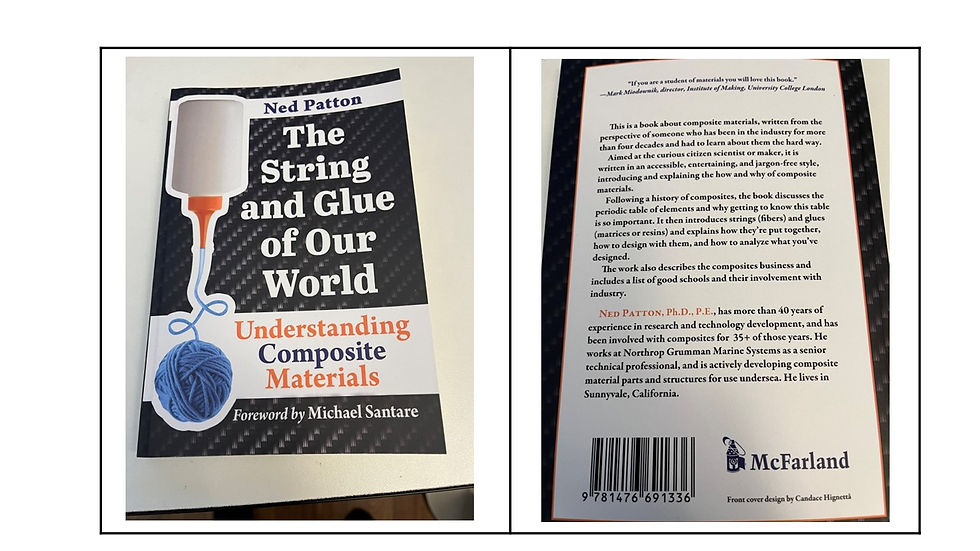
Last but not least, I still need to plug my first book. “The String and Glue of our World” pretty much covers the watershed in composites, starting with a brief history of composites, then introducing the Periodic Table and why Carbon is such an important and interesting element. The book was published and made available August of 2023 and is available both on Amazon and from McFarland Books – my publisher. However, the best place to get one is to go to my website and buy one. I will send you a signed copy for the same price you would get charged on Amazon for an unsigned one, except that I have to charge for shipping. Anyway, here’s the link to get your signed copy: https://www.nedpatton.com/product-page/the-string-and-glue-of-our-world-signed-copy. And as usual, here are pictures of the covers of both books.


Comments