Flax, Flax, and More Flax, And Some Other Stuff

There appears to be quite a bit of movement in the natural, plant-based fiber business this past week or two. Two announcements came out in Composites World about companies that are scaling up their flax fiber composite reinforcements business, and another one that I will talk about a bit later about a basalt fiber production facility being built in the Middle East.

Circular Structures, GmbH of Bremen, Germany very recently opened a workshop and distribution facility in Roanoke, VA to distribute their flax fiber products to manufacturers here in the U.S. These are the folks that provide the fiber for Greenboats and the Greenlander mobility platform and is basically a large utility vehicle for first responders and potentially for the military that has a body made out of flax fiber composites.
It appears that they have repurposed an old industrial building in Roanoke to bring their well established supply chain from Europe to the US market. The new CEO of the company, Gresh Chapman, says that the intent here is to move natural fiber composite reinforcements from the prototype and laboratory scale demonstration phase to the high tonnage industrial phase here in the US. This looks to be a great opportunity for several commercial composites companies, boat builders, infrastructure construction companies, and even small aerospace companies to begin to make the transition from glass and carbon fiber to natural fibers where that makes sense and where they can save both weight and money. The added benefit is that they can also make their end products much less carbon intensive. So, this one looks like a win.

Circular Structures has been providing these products for several industries in Europe for the last several years and had been eyeing the US market for some time. They also knew that when they came here they had to do it in force with a fully established supply chain and credentialed materials ready to supply in industrial quantities. They also knew that they would have to provide technical support for their products as their customers begin the transition from traditional glass and carbon fiber to flax fiber. The properties, processing, and design with natural fibers is quite different than using the commodity glass and carbon fibers, which is one of the things that has held back natural fibers a bit from being applied in large scale. And, since Circular Structures has the technical expertise to be able to do this from many years of experience in Western Europe, they are well positioned to be able to provide all of the product technical support needed to make this work for US manufacturers.
Putting this tech and distribution center in Roanoke Virginia which is a manufacturing center and home of Eldor Group, an Italian manufacturer of automotive electronic components and power train components for hybrid and electric vehicles, as well as being close to the industrial heartland of the East Coast of the US places them in a very good position to be the go to supplier of natural fiber reinforcements for a number of US industries. Eldor, by the way, sold its Electric Hybrid Systems division to Borg Warner in 2023. Any of you that have been around as long as I have will recognize this name, one of the top automotive electrical component manufacturers in the world. They have sponsored the Indy 500 trophy since 1936.

Ather Energy in Bengaluru, India, an electric two-wheel scooter startup, has partnered with Bcomp of Fribourg, Switzerland to incorporate a considerable amount of flax fiber fabric reinforcement to their prototype scooter that they are calling Redux. This electric scooter isn’t just your typical 2-wheeled scooter that you see in images of the streets of most big cities in India, it is sort of a cross between a scooter and a motorcycle. It apparently rides like a motorcycle but it has the maneuverability of a scooter, which is what is required for personal transportation in the streets of Mumbai. I’ve seen video of the controlled chaos in those streets where the people on scooters seemingly have their own laws about traffic and don’t much heed traffic lights or stop signs. Must be just a suggestion to them. Having an electric scooter that is a hybrid scooter / motorcycle that is also lightweight because of the materials it is made from should be a hot seller. Apparently Ather Energy has already sold more than 5000 scooters, so when this one gets into their product line it should sell well.
The Bcomp fiber goes into all of the body panels making them not only lightweight but also strong, impact resistant, and inexpensive to make. The fact that Ather is leaving a lot of the woven fiber visible in the bodywork of this scooter also adds to its aesthetics and should make for a great addition to their line of scooters. The 85% CO2 reduction doesn’t hurt either. This fits well with Ather’s strategy to bring sustainable products to the urban mobility market. And on top of that this is something that cities like Mumbai desperately need.

In another, non-flax, news story, Mars Materials with their bio-based carbon fiber has been selected into the Shell GameChanger program to progress to the second phase of this program which is the precursor to commercial scale-up. I wrote about Mars Materials and their bio-based acrylonitrile a couple of weeks ago when they published their results and got certification that their acrylonitrile was chemically identical to the aerospace standard acrylonitrile that is used to make aerospace grade carbon fiber. This transition from initial demonstration to the beginnings of scale up of this bio-based carbon fiber puts Mars Materials in a leadership position here in the US in the green carbon fiber industry. Of course, now that they have demonstrated their carbon fiber precursor in a scalable manufacturing process, this is when the real work starts – turning this into a sustainable business and making carbon fiber by the ton. Since that has been their intent all along, they seem rather well positioned to be able to scale this stuff up and start to take on the majors in this business. In a few years’ time I see a major acquisition coming in the carbon fiber business. I’m sure that the likes of Toray, Teijin, and Hexcel are watching what happens here. I for one am going to watch this company and see who invests the most in scaling up production and bringing this fiber to the commercial market. Whoever does will win this game.

In another interesting news article that I found in the last couple of weeks, Arab Basalt Fiber Company (Fujairah, UAE) has announced a partnership with Orlimex (Osik, Czechia), a specialist in the engineered composites business and a subsidiary of the Orlitech Group based in the U.K. This new partnership will bring a high performance, low carbon reinforcement to the construction, infrastructure, and manufacturing sectors in the Gulf Cooperation Council’s megaproject pipeline. There is a tremendous amount of construction ongoing in the Gulf States as they begin to diversify their industries and as their population rapidly grows. Dubai, UAE, Saudi Arabia, and many other members of the GCC are very rapidly growing countries that are using their petroleum revenues to modernize and build out their infrastructure not only for their people but also for the growing commerce in the Gulf States. Those of you that remember, I wrote about basalt fiber about a month and a half ago, but this is arguably the biggest strategic partnership in the basalt fiber sector. This will also be an interesting development to watch to see how well they are able to scale up their production of this fiber and begin to lower the costs. Since the fiber is just molten basalt stretched into a fiber, the raw materials are – excuse my pun here – dirt cheap. And basalt fiber is not only stronger than glass, it is also completely resistant to acids, alkaline environments (like concrete) and will not rust, so any infrastructure built using this stuff should last a very long time indeed.
So, that’s it for this week’s post. As always, I hope everyone that reads these posts enjoys them as much as I enjoy writing them. And I hope people who are interested find something they can use in their lives or at least some ideas that they might be able to put into practice. At least I hope that these make people think a bit about sustainability and some of the major issues looming before us. And if you have any of the normal orthopedic issues that come with aging if you have had an active lifestyle, stay tuned to this newsletter and I will be giving you some more info in future posts.
I will post this first on my updated website – www.nedpatton.com – and then on LinkedIn. And if anyone wants to provide comments to this, I welcome them with open arms. Comments, criticisms, etc. are all quite welcome. I really do want to engage in a conversation with all of you about composites because we can learn so much from each other as long as we share our own perspectives. And that is especially true of the companies and research institutions that I mention in these posts. The more we communicate the message the better we will be able to effect the changes in the industry that are needed.
My second book, which will be out soon, is a roadmap to a circular and sustainable business model for the industry which I hope that at least at some level the industry will follow. Only time will tell. At least McFarland announced it in their Fall Catalog. And this time it is under a bit different category – Science and Technology. Maybe it will get noticed – as always that is just a crap shoot. As I said last week, I heard from my publisher and answered all of their questions, so the book has gone from editing to production. This means that in a few weeks to a month or so I should see page proofs to take a look at. That also means that I will have to build a bibliography and an index, so there is still some work for me to do. Writing a book is quite an endeavor as you may imagine, but very rewarding for someone like me.
Just so that everyone is reminded, I’ve included the approved cover at the end of this post. Let me know whether or not you like the cover. Hopefully people will like it enough and will be interested enough in composites sustainability that they will buy it. And of course I hope that they read it and get engaged. We need all the help we can get.
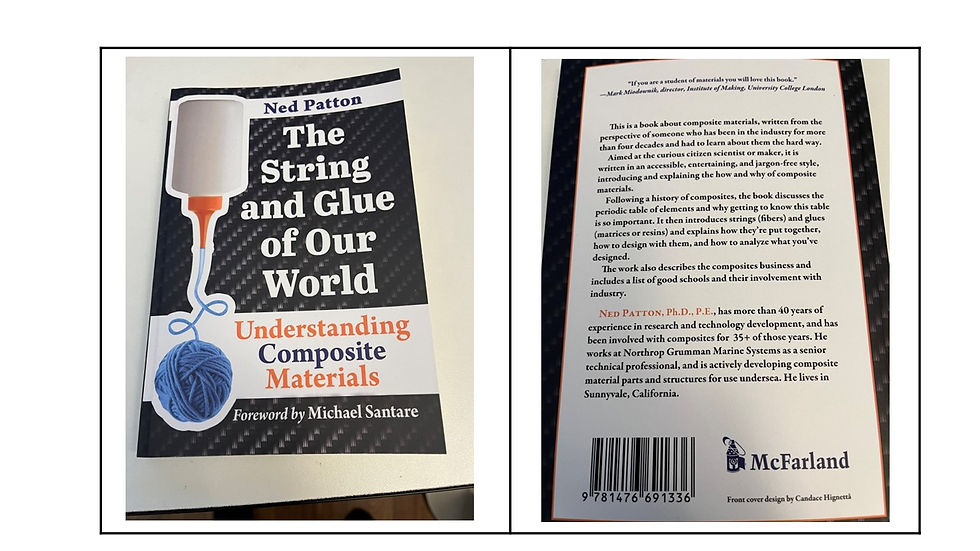
Last but not least, I still need to plug my first book. “The String and Glue of our World” pretty much covers the watershed in composites, starting with a brief history of composites, then introducing the Periodic Table and why Carbon is such an important and interesting element. The book was published and made available August of 2023 and is available both on Amazon and from McFarland Books – my publisher. However, the best place to get one is to go to my website and buy one. I will send you a signed copy for the same price you would get charged on Amazon for an unsigned one, except that I have to charge for shipping. Anyway, here’s the link to get your signed copy: https://www.nedpatton.com/product-page/the-string-and-glue-of-our-world-signed-copy. And as usual, here are pictures of the covers of both books.


Comments