Composites in Orthopedics Part 1 – the Hip

Hello everyone, I’m back for my first post in 2026. I hope everyone had a great holiday and is ready to start this year strong – I know I am. I’m gong to diverge a bit from the sustainability rant that I have been on for the last several months and talk a bit about composites in orthopedics and how composite materials are replacing metals – especially titanium – in orthopedics, both the implanted kind and the wearable kind. And I wanted to start this off with something that I will be facing this year – what is called a total hip arthroplasty – AKA hip replacement. This is apparently a fairly common surgery for folks my age that have worn out the cartilage in the socket of the ball and socket joint at the top of the femur (long upper bone in your leg for those that are not medically inclined).

Hopefully this pic isn’t too gruesome for my readers, but this X-ray image is from an article in the November 2025 issue of the Journal of Composites Science that compared a standard Titanium implant – Ti 6-4 for the metallurgists in the crowd – to a fairly recently developed alloy of Titanium - β-Titanium and to a carbon fiber / PEEK implant. The metal and composite parts are in what is called the distal stem or femoral stem – basically the part that sticks down into the leg bone after the original ball is removed and that acts as the top of the femur. Titanium is of course the standard for this implant, but increasingly orthopedic surgeons are starting to use carbon fiber composite distal stems.

The problem with Titanium is that it is much stiffer than the bone is and therefore carries more of the load than the rest of the leg bone does. And, since your bones are constantly remodeling (whether you know this or not) what happens is that what are called osteoclasts (cells that remove bone where it isn’t needed) begin to take away bone at the top of the femur. Eventually what happens is that the implant loosens and a surgeon has to go in and replace the implant. This phenomenon is called stress shielding and has kept surgeons from performing this operation on younger folks if it wasn’t required. They used to make them wait until they knew that they wouldn’t have to go in 20-30 years down the road and replace the titanium stem.
And then along comes someone with the bright idea of using carbon fiber composites for this part because as those of you know that have read my newsletters over the years, composites are sort of a dial a stiffness material. What this means is that the prosthesis manufacturers can tailor the stiffness of the femoral stem to be a close match to the hard bone of the femur and completely avoid stress shielding.
So why am I writing about this? The short answer is that I wore out the cartilage at the top of my left femur and it hurt enough about the middle of last year that I had to hang up my running shoes. I am a life long distance runner with 2 marathons, uncountable 10-Ks, and an average of 25-30 miles a week for 40+ years. I wore the damn thing out. And it is on the left because I am left side dominant – southpaw if you wish. That made me tough to deal with on the soccer field in my youth (I liked center half for those of you that play the game) because I could handle the ball just as well with either foot (more accurate with the left). And those days probably added up as well to the wear and tear in my left hip.
My actual diagnosis is osteoarthritis of the left hip (I have some in the right as well but not as bad as the left) which is also called wear and tear arthritis. And from the looks of it, this is one of the more common ailments that those of us that have been active all of our lives face when we get up in years. I’m writing this sort of for my own use but also for those of you that have some of the same conditions as I do because you have been as active as I have been over the course of my life and have also worn out one of the most critical joints in your body.
Back to the paper about the three different materials for the femoral stem, both of the Titanium materials caused stress shielding and the carbon fiber / PEEK material did not. Needless to say that is a great result. But this paper was based only on a stress analysis using an accepted structural model of a femur and actual material properties and designs of these implants. Fortunately – at least for me – there has been enough study in sheep models and use in actual clinical settings that good orthopedic surgeons of today are not afraid to use a carbon fiber based composite femoral stem for their implants.
My first appointment with an orthopedic surgeon is at the end of this month, so I’ll let everyone know what he says. I also wanted to give people examples of what these things look like, so here are a couple of images of the stem part as well as the ball that replaces the original bony ball at the top of the femur (ceramic is the best choice for this), and even a stress analysis image from the paper cited at the outset of this post.

If you look carefully at the bottom right pic here you can see how the CFRP (carbon fiber reinforced plastic) shows almost zero stress shielding. The place where the shielding happens is on the upper outside of the femur just below where the insert meets the bone. In the middle stress plot the stresses are very consistent all the way down the femur meaning that the distribution of stress is even and there is zero stress shielding. In the one on the left (the new Titanium alloy) you see some dark blue on the outside of the bone which means that it is being shielded by the implant and therefore ripe for osteoclasts to start softening that part of the bone and taking away bone whereas in the one on the right side that area is also dark blue, but the load has been transferred to the femur farther down the femur than the top, so while this bone lower down may get stronger, where the implant meets the bone it will get weaker. In the middle case – the CFRP stem – the stresses are very evenly distributed down the length of the femur and there is no stress shielding. This is the real magic of composites and it is why they fascinate me enough to write about them. The rest of the magic is that these materials are completely biocompatible and even more so than any of the metals that have been used in the past. Even the ceramic balls that are in common use today for the ball part of the joint are biocompatible. The ceramic that is used most commonly is called “delta ceramic” which is basically a zirconia toughened alumina ceramic with microscopic strontium oxide platelets embedded in the ceramic to blunt any cracks that might form. This makes for an extremely tough material that can be polished to the point where it does not abrade the highly crosslinked polyethylene plastic liner that replaces the cartilage that I wore out. So this whole thing ought to be good for the next 30 years or so – at least that’s my hope.
Needless to say, my appointment at the end of the month will be interesting. I guess I am going to find out how much my orthopedic surgeon knows about composite materials and whether he understands stress shielding.
That is about enough for composites in hip replacement. Fortunately there are several more examples of the use of carbon fiber composites in medical prostheses, and even for athletes who have lost limbs, enabling them to compete again. But that will be for posts in the future. Next week I’m probably going to go back to composites sustainability and things that have happened over the past month or so in that space. My intent here is to weave new subjects into these posts as time goes along just to make sure that I keep everyone – myself included – informed about new stuff happening in the world of composite materials and their application to demanding problems.
And that’s it for this week’s post. As always, I hope everyone that reads these posts enjoys them as much as I enjoy writing them. And I hope people who are interested find something they can use in their lives or at least some ideas that they might be able to put into practice. At least I hope that these make people think a bit about sustainability and some of the major issues looming before us. And if you have any of the normal orthopedic issues that come with aging if you have had an active lifestyle, stay tuned to this newsletter and I will be giving you some more info in future posts. Like I said above, I am going to go back to sustainability next week, but I’m gong to keep returning to this thread and maybe add another as time goes on this year. Of course, if there is anything that anyone wants me to research and write about, please speak up. I’m all ears.
I will post this first on my website – www.nedpatton.com – and then on LinkedIn. And if anyone wants to provide comments to this, I welcome them with open arms. Comments, criticisms, etc. are all quite welcome. I really do want to engage in a conversation with all of you about composites because we can learn so much from each other as long as we share our own perspectives. And that is especially true of the companies and research institutions that I mention in these posts. The more we communicate the message the better we will be able to effect the changes in the industry that are needed.
My second book, which will be out sometime next year, is a roadmap to a circular and sustainable business model for the industry which I hope that at least at some level the industry will follow. Only time will tell. At least McFarland announced it in their Fall Catalog. And this time it is under a bit different category – Science and Technology. Maybe it will get noticed – as always that is just a crap shoot. At least it is now up on my website as promised, so people can pre-order it if they wish. It is available for pre-order also from McFarland (m publisher) and on both Amazon and the Barnes and Noble website.
As I have said before, my publisher and my daughter have come to an agreement about the cover. So, I’ve included a pic of the approved cover at the end of this post. Let me know whether or not you like the cover. Hopefully people will like it enough and will be interested enough in composites sustainability that they will buy it. And of course I hope that they read it and get engaged. We need all the help we can get.
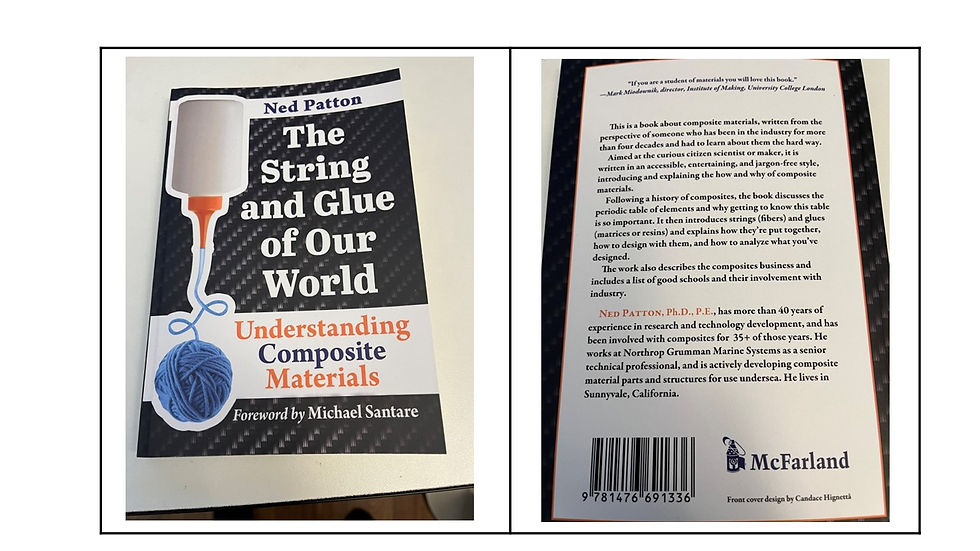
Last but not least, I still need to plug my first book. “The String and Glue of our World” pretty much covers the watershed in composites, starting with a brief history of composites, then introducing the Periodic Table and why Carbon is such an important and interesting element. The book was published and made available August of 2023 and is available both on Amazon and from McFarland Books – my publisher. However, the best place to get one is to go to my website and buy one. I will send you a signed copy for the same price you would get charged on Amazon for an unsigned one, except that I have to charge for shipping. Anyway, here’s the link to get your signed copy: https://www.nedpatton.com/product-page/the-string-and-glue-of-our-world-signed-copy. And as usual, here are pictures of the covers of both books.


Comments