The Maturation of Composite (Fiberglass) Structural Shapes in Construction

In this last post of 2025, I wanted to complete what I started last week and talk about fiberglass being used for structure in the construction industry. Specifically I want to chat a bit about the evolution of what we have today as standard structural shapes as well as where these products are beginning to replace steel in construction.

By far the biggest player in this business, and the one that has been in it the longest and is the probable inventor of this line of composite products is Strongwell Inc. In business since 1924 as a furniture factory, they started working in reinforced plastics in the 1940’s. And in 1956 they came up with a production process that they called “the continuous automatic process” which we know today as pultrusion. By far their longest running product line is fiberglass ladder rail, so any of you that have a fiberglass ladder may have some Strongwell fiberglass in the garage.
One of the things that has kept Strongwell in the lead in this regard is that they understood their market very well and worked with the regulators very early in the game to develop specifications for these products that could be accepted by all of the major regulatory agencies. For ladders of course, that is Underwriters Labs (UL) or the American National Standards Institute (ANSI) which are the major safety standards setting bodies in the US. There are different organizations in Europe and Asia, but most of those organizations follow the US lead in setting these standards.
And of course, since Strongwell started this in Bristol, VA, there have been a number of companies that have followed their lead and also now produce and sell fiberglass structural shapes to be used in the construction industry. In the US, companies like Structural Fiberglass Inc. in Bedford, PA which is mostly a custom fiberglass structural shape supplier, Fibergrate in Dallas, TX that started off by developing and marketing fiberglass molded grating for walkways and interior flooring for industrial and chemical plants, and Liberty Pultrusions in Pittsburgh, just to name a few of the major companies here in the US.

Building materials like are what is pictured above and that get used in structures like the lead pic in this post are regulated not only by ANSI but also by the Uniform Building Code. Strongwell took the lead early in this in development of specifications for how these pultruded reinforced plastic structural shapes are made as well as how the process of making them is controlled to provide a consistent product that can be certified to be compliant with the ANSI standards that it needs to be compliant with.
It is the ability of these products to directly replace their steel counterparts at about the same cost, with a significant weight savings, and very high resistance to corrosion that has made these fiberglass structural shapes the material of choice for infrastructure projects like what you see in the lead pic in this post. The fact that there are industry standards for these products allows municipalities and their civil engineers to use them in major infrastructure projects that are intended to last.

This is especially true of the offshore oil and gas industry, where seawater eats up steel at a fairly rapid rate. Since the advent of fiberglass structural shapes that can replace steel became widely available, the offshore industry adopted them quickly. The fact that these materials weigh about half or less than their steel equivalents and need little to no maintenance, not even paint, makes them the materials of choice for everything that is from the waterline up on an offshore platform.
And of course the other thing driving this is that on an oil platform everything above the waterline has to be supported on the steel columns that go down to the sea bed. Reducing the weight that these columns have to carry makes the platform that much safer when the weather turns nasty. Most of this stuff in the US is in the gulf of Mexico, and that’s where hurricanes happen.
On a floating platform, all of the structure and equipment above the waterline has to have at least the equivalent of its weight in buoyancy below the waterline or the platform would sink. There is already a lot of heavy equipment and piping on one of these rigs, so taking weight out of the structure is a big win.

In Europe, actually in Finland, there is a company that also makes composite structural shapes. Excel Composites was formed in 1960 by three chemists who specialized in the production of electric detonator caps. They originally called themselves Explosive Electrics and eventually got involved in competitive pistol shooting which got them into the sporting goods market. From there they developed a pultrusion process for making ski poles – this is Finland after all. They patented the first carbon fiber pultruded ski poles in 1974 which became the winter sports standard after their introduction at the Innsbruck Olympics in 1976. Since that time they have of course broadened their horizons as well as their product lines and are now not only Europe’s but the world’s largest manufacturer of pultruded composite shapes. They have manufacturing facilities in the EU, the UK, Canada, the US, China, and India. And they serve the sporting goods, energy, and infrastructure industries with their products.

Finally, for something a bit more approachable, there is a company - American Plastic Lumber - that uses recycled plastics to make lumber that can be used just like what comes from a tree. I took a quick look at what they do, and it appears to me to be a composite albeit not fiber reinforced like a traditional composite. They comingle post-consumer plastics like the PET from soda bottles, high density PE from milk jugs and yogurt containers, PVC from used sprinkler pipes, low density PE from bread bags and paint can lids, and polypropylene from other food containers, yarns and fabrics (see – some fiber at least), and old car seats, polystyrene from your McDonalds’ Big Mac container, and what they call “other resins” which includes plastics not mentioned previously as well as multi-layered material. They mix all of this recycled material up in proportions appropriate for what they are making and turn it into lumber. The pic above has actual lumber for the underpinnings of this bridge, but the decking and railing is all recycled plastic turned into lumber.

Fence posts that will last a lifetime anyone? How about railroad ties that will never need replacing. On their website American Plastic Lumber says that one 8’ 6x8 landscape timber contains the equivalent of 735 used milk jugs.

And of course, American Plastic Lumber also makes decorative structural lumber as well. How about a pergola over your composite deck that is made from recycled plastic and does not need to be painted every few years.
So, that’s it for this week’s post, and as I said at the outset, this is my last post of this year. I will come back in early January and start off on another subject. It will of course be about composites because that is what I write about, but I plan to venture into some new areas in these posts and explore the future a little bit in some up and coming areas of application of composites.
As always, I hope everyone that reads these posts enjoys them as much as I enjoy writing them. And I hope people who are interested find something they can use in their lives or at least some ideas that they might be able to put into practice. At least I hope that these make people think a bit about sustainability in whatever they do and whatever industry they work in so that together we can tackle some of the major issues looming before us.
I will post this first on my website – www.nedpatton.com – and then on LinkedIn. And if anyone wants to provide comments to this, I welcome them with open arms. Comments, criticisms, etc. are all quite welcome. I really do want to engage in a conversation with all of you about composites because we can learn so much from each other as long as we share our own perspectives. And that is especially true of the companies and research institutions that I mention in these posts. The more we communicate the message the better we will be able to effect the changes in the industry that are needed.
My second book, which will be out sometime next year, is a roadmap to a circular and sustainable business model for the industry which I hope that at least at some level the industry will follow. Only time will tell. At least McFarland announced it in their Fall Catalog. And this time it is under a bit different category – Science and Technology. Maybe it will get noticed – as always that is just a crap shoot. I do know that it is in editing right now, so I might actually see something fairly early in the next year. But I’m certainly not going to hold my breath. My publisher will get to it when they get to it.
As I have said before, my publisher and my daughter have come to an agreement about the cover. So, I’ve included the approved cover at the end of this post. Let me know whether or not you like the cover. Hopefully people will like it enough and will be interested enough in composites sustainability that they will buy it. And of course I hope that they read it and get engaged. We need all the help we can get.
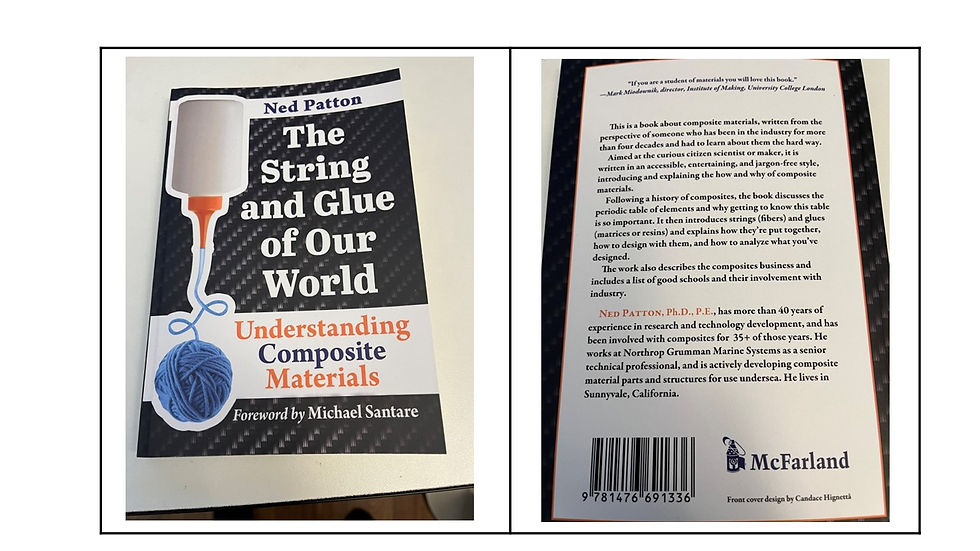
Last but not least, I still need to plug my first book. “The String and Glue of our World” pretty much covers the watershed in composites, starting with a brief history of composites, then introducing the Periodic Table and why Carbon is such an important and interesting element. The book was published and made available August of 2023 and is available both on Amazon and from McFarland Books – my publisher. However, the best place to get one is to go to my website and buy one. I'm also going to be offering my second book as a pre-order on the website as soon as I can get to it over the holidays. I will send you a signed copy for the same price you would get charged on Amazon for an unsigned one, except that I have to charge for shipping. And as soon as my second book drops I will ship any pre-orders out right away. Anyway, here’s the link to get your signed copy: https://www.nedpatton.com/product-page/the-string-and-glue-of-our-world-signed-copy. And as usual, here are pictures of the covers of both books.


Comments