This Week’s News about Recycling and End-of-Life Composites

This week I’m going to make my newsletter just a bit shorter than what I did last week with all of the pictures of sailboats that use recycled or natural fibers for primary structure. There are a couple of fairly newsworthy things that have happened just in the last few weeks that I want to focus on this week. And I want to also let everyone know that I am going to take a couple of weeks off writing newsletters over the holidays. It’s about time I took a break, and then I can come back fresh in the new year because stuff will inevitably happen that will be worthy to write about. So I will not post a newsletter in the Christmas and New Years weeks.

The first newsworthy thing I want to talk about this week is an EU funded project, EuReComp, which is demonstrating what they call “circularity and high-performance design going hand in hand” with a modular cabin demonstrator made almost entirely out of used wind turbine blades and other end of life composites from the aviation industry. They actually built one of these as a demonstration that a perfectly livable small cabin can be made using almost entirely end of life composites.
They are accomplishing this feat partly by using the end of life parts themselves as some of the structural and façade parts of the cabin with the rest from resin infused recycled glass and carbon fiber made into structural shapes.
For the frame of the cabin they used standard steel framing, but the remainder of the cabin was nearly entirely made using recycled carbon and glass fiber composites.

They used the glass fiber wrapped balsa wood shear webs (the structures that connect the front to the back of the blade) from end of life wind turbine blades for flooring, interior sidewalls, bathroom flooring, and door thresholds. They basically cut these flat panels into shape, refinished them to make them look nice as well as hold up to foot traffic, and put them in place.
For the side walls, they used a recycled glass fiber reinforced expanded polyurethane and for the roof they integrated reclaimed recycled carbon fiber patches infused with resin to complete the structural part of the roof. Other parts of the structure, like the door frames, window frames, etc. the EuReComp team used recycled wind turbine and end of life aircraft parts as much as possible. Finally, they formed their own structural elements using left over recycled carbon fiber and glass fiber infused in resin to make structural shapes and decorative shapes to complete the project.

All in all, the project was quite a success and demonstrates another use for end-of-life wind turbine blades, aircraft parts, and other composites being used in a completely circular manner. Final work is currently underway to make 3D printed naval windows, manufacture and apply the final building cladding, and complete the as-built documentation. Once this is complete, this ROCCA cabin design could easily be moved from a one-off demonstration to a deployable unit complete with instructions for how to make and assemble all of the pieces and parts of the structure. The EuReComp team believes that this cabin design could very well find use for off-grid or modular housing, boat houses, quick response disaster relief shelters, sustainable micro workspaces, and many more uses wherever a rapid deployment of usable interior space is needed.

The second newsworthy event that was announced right before Thanksgiving here in the US is that Verretex has achieved a completely closed loop glass fiber composite recycling and reuse process in partnership with Fiberloop. I got this announcement in an email from the CEO of Verretex a little over a week ago, so I thought this would be a good thing to highlight in this week’s post.
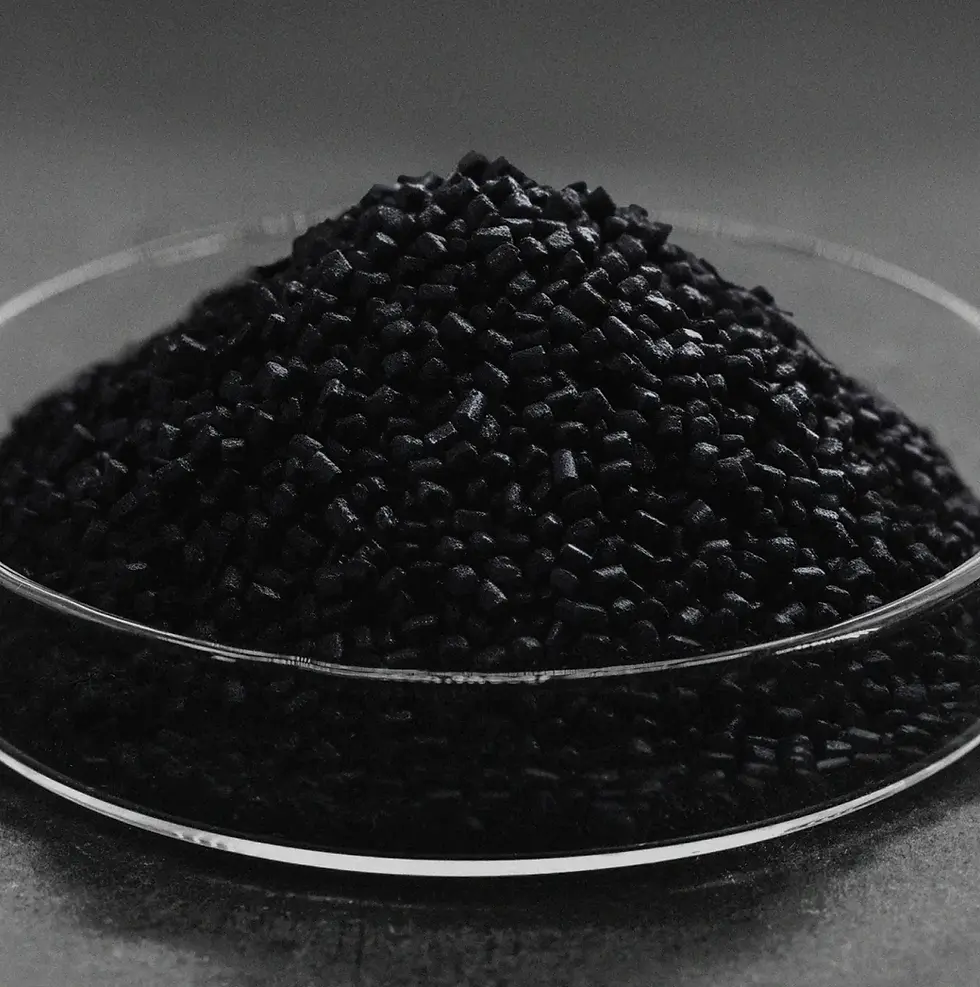
This partnership uses recycled fiberglass from the patented Fiberloop thermolysis process to make ready to use glass fiber textiles using Verretex’s demonstrated textile manufacturing process. The partnership has been able to demonstrate a completely production ready glass fiber material like the product shown above using entirely recycled glass fiber from the Fiberloop thermolysis process. The product shown above is among the highest grade recycled glass fiber products being produced today and rivals the properties of the virgin glass fiber equivalent, at a much lower cost as well as being entirely circular.
Verretex has done extensive testing of not only the raw recycled glass fiber that the Fiberloop thermolysis machines provide, but also the end products into which it has been integrated. The Fiberloop process produces a very consistently high quality recycled glass fiber that is completely clean and undamaged so it is very nearly virgin long chopped glass fiber when the Fiberloop machine completes its recycling process. This has enabled Verretex to provide a consistently high quality suite of glass fiber textile products that are completely production ready.
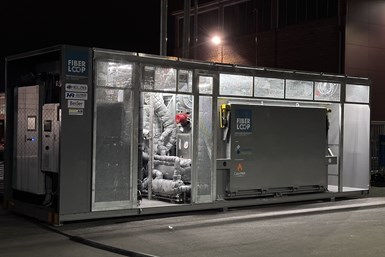
And, since this process can be repeated as many times as needed, the process is truly circular. The glass fiber products that Verretex is able to produce using this process can be directly applied to making new wind turbine blades to replace the ones that came to the end of their useful lives. And of course since this entire process starts with what is essentially a free material resource, the production ready recycled glass fiber products are far less expensive than virgin material. This may be a game changer for the installed base in the wind turbine industry because blades must be changed out about every 20 years, so there is already a steady supply of raw material for Verretex / Fiberloop to use as inputs to their process.
This collaboration is already working on deployment opportunities in a number of regions across the world, including North America, Europe, the Middle East, North Africa, and Asia, all of which have extensive installations of wind turbines that are already experiencing blade end of life issues. Of course this brings to mind the huge pile of used wind turbine blades in a field just outside of Sweetwater, Texas that I have written about extensively. There are apparently similar albeit smaller (everything is bigger in Texas 😊) piles of used blades in France, Belgium, the Netherlands, North Africa, and several other areas where wind energy has been in use for a few decades at this point.
That’s about it for this week’s post. Like I said at the outset this week, this one is a bit shorter than usual. As always, I hope everyone that reads these posts enjoys them as much as I enjoy writing them. And I hope people who are interested find something they can use in their lives or at least some ideas that they might be able to put into practice. At least I hope that these make people think a bit about sustainability and some of the major issues looming before us.
I will post this first on my website – www.nedpatton.com – and then on LinkedIn. And if anyone wants to provide comments to this, I welcome them with open arms. Comments, criticisms, etc. are all quite welcome. I really do want to engage in a conversation with all of you about composites because we can learn so much from each other as long as we share our own perspectives. And that is especially true of the companies and research institutions that I mention in these posts. The more we communicate the message the better we will be able to effect the changes in the industry that are needed.
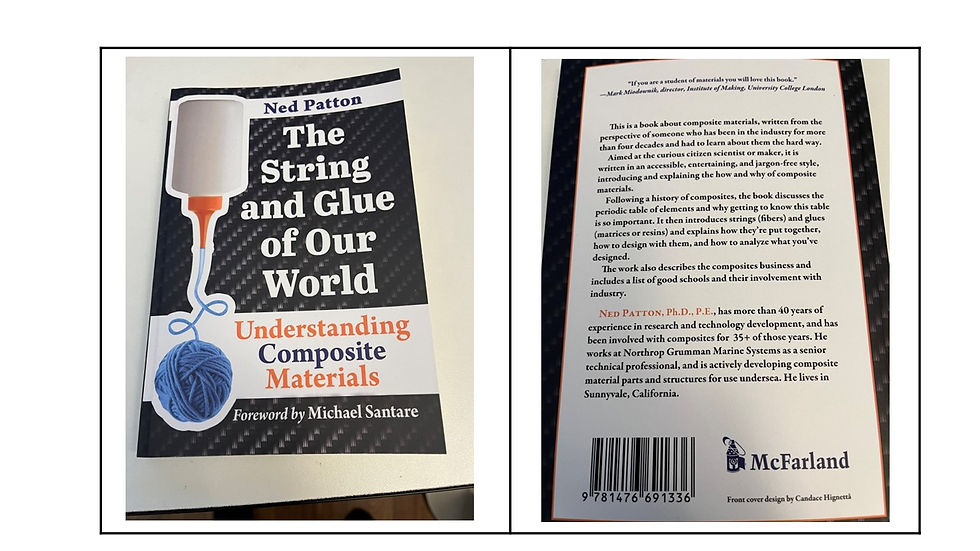
My second book, which will be out sometime next year, is a roadmap to a circular and sustainable business model for the industry which I hope that at least at some level the industry will follow. Only time will tell. At least McFarland announced it in their Fall Catalog. I contacted them last week and was told that the book is in editing right now, so I might see their edits early in the next calendar year. This time the book is under a bit different category – Science and Technology. Maybe it will get noticed – as always that is just a crap shoot.
As I have said before, we came to an agreement about the cover. So, I’ve included the approved cover at the end of this post. Let me know whether or not you like the cover. Hopefully people will like it enough and will be interested enough in composites sustainability that they will buy it. And of course I hope that they read it and get engaged. We need all the help we can get.


Comments