There’s a New Entrant in the Pyrolysis/Thermolysis Business

I read this week both in Composites World and in JEC about a new entrant in the scaled up low temperature pyrolysis or thermolysis business that is building a 2800 tonne (sorry European spelling) capacity low temperature pyrolysis recycling facility in Norway. Gjenkraft AS in Hoyanger, Norway has raised about $6M (60 million NOK) in venture capital, from multiple sources – the EU through a Horizon grant, two contributions from Innovation Norway, and a mix of other investments that make up about $850k of the $6M.

This effort by Gjenkraft is a direct result of their participation in the EU funded REFRESH project (smart dismantling, sorting and Recycling of glass Fiber Reinforced composite from wind power Sector through Holistic approach). That seems like a bit of a stretch to make up an acronym to me, but at least the project has a focus and has produced results. The biggest to date is the new funding round just secured by Gjenkraft to build and begin to operate an industrial scale wind blade recycling facility.
From what I have been able to gather from looking into this, Gjenkraft is using a Pyrolysis approach (high temperature in an oxygen free environment) that breaks down the cross links in the resins and renders them back into an oily substance useful for remaking into resin and some gaseous hydrocarbons that they also capture and cool to condense out the liquids and then save the lighter stuff for use on something else. So, this is another means of breaking down used fiberglass and retaining both the fiber and the resin components. This is 100% recycling of the fiberglass part of the wind turbine blades.
Also from what I read about what they do – which is proprietary to Gjenkraft – it is just slightly different than what Composite Recycling does with their Thermolysis technique. It is similar but the Gjenkraft process seems to operate at a higher temperature because they do get a gaseous component whereas with Composite Recycling’s approach there is little to no gaseous component that comes out of the process.
This is at least another entrant that is going to do this at scale the way Composite Recycling already has done. Composite Recycling has of course already built and demonstrated their recycling equipment in a 40’ ISO container. They have also joined the consortium led by Beneteau and Owens Corning to scale up their Thermolysis process probably past the scale envisioned by Gjenkraft. And this consortium has been funded now for some time and is actively engaged in the scale up. So, Gjenkraft is probably a year or maybe more behind Composite Recycling. That is, however, good news.
That brings me to the REFRESH Project and what this project entails as well as who the partners are. According to the EUCIA (European Composites Industry Association) website, and I quote “REFRESH (Smart dismantling, sorting and REcycling of glass Fibre Reinforced composite from wind power Sector through Holistic approach) aims to develop and demonstrate a novel circular, smart system enabling improved recycling of glass fibre reinforced composite materials derived from turbine blades.” The project team includes RINA Consulting SpA (Italy), ACCIONA Construccion SA (Spain), CETMA (Italy), CIRCE (Spain), EUCIA (Belgium), Enecolab Srl (Italy), GEES Recycling (Italy), Gjenkraft AS (Norway – the one this post mentions first), MFB Manufacturing (France), STD Environment (France), and TECNALIA (Spain).
All together these companies and organizations cover the entire watershed of what is required to actually make this work. From a recycling company that is already in the business of obtaining the blades and getting them prepared to be recycled (GEES), to the company that takes the fiber and resin apart (Gjenkraft), to the companies that can sell the recycled materials, make parts out of recycled materials, handle the environmental impact requirements and reporting required in the EU, to research centers in two countries lending technical expertise, all managed by a consulting firm that is already in this business and seems to know how to make the partnership work.

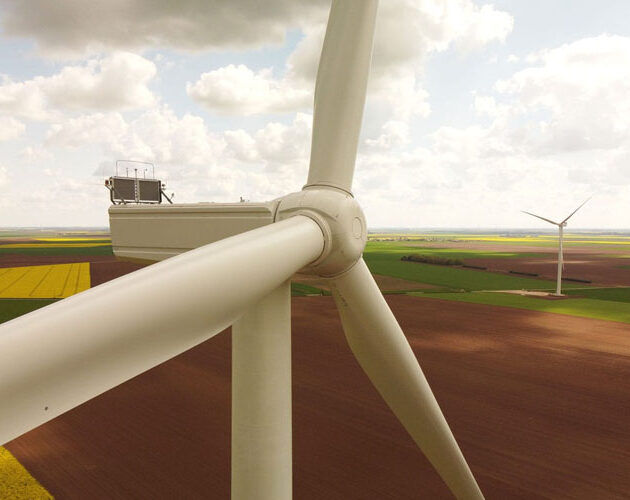
In addition to the REFRESH Project, in my research about this topic, I came across another EU company, this time in the Netherlands that is also using the Gjenkraft facilities to recycle all of their used blades. The company is Vattenfall AB and they are one of the largest renewable energy providers in Europe, with renewable installations in the Netherlands, Denmark, Finland, France, Germany, Sweden, and the one pictured above offshore of the UK. They sold this farm in 2024 but are building two new ones off the coast of the UK. This is of course, in the North Sea, which is not only very windy, it is a very challenging environment for permanent structures The land based installations are both solar and wind, so they have a lot of used wind turbine blades that they will need to recycle soon. And they have made the commitment to recycle all of their used wind turbine blades by 2030, primarily because of the EU landfill ban.
Let’s just say that Gjenkraft is going to be busy. Hopefully Composite Recycling can step in and lend a hand because they are going to need all the help they can get to meet a 2030 100% recycling target with as many blades as they have coming up to the end of their useful life.
All together this is very good news for the planet and for the environment of Europe and its surrounding areas. And while the Europeans are still way out front in this sort of endeavor, largely because of their recently passed “no landfill” laws, there is actual movement in the right direction here in the US.
That’s about it for this week. As always, I hope everyone that reads these posts enjoys them as much as I enjoy writing them. I will post this first on my website – www.nedpatton.com – and then on LinkedIn. And if anyone wants to provide comments to this, I welcome them with open arms. Comments, criticisms, etc. are all quite welcome. I really do want to engage in a conversation with all of you about composites because we can learn so much from each other as long as we share our own perspectives. And that is especially true of the companies and research institutions that I mention in these posts. The more we communicate the message the better we will be able to effect the changes in the industry that are needed.
My second book, which may be out in the late fall, is a roadmap to a circular and sustainable business model for the industry which I hope that at least at some level the industry will follow. Only time will tell. At least McFarland announced it in their Fall Catalog. And this time it is under a bit different category – Science and Technology. Maybe it will get noticed – as always that is just a crap shoot.
As I have said before, my publisher and my daughter have come to an agreement about the cover. So, I’ve included the approved cover at the end of this post. Let me know whether or not you like the cover. Hopefully people will like it enough and will be interested enough in composites sustainability that they will buy it. And of course I hope that they read it and get engaged. We need all the help we can get.
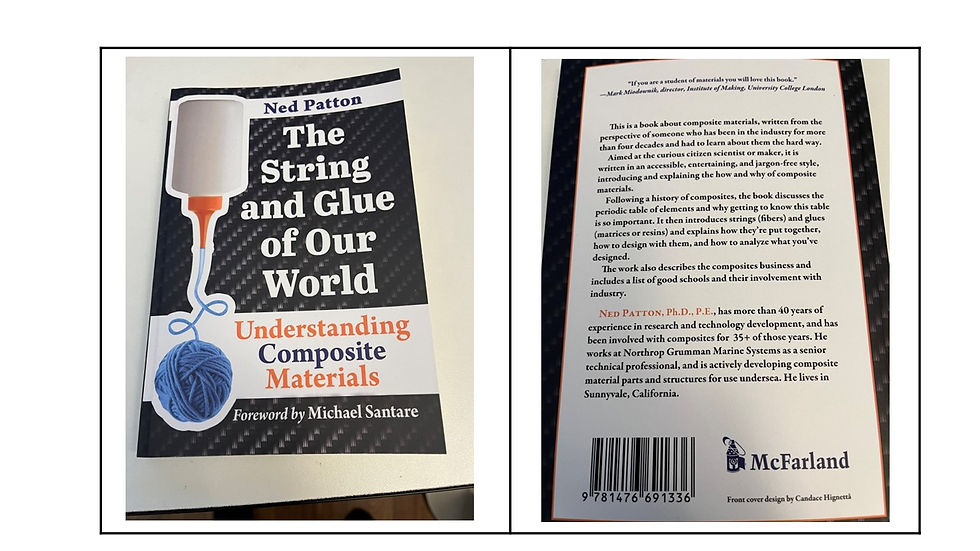
Last but not least, I still need to plug my first book. “The String and Glue of our World” pretty much covers the watershed in composites, starting with a brief history of composites, then introducing the Periodic Table and why Carbon is such an important and interesting element. The book was published and made available August of 2023 and is available both on Amazon and from McFarland Books – my publisher. However, the best place to get one is to go to my website and buy one. I will send you a signed copy for the same price you would get charged on Amazon for an unsigned one, except that I have to charge for shipping. Anyway, here’s the link to get your signed copy: https://www.nedpatton.com/product-page/the-string-and-glue-of-our-world-signed-copy. And as usual, here are pictures of the covers of both books.


Comments