The History of Composites from My Perspective

#composites, #polyester, #carbonfiber, #AS4-3501, #cost
I thought this week I would go over a history of composites of sorts, as seen from my perspective. Of course this is going to get a little personal, but it really is how I got into this stuff from when I was a little kid. First of all, I do have to let everyone know that I was a very curious kid, had an erector set, HO scale cars and a track, a chemistry set I messed around with, and my father had a rather large and well equipped (if not some rather ancient equipment) workshop. He was a physician but started his education in engineering after having rebuilt several motorcycles and cars when he was a kid. So I understood tools from a very young age and knew what they did. And he liked to make stuff as well, so he and I had wonderful times in the workshop.

I wanted to show you this pic first because it resembles somewhat the table that my dad made that introduced me to polyester resin. What he got was a teak slab cut from the trunk of a very old teak tree that had split into two trunks. It was a beautiful piece about 2” thick and about 4’ long and 2’ wide. He cast this thing in polyester resin and learned when he did it about how to keep out the air bubbles without using a vacuum, how to support the thing while it was curing, and how to cast a table with a nice thick resin coating all the way around it. It wasn’t easy but it was my first introduction to how to cure a resin.
We had of course owned a 15’ runabout with a 40hp engine on the back that was fiberglass for when we went camping every summer, but I never paid much attention to the fact that the boat was fiberglass. My how things change as you get older, go to school, and end up at a place like the University of Delaware’s Center for Composite Materials.
But I am digressing a bit from what I wanted to talk about this week. First, I want to give you a bit of history about composites, where they came from, how I learned about them and when, what I learned and when, and how I eventually ended up where I am today.

The basic history of fiberglass starts with this gentleman, Dale Kleist, a new researcher at Owens-Corning Glass Company in 1932. He had graduated from Ohio State and took a job at Owens-Corning where he was trying to seal together pieces of glass block by melting and spraying glass. He was working with James Slayter (commonly referred to as the father of fiberglass) and Jack Thomas when he noticed thin glass tendrils hanging from the ceiling where they had oversprayed molten glass. The little particles had coagulated to form thin fibers. Once Dale made this observation, the three of them worked together on it because they noticed that these thin, flexible fibers were very strong and yet not brittle because they were so thin. Between the three of them they developed the steam-blown technique with is a less refined offshoot of how inexpensive glass fiber is made today.
Of course I knew nothing about this at the time but was fascinated by fiberglass and how it was used in any case as my dad not only made this table but reinforced all manner of things with fiberglass mat and resin. And of course, the workshop used to stink from the styrene offgas that we used to get when dad messed with the stuff, but apparently I have been lucky enough to not have any long term effects of that.

But I want to move on from childhood to my first professional job and my first introduction to composites. I went to work for Battelle Northwest out of school with a newly minted Masters in Mechanical Engineering and immediately got into the world of tank gun launched munitions. This is where my introduction to these wonderful materials began. I initially took a look at metal matrix composites and actually had some stuff built using aluminum silicon carbide, yes a metal matrix composite that was made using sintered metal and ceramic powders. And we shot a few of these successfully. And by successful I mean we finally got a clean discard, and the weapon went downrange to the target. This is of course after several attempts when we got what we called “pieces and parts”. Basically a bunch of crap coming out the end of the gun in a big cloud of pieces and parts.
But the real introduction was when I left Battelle to go to Aberdeen Proving ground to what was at the time the US Army Ballistic Research Lab. What we eventually came up with, working with a contractor that we could get to do the manufacturing process control necessary to make them were the first prototypes of what is now the M829A3. This is the one the tankers in Iraq called the silver bullet because it could stop an old Russian tank (the only ones the Iraqis had at the time) before the enemy tanks could come anywhere near the range of the US M1.
Needless to say I also was told to go to the University of Delaware and get my Ph.D. which I did. It was there that I was really introduced to composites by the professors and the leadership of what is now CCM. At the time Byron Pipes was running the place and the current head of CCM, Jack Gillespie, was more of a technical director than anything else. In any case, I was the US Army Liaison to what was a composites consortium led by the University that had membership of academia, Government (largely me), and industry that were all working together to develop the first real manufacturing and industrial design processes for high performance composites.
That brought me to Southwest Research in San Antonio where there was a gentleman in need of a newly minted Ph.D. Mechanical Engineer with expertise in composites to bring the use of composites to the underwater world, both for the Navy and for the Offshore Oil Patch. One of the first things I did was to take a good look at the feasibility at the time of the use of composites for the undersea environment, primarily for the covert Navy, but also for the deep ocean oil patch. And just to show you what the changes have been, I am including a table I put together at the time (somewhere between 1992 and 1994) for the new ideas about Tension Leg Platforms for deep water.
Table 1. From Early 1990's "Composite Materials for Offshore Platforms"
Fiber/Resin System |
Stiffness (x106 psi) |
Strength (ksi) |
Density (lb/in3) |
Cost ($/lb) |
E-glass/Polyester 30% fiber - pleasure marine | 1.5 | 30 | .07 | 8-10 |
E-glass/Polyester 50% fiber - Structural | 3 | 50 | .08 | 10-12 |
S-glass/Phenolic 50% fiber - Structural | 5 | 100 | .075 | 15-20 |
Graphite/Epoxy 50% fiber - Aerospace | 10 | 100 | .05 | 100 |
Kevlar/Phenolic 50% fiber - Impact Resist | 5 | 80 | .04 | 60 |
Spectra/Phenolic 50% fiber - Impact Resist | 2 | 60 | .03 | 60 |
Note in this table what the prices were and compare those to today. In the 1990’s carbon/epoxy which at the time was Hexcel’s AS-4/3501 was $100 a pound. Now you can buy T1100 or IM11 with a Toray resin or a Hexcel 3900 resin system for less than half of that. And AS-4/3501 had about the strength and stiffness of some of the lower strength industrial grade carbon fibers of today like T300 which is getting down to about $10-15 a pound.
But that did not really perturb me at the time because there were a few customers like the Navy that needed composite things, and the Offshore Oil industry, especially with what was called the DeepStar program a the time, was keenly interested. In fact, I ended up doing a few things, one of which is actually building something quite large for the Naval Underwater Warfare Center in New London, CT. These guys had a research vessel they wanted to tow a large low frequency high power sonar array with that weighed in excess of 5000 pounds whereas the winch capacity on their boat was only 8000 pounds and that had to include all of the tow hardware and cable to tow this thing with. Needless to say, we needed to make the tow cable neutrally buoyant which meant that the strength member could not be steel and had to be a lightweight, strong fiber. Kevlar came to our rescue there. Worse was the fact that the Nave needed the array to be vertical to work correctly for what they wanted, so the lower transducers had to swing down and lock into place before they could tow this thing.

This is what we came up with as mounted on the winch chute. The lower section swings out when this thing is launched and they stop the boat and let it drop and eventually lock into place. Clever little air bladder was supposed to do the trick but they couldn’t make it work quite right most of the time, so they figured out how to make it half-way work and take data. They were apparently successful even though they did not let me go on any of their cruises to help them work out the kinks – story of my professional career.
This thing was made using S-2 glass and epoxy and we made the molds as well as all of the fittings and outfitted the entire tow body with the transducers bolted into place. Quite the endeavor, but it was all composite and came in right on weight until they decided that they needed an electronics canister that weighed about 100 pounds that they promised they would not add to the design. Again, story of my professional career. Anyway, the bottom line here is that this was a custom composite structure that was made as light weight as possible and yet as strong as it needed to be to get rough service being put in and out of the water. Believe me that is no easy task, although it is much easier to do today with the computer tools that we have.

And in another composites adventure for none other than the Gas Research Institute, which I believe I have already written about, we came up with a design scenario for fiberglass wrapped steel natural gas transmission line. This was long before today’s carbon fiber repair for natural gas pipeline and was originally intended to be the used if the Alyeska Pipeline was ever to be built. It of course never got built, but the idea was that we could take 2000 psi steel pipe that was 24” OD, wrap it with glass composite for its entire length, and design the same pipe to take greater than 3000 psi and dense phase gas. This made the pipeline only 2’ in diameter that would carry the gas from a 36” diameter pipe and enable one truck to carry almost twice as much pipe to the construction site. The costs of doing this across Alaska and Canada were staggering in their savings, but the business changed and the environmental regulations changed as well, and the gas companies did not see the cost benefit of even taking gas across Alaska in a pipeline. That is why we still have LNG tankers loading up in Anchorage and coming down to Seattle and Long Beach today. That is most probably a good thing since renewables are beginning to take hold as they should on the West Coast, and natural gas does not have the profit structure it used to have. All in all a good thing, but it was fun to actually make and demonstrate some of this stuff.
I eventually moved to California and worked in a plastics company for a while and then in smaller R&D establishments, all of which I brought my composites expertise to. Some of that stuff I still can’t talk about that much, but we did have some collaborations with the Navy and Special Forces where we were doing our best to lighten their load. That has always been the nature of the beast with composites. People always want to use them to make things lighter but often do not realize the upfront cost of redesigning something from scratch that used to be made using metal in to something made using composites. Completely different paradigm in design, and often that by itself is enough of a sticker shock for some. And to be honest that is probably why I like working with the Special Forces guys. They carry lots of gear and treat it like crap. Making something for these guys out of composites that is robust enough for how they treat it is something I have always loved as a challenge.
Since that time I have worked for several small to medium companies on several things, always attempting to fit composites in where they make sense, sometimes successful and sometimes not, but always with an eye to helping a customer solve a problem that they can’t solve using their traditional design and materials. Which is why I do what I do today and act in a capacity at my current company as a resource for pretty much anything that needs to be lighter and that someone thinks they may be able to address using a lighter weight material. And, I say this for the unitiated or less experienced, bring the entire system into the discussion right off the bat. That is the only way you can make an informed decision.
And that brings me to why I write this stuff. It is also why I have written the two books I wrote and have available for anyone interested. We have come a long way in composites, and we have made some good choices and bad ones, but now that composites are mainstream, and carbon fiber / epoxy is now about $20 a pound or less and a commodity rather than $100 a pound, it is time to start thinking about how we are going to deal with these materials for the future, which brings me back to composites sustainability.
Sustainability has finally come mainstream in the composites business and those of us that have been yelling from the rooftops now for several years are being vindicated. It is actually quite heartening for me to be able to watch this transform from where it used to be to today. And while we can have hindsight quite well and may have been talking about for several years at this point, what we have been saying people are now actually believing. Circularity and reduction of CO2 footprint saves money. And it also reduces our footprint on the planet and once completely developed it can be adopted in not only the developed world but the developing world as well. It is about time those that really want to build these businesses in their local communities that have been underserved get a chance. And that is why I write what I write to do whatever I can to make this happen or at least to make everyone aware of it.
So, that’s it for this week’s post. And for an update on the stroke, I’m back to being the irascible engineer focused on spreading the word about the carbon footprint of the composites industry. Fortunately from where I sit it appears that the industry has begun to wake up to their problem.
Finally, as always, I hope everyone that reads these posts enjoys them as much as I enjoy writing them. And I hope people who are interested find something they can use in their lives or at least some ideas that they might be able to put into practice. At least I hope that these make people think a bit about sustainability and some of the major issues looming before us.
I will post this first on my website – www.nedpatton.com – and then on LinkedIn. And if anyone wants to provide comments to this, I welcome them with open arms. Comments, criticisms, etc. are all quite welcome. I really do want to engage in a conversation with all of you about composites because we can learn so much from each other as long as we share our own perspectives. And that is especially true of the companies and research institutions that I mention in these posts. The more we communicate the message the better we will be able to effect the changes in the industry that are needed.
My second book is a roadmap to a circular and sustainable business model for the industry which I hope that at least at some level the industry will follow. Only time will tell. Maybe it will get noticed – as always that is just a crap shoot. I’ve included a picture of the cover at the end of this post. Let me know whether or not you like the cover. Hopefully people will like it enough and will be interested enough in composites sustainability that they will buy it. And of course I hope that they read it and get engaged. We need all the help we can get.
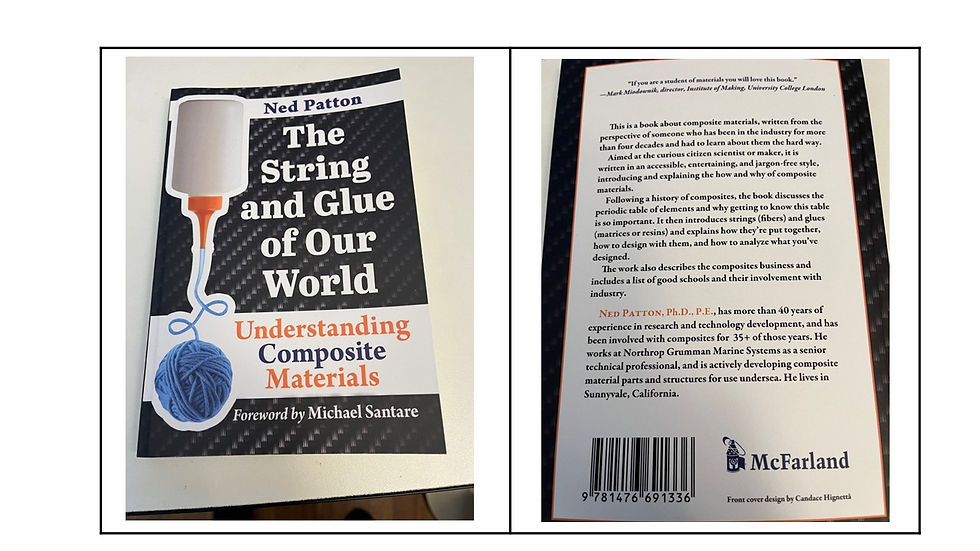
Last but not least, I still need to plug my first book. “The String and Glue of our World” pretty much covers the watershed in composites, starting with a brief history of composites, then introducing the Periodic Table and why Carbon is such an important and interesting element.
Both books are available both on Amazon and from McFarland Books – my publisher. However, the best place to get one is to go to my website and buy one. So, I will send you a signed copy of either or both books for the same price you would get charged on Amazon for an unsigned one, except that I have to charge for shipping. Just go to the link to the product page on my website (https://www.nedpatton.com/product-page) and order either book. And as usual, here are pictures of the covers of both books.


Comments