Recycled Carbon Fiber Use in the Clean and Renewable Energy Business

I saw an announcement in Composites World that was repeated in JEC about the use of recycled carbon fiber in the clean energy industry. Gen 2 Carbon (Coseley, UK) and Americarb (Niagara Falls) have inked an agreement to use Gen 2’s recycled carbon fiber in applications that Americarb is pursuing in the green energy (renewable energy) business.

Predominantly these recycled fibers are going into Lithium ion battery anodes, flow and metal-air batteries, fuel cells, and multifunctional materials that store energy when load is applied to them. Apparently the way this is going to work is that Gen 2 Carbon is collecting and recycling the carbon fiber from used carbon fiber parts. Their specialty is converting used carbon fiber into new nonwoven intermediate carbon fiber sheet goods ready to be used by a composites fabricator that specializes in use of recycled carbon fiber. That’s where Americarb comes into the picture. Their specialty is actually in carbon carbon composites as well as high temperature carbon fiber composites, so they are used to dealing with somewhat more challenging fiber precursors and challenging to make end products.
I put this pic of a wind turbine up first just to show another application where recycled carbon fiber is beginning to turn up in a renewable energy industry. The demand for carbon fiber in the wind industry is extraordinary and is expected to grow to outstrip the global supply of carbon fiber by the mid-2030’s. So a lot of wind turbine manufacturers are looking to the recycled carbon fiber industry to source fiber for their next generation wind turbine blades.

Back to Gen 2 Carbon and Americarb. They very recently (last week) announced this strategic partnership on LinkedIn, and both JEC and Composites World picked up on it immediately. Both of these companies have formed these strategic partnerships in the past, so this isn’t so much new news as it is a completely different application of recycled carbon fiber from what has been the story in the past. We have seen recycled carbon fiber used mostly for niche applications or lower performance applications to date. Things like race car bodies, automotive interior parts and body panels, aircraft interiors, wind turbine blades, mixed into concrete, and the sporting goods and electronics industries. In all cases previously, these have not been for primary structure or primary high performance parts. Fortunately, some of those applications, like in the automotive industry, are high volume (read as high tonnage) applications so their demand for quantity of product is high, especially if they can get it for less money per pound. That is the primary driver for recycled fiber to be used in the applications it has been used it to date.


This new strategic partnership is going to produce products at a much higher level of performance than most of the previous applications of recycled carbon fibers, albeit quite a bit lower tonnage than the lower performance parts made for the automotive industry and wind turbine blades. This is very encouraging and may start the actual application of recycled fibers in high performance structural parts. It will, however, be some time before the aerospace industry accepts recycled fiber for primary structure, mostly for passenger safety reasons.
Apologies for jumping around a bit in this post, but I want to get back to other uses of recycled carbon fiber in the renewable energy business. Specifically I want to talk a little bit about the use of recycled carbon fiber in manufacturing of new wind turbine blades. While this has been talked about, and even studied quite a bit, there have to date been no commercially viable uses of recycled carbon fiber in wind turbine blades.
That picture will change in the not too distant future. There is a company in Englewood Colorado, Faraday Technology Inc. that has partnered with Washington State University to get a DOE SBIR award to use their proprietary electrochemical carbon composite recycling process to recycle the carbon fiber parts of used wind turbine blades. The recovered fiber retains nearly 100% of its original strength and stiffness, making it applicable for forming into new wind turbine blade parts. That is the end result that Faraday is shooting for with their SBIR awards.
Mostly this fiber will be going into the shear webs that with the spar caps make up the box beam structure down the center of the wind turbine blade. The spar caps (parts on the front and back side of the box beam) are still made using continuous virgin fiber, because the spar caps take all of the tensile and bending loads on the blades. Faraday Technology is focusing on the rest of the structure of the main spar with their recycled carbon fiber since they have been able to produce viable fiber for a considerably lower cost than virgin fiber, and it is in a form that can be applied directly to the shear web of the box beam structure of the central spar of a wind turbine blade.
They won two 2024 DOE Phase I SBIR awards, and have converted them to one Phase II award that is scaling up their successful demonstration in Phase I. This second phase is worth a tad over a million dollars, so there is the chance that if they find the right commercialization partner this thing might be successful. Faraday Technology has worked with GE in the past on some of their other electromechanical and power generation and conversion electronics products, so maybe, given that they are successful in Phase II, they can work with GE again to commercialize their results. The market is certainly ripe for a lower cost and easily available source of high quality carbon fiber that is completely sustainable because it comes from used blades. So while it has not been announced yet, you can probably bet money on the fact that GE Energy is going to pick up on the results of the Faraday Technology Phase II SBIR.
Finally, I wanted to comment on a conversation I had with a researcher at the National Composites Center in the UK (NCCUK) when I attended the International Conference on Composite Materials in Baltimore a few weeks back. This researcher, Monali Dahale, gave a presentation about the CEAMS project (Center of Expertise in Advanced Materials and Sustainability) which is a collaboration between NCCUK, the University of Manchester, the National Physical Laboratory, CPI (commercialization specialists), the Henry Royce Institute, and the Rochdale Development Agency. The collaborative project is funded by a grant from the UK Government, Innovate UK, and a number of other funding agencies, and was formed primarily to assist startup companies or multinational corporations in the transition to the use of sustainable materials. The group I talked to is almost entirely focused on sustainable composite materials, and our conversation was fairly wide ranging as I’m sure you can imagine.
My intent in bringing this up now is that I am working with them to bring their story and the results of their studies and research to more of a US audience, since most of their audience is currently in the UK with some other EU participation. Since the work that they have done is directly relevant not only to what I post in this newsletter but also is the subject of my second book, it’s a fairly natural communications link for me to form.
That’s about it for this week. As always, I hope everyone that reads these posts enjoys them as much as I enjoy writing them. I will post this first on my website – www.nedpatton.com – and then on LinkedIn. And if anyone wants to provide comments to this, I welcome them with open arms. Comments, criticisms, etc. are all quite welcome. I really do want to engage in a conversation with all of you about composites because we can learn so much from each other as long as we share our own perspectives. And that is especially true of the companies and research institutions that I mention in these posts. The more we communicate the message the better we will be able to effect the changes in the industry that are needed.
My second book, which may be out late this year but more likely fairly early next year, is a roadmap to a circular and sustainable business model for the industry which I hope that at least at some level the industry will follow. It looks like the CEAMS project at NCCUK might be one of the first. Only time will tell. At least McFarland announced it in their Fall Catalog. And this time it is under a bit different category – Science and Technology. Maybe it will get noticed and people will be interested enough to buy it but as always that is just a crap shoot.
As I have said before, my publisher and my daughter have come to an agreement about the cover. So, I’ve included the approved cover at the end of this post. Let me know whether or not you like the cover. Hopefully people will like it enough and will be interested enough in composites sustainability that they will buy it. And of course I hope that they read it and get engaged. We need all the help we can get.
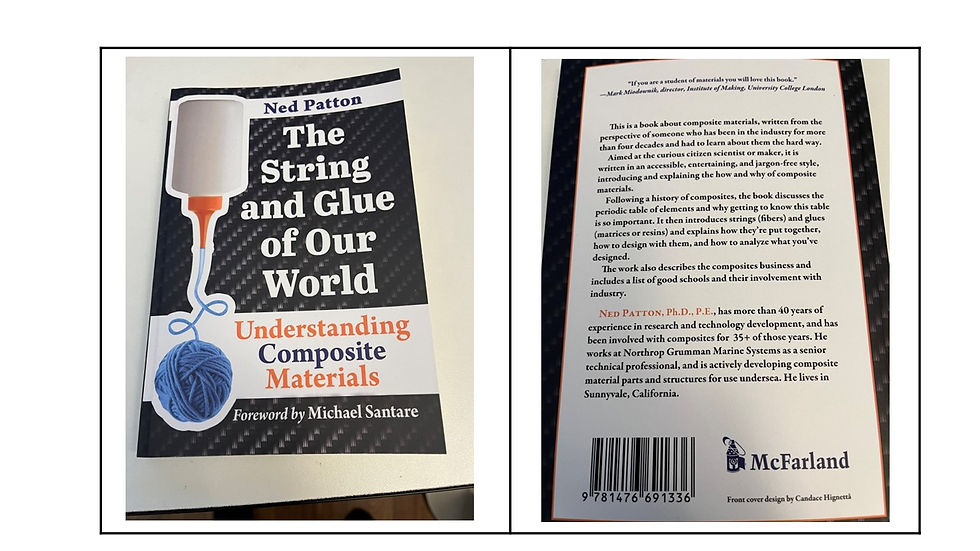
Last but not least, I still need to plug my first book. “The String and Glue of our World” pretty much covers the watershed in composites, starting with a brief history of composites, then introducing the Periodic Table and why Carbon is such an important and interesting element. The book was published and made available August of 2023 and is available both on Amazon and from McFarland Books – my publisher. However, the best place to get one is to go to my website and buy one. I will send you a signed copy for the same price you would get charged on Amazon for an unsigned one, except that I have to charge for shipping. Anyway, here’s the link to get your signed copy: https://www.nedpatton.com/product-page/the-string-and-glue-of-our-world-signed-copy. And as usual, here are pictures of the covers of both books.


Comments