Natural Fibers and Racing Sailboats – How Much Fun is That?

I saw an article in Composites World this week about a flax fiber boat manufacturer I wrote about two and a half years ago – Greenboats – that has been building recreational sailboat hulls since about 2020 using flax fiber. They source their flax of course from France which grows more of this stuff than any other country in Europe. Anyway, the article is about a strategic partnership between the International Laser Class Association (ILCA) and Greenboats GmBH to develop a sustainable ILCA concept boat that uses natural fiber and potentially bio-based resins to introduce to this international racing dinghy class.

Those of you that have been reading my posts for a while will probably understand why I picked up on this. I have owned several of what are called “sailing dinghies” in the sailboat world and even tried once to keep up with one of these things. I didn’t stand a chance, the Laser left me in its wake. Those things are fast in the hands of an experienced sailor.
In any case, the Laser has been an Olympic Class racing dinghy for almost three decades at this point, and the article this pic is from talks about the intense competition in this particular class of racing. It is probably the most competitive class racer in the sailing dinghy racing circuit. So, having a natural fiber sailboat hull builder form an alliance with the class association that tightly controls all things about dimensions, weights, permitted rigging, etc. is a really big deal in the racing dinghy world. The rules for construction and the weights of all of the boats with all of their rigging has to be within just a few pounds of the standard. And there are only certain rigs and hardware that are allowed for the boat to qualify to be in a Class sanctioned race. Changing from glass fiber to flax fiber is going to be a big deal because the entire hull which is all fiberglass is only 130 pounds. The same amount of composite using flax fiber would be less than 100 pounds. Clearly they have got a lot of work to do to get flax fiber boats qualified, but they should be given credit for launching into this to make the ILCA boats more sustainable.
This post of course got me thinking about sustainable materials being applied to the sailboat industry, both here in the US and in Europe. Greenboats may be the first to delve into the international dinghy class racing world, but they are not the first to build a sailboat hull out of flax fiber. That milestone may be attributed to a company that I have written about in previous posts, Huntsman Corporation. Huntsman, headquartered right outside of Houstin, Texas, is a specialty chemicals company that is one of the largest in the world, mostly through mergers and acquisitions. In 1994 they acquired Texaco Specialty Chemicals, and in 1999 acquired Imperial Chemical Industries’ urethane, aromatics, and petrochemical business. And in 2006 they acquired the specialty chemicals business of Ciba Geigy in Basel, Switzerland, creating Huntsman Advanced Materials.

It is this Advanced Materials business that has sharpened their focus on sustainability, especially in their composite materials business. They market a 50% flax fiber / epoxy material that they call Araldite that was used to build a 6.5 meter (21 foot) racing sloop. They have since gone on to build several more different boats for different classes of ocean racers and have had good success on the ocean racing circuit. They have also introduced bio-based adhesives along with their natural fiber composite offerings, all under the Araldite brand name. The pic above is from an article about the use of paste epoxy adhesives in racing sailboat construction and repair.

This 40 foot racing sailboat, the Crosscall, won the Class 40 championships in June of 2022. Class 40 sailboats are some of the lightest and yet most rugged racing sailboats on the ocean and are designed and built to handle very extreme conditions. The yacht designers wanted to use as much flax fiber as possible on their new creation but were concerned about the structural limitations that they perceived of using flax. They realized that the cockpit of the boat was not necessarily a structural element of the hull they decided to go all in on flax fiber for the cockpit. And they also decided to use a partly plant-oil based, low toxicity resin from Sicomin to glue the flax fiber together. They used a resin infusion process – most probably vacuum infusion similar to the SCRIMP process – to make the hull in one piece and the hybrid deck with the flax fiber cockpit section also in one piece and infuse both with the Sicomin resin. The flax fiber cockpit of course saved them considerable weight above the center of buoyancy of the boat which is a distinct advantage in a racing sailboat when you need to beat as hard to windward as you can. If the boat is heavier above the center of buoyancy you need more ballast in the keel to keep it upright. This of course slows down the boat. And that isn’t a great way to win sailboat races.

Baltic Yachts, another yacht builder that builds considerably larger yachts than what Greenboats makes or of the Class 40 design Crosscall, has also taken on the challenge of building sustainable larger yachts that have a low carbon footprint. And they have done this not only with the materials that they use to make their hulls and decks they have also adopted electric and hybrid auxiliary engines for their yachts.

Baltic uses a flax fiber fabric from Bcomp for 50% of the reinforcement in their hulls and decks, making the boat significantly lighter and much more able to sail in lighter air (slower wind speeds for you land lubbers) than some other yachts this size. They used flax in combination with carbon fiber to provide a bit more flexibility and resilience in the hull as well as using it for its sound deadening properties, so they did not have to add any sound deadening materials to the interior of their carbon fiber hulls. Baltic even went so far as to do away with the typical teak decks and used cork instead which is an entirely sustainable material because it is from the outer layers of bark of a cork oak tree. Harvesting cork does not damage the tree, and the cork itself can breathe just enough to make it indispensable as a material to “cork” fine wines with. The cork oak trees grow in southwest Europe and northwest Africa and has been used for many purposes for millennia. Baltic has gone all in on sustainability on the design of the Café Racer 68 with solar panels to charge the batteries and run the HVAC system for the passengers, what they call hydrogeneration which I imagine is a propellor driven electrical generator for charging the batteries, two 15 kw electric propulsion motors, and just a small low emission gas turbine as a range extender.

One last boat I want to mention here is from Outremer which is a large multihull sailboat manufacturer. Their new Outremer 60 was designed from the ground up to not only be sustainable, but to also sail well in light air. This boat is 60 feet long and will actually sail in as little as a 5 knot breeze, which is about half the wind speed it takes for your typical large yacht. And since it is a multihull, it also is capable of standing up to some of the more extreme conditions that one might see in an Atlantic crossing. And Outremer has also installed closed loop auxiliary propulsion systems that can replenish while on the way, much in the same manner as Baltic’s electric propulsion system with its small hydrogenator and solar panels to keep the batteries charged for when they are needed.
So, from what I see, natural fibers, especially flax fiber, have made it into the mainstream of sailboat production in a significant way. All the way from the little one man Laser to a 60 foot catamaran, sustainable flax fiber has made a major impact on the sailing world.
That’s about it for this week’s post. If you haven’t all figured it out yet, I’m a big fan of sailboats and also windmills. I also have serious concerns about our ability to slow down or even reverse the human-caused warming of the planet. Our very survival may depend on it. As always, I hope everyone that reads these posts enjoys them as much as I enjoy writing them. And I hope people who are interested find something they can use in their lives or at least some ideas that they might be able to put into practice. At least I hope that these make people think a bit about sustainability and some of the major issues looming before us.
I will post this first on my website – www.nedpatton.com – and then on LinkedIn. And if anyone wants to provide comments to this, I welcome them with open arms. Comments, criticisms, etc. are all quite welcome. I really do want to engage in a conversation with all of you about composites because we can learn so much from each other as long as we share our own perspectives. And that is especially true of the companies and research institutions that I mention in these posts. The more we communicate the message the better we will be able to effect the changes in the industry that are needed.
My second book, which will be out sometime next year, is a roadmap to a circular and sustainable business model for the industry which I hope that at least at some level the industry will follow. Only time will tell. At least McFarland announced it in their Fall Catalog. And this time it is under a bit different category – Science and Technology. Maybe it will get noticed – as always that is just a crap shoot.
As I have said before, my publisher and my daughter have come to an agreement about the cover. So, I’ve included the approved cover at the end of this post. Let me know whether or not you like the cover. Hopefully people will like it enough and will be interested enough in composites sustainability that they will buy it. And of course I hope that they read it and get engaged. We need all the help we can get.
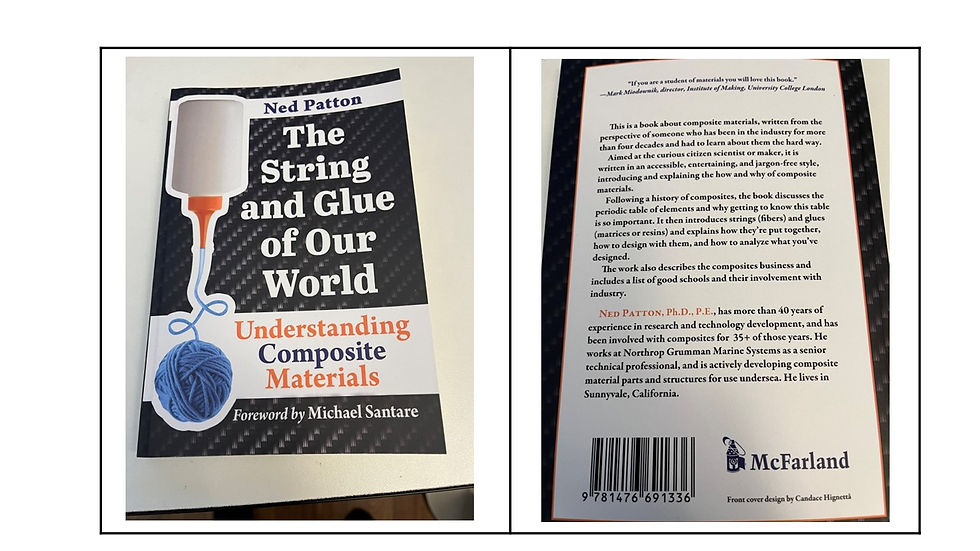
Last but not least, I still need to plug my first book. “The String and Glue of our World” pretty much covers the watershed in composites, starting with a brief history of composites, then introducing the Periodic Table and why Carbon is such an important and interesting element. The book was published and made available August of 2023 and is available both on Amazon and from McFarland Books – my publisher. However, the best place to get one is to go to my website and buy one. I will send you a signed copy for the same price you would get charged on Amazon for an unsigned one, except that I have to charge for shipping. Anyway, here’s the link to get your signed copy: https://www.nedpatton.com/product-page/the-string-and-glue-of-our-world-signed-copy. And as usual, here are pictures of the covers of both books.


Comments