Natural Fibers and Circularity in the Auto Industry

This week I thought I would highlight one of the things I touched on in my second book and also expand a bit on a theme I brought up a few months ago. The idea is that there is a growing trend in the auto industry to make their products more environmentally friendly as well as easier to recycle when the auto is used up. This theme is a recurring one in many industries, but since the auto industry uses such a wide variety of materials in every car that they make, and since they make on the order of a million copies a year of certain models, this is one of the higher tonnage waste problems that we need to tackle, probably second only to wind turbine blades.

It was nice of the Porsche people to leave a lot of the bodywork on this Cayman 718 GT4 CS MR that was raced at the 24 hour Nürburgring race in 2019 unpainted and in its natural state. Porsche made this body using flax fiber composites from Bcomp for a number of reasons, and not only just to make a statement about their commitment to recyclable body parts for their race cars. It turns out that this body is lighter weight than the fiberglass bodywork that they had traditionally used and is as strong and stiff where it needs to be as a carbon fiber body that they had also made for their race cars. The great thing about this is that the Bcomp product that they used can be fairly easily recycled since the Bcomp Amplitex prepreg fabric that makes up the body of this car is flax fiber with a polypropylene thermoplastic matrix.
Since this pic was taken, Porsche, through its collaboration with Bcomp, has developed a complete flax fiber body kit for the autosports version of their Cayman 718 GT4. This is at least partially due to the fact that the Bcomp Amplitex material is a flax fiber / polypropylene prepreg that processes in a manner consistent with the current thermoplastic composite molding machinery that is used to make their thermoplastic composite body panels.

And not to be outdone, BMW has also stepped up to the plate and has started incorporating flax fiber composites into their motorsport lineup as well. This is the rear end of a BMW M4 GT with a flax fiber composite body. BMW has implemented this in a few of their high end motorsport lines in much the same way that Porsche has, so it is apparent that the German auto industry is very interested in the sustainability and circularity of their products and are spending their own resources to make this happen. Of course, since France and Belgium are the big dogs in the flax fiber business since more is grown in these two countries than anywhere else, this isn’t such a stretch for the German auto industry, since these countries are all part of the EU.
But what about the rest of the industry? As it turns out most of the cars made today both in Europe and in the US use natural fiber in quite a bit of the parts of the car that you really don’t see.

Every part that you see here that isn’t in the car is made using composites, and a lot of it is natural fiber composite. Headliners, door panels, trunk liners, floor liners, seat cushions, dash parts, fender wells, all of this stuff either is or can be made using natural fiber composites. And even though this is a Mercedes, this picture could have been taken using nearly any make or model car that is produced today either in Europe or the US.
And, increasingly natural fibers are making it into the automotive world not only because of recycling and reuse benefits, but also for the aesthetic benefits of natural fibers like flax, as least according to a February 2023 article in the International Fiber Journal (https://www.fiberjournal.com/natural-fibers-the-new-fashion-in-automotive-composites/). We have seen dash elements in some higher end sports cars and body work on Porsches and BMWs, but also in some of the interiors of other luxury brands where the warmth of wood is being replaced by the warmth and warm color tones of natural fibers.

These fabrics and materials have a very warm look to them that make them a nice replacement for what used to be wood in some car interiors. And it isn’t just the European cars that are using this stuff, there is a competing product here in the US with Hexcel’s Nature Range flax fiber fabric that also can come as a prepreg product to be directly applied to the automotive market here in the US. Of course, since Hexcel is one of the larger international producers of composite prepregs, carbon fiber, and all other things composite, this product is available and in use worldwide.
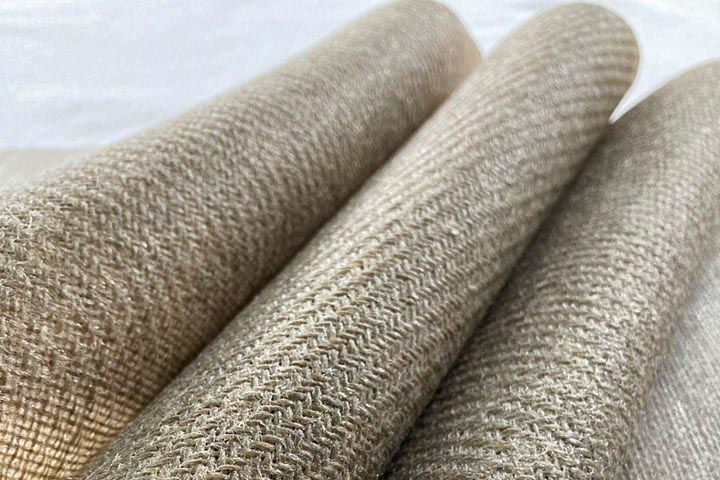
The use of natural fiber materials and natural fiber composite in automotive interiors was fairly recently described in a review article by some researchers in South Africa in the March 2024 issue of the “International Journal of Engineering Trends and Technology” (https://doi.org/10.14445/22315381/IJETT-V72I3P109). These researchers talk initially about the impetus to move toward natural and inherently sustainable and recyclable composite materials for auto interior panels primarily from the perspective of what happens to these panels at the end of life of the car they were in. Mostly they are incinerated and since they have to date mostly been plastics made using petroleum precursors, this is not only wasteful it also causes quite a bit of pollution in the local area where they are incinerated. The incineration products can also be toxic because of the nature of the plastics and what they are made of.
Natural fibers all but eliminate the incineration problem because, as these researchers report, they are not normally incinerated at end of life and since they are inherently biodegradable they also break down rather quickly in landfills and return their carbon to the local soils without adding any toxic chemistry.
These researchers also bring up some of the drawbacks of natural fibers in that since they do biodegrade rather easily, they are susceptible to molds, rotting from excessive moisture if they are exposed, and are more susceptible to UV degradation from the sun than are some other man-made materials.
Fortunately there are mitigation methods to all of these drawbacks that are fairly easy to implement in the high volume industrial settings of the automotive manufacturing industry. So, expect to see more application of these materials to your next new car, whether you can see the fiber as in the Porsche and BMW body panels, or the ones you can’t see like the insulation in your interior door panels as well as the structure of the panels themselves, and maybe even your trunk liner. And since natural fibers and natural fiber composites allow the auto manufacturers to not only save both weight and cost, they also help these manufacturers meet regulatory sustainability and recyclability targets set by governments, we are all going to increasingly see these materials make their way into the non-structural parts of cars of the future.
So, that’s it for this week’s post. As always, I hope everyone that reads these posts enjoys them as much as I enjoy writing them. And I hope people who are interested find something they can use in their lives or at least some ideas that they might be able to put into practice. At least I hope that these make people think a bit about sustainability and some of the major issues looming before us.
For those of you that have been following me on my orthopedic journey, the recovery from a total hip replacement is really not that bad. My bandage came off 7 days after my surgery, and over the first weekend after surgery (4-5 days) I was already starting to be able to dress myself without trouble and move around with little difficulty. In other words, if you are anything like me and you have worn out a hip or a knee joint, and you are at the age where the replacement won’t wear out before you’re gone, I highly recommend just getting it done.
I will post this first on my updated website – www.nedpatton.com – and then on LinkedIn. And if anyone wants to provide comments to this, I welcome them with open arms. Comments, criticisms, etc. are all quite welcome. I really do want to engage in a conversation with all of you about composites because we can learn so much from each other as long as we share our own perspectives. And that is especially true of the companies and research institutions that I mention in these posts. The more we communicate the message the better we will be able to effect the changes in the industry that are needed.
My second book, which is coming out in a week or two, is a roadmap to a circular and sustainable business model for the industry which I hope that at least at some level the industry will follow. Only time will tell. Maybe it will get noticed – as always that is just a crap shoot. As far as schedule is concerned, I got a message from my publisher on Friday (March 13) asking about one last little nit about figure captions which I answered. This is apparently the last question they needed answered before the book goes to the printer. So my expectation is that the printer will have it next week, and I may have my first copies in another week. Let’s just say that would be a very nice birthday present for me because my birthday is in about a week from the time I post this. As usual, I’ve included the approved cover at the end of this post. Let me know whether or not you like the cover. Hopefully people will like it enough and will be interested enough in composites sustainability that they will buy it. And of course I hope that they read it and get engaged. We need all the help we can get.
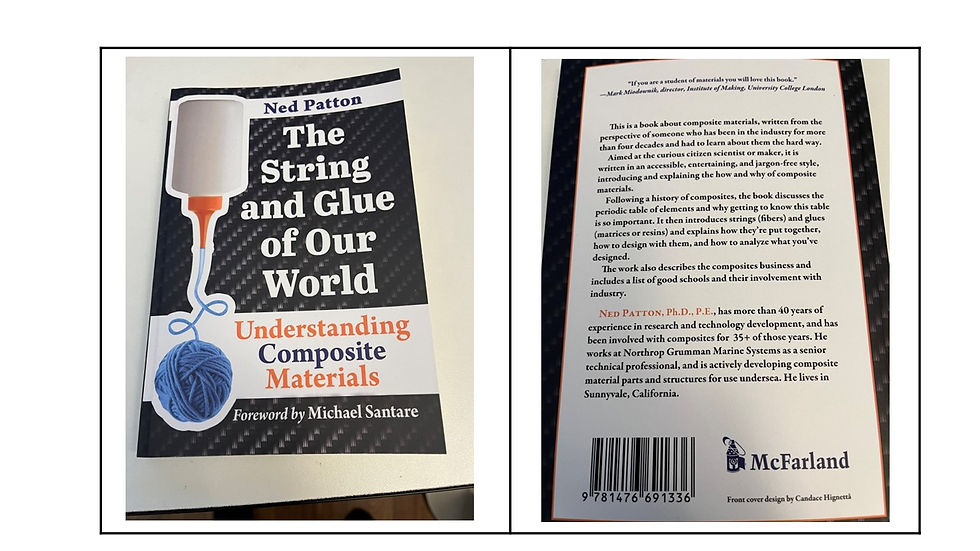
Last but not least, I still need to plug my first book. “The String and Glue of our World” pretty much covers the watershed in composites, starting with a brief history of composites, then introducing the Periodic Table and why Carbon is such an important and interesting element. The book was published and made available August of 2023 and is available both on Amazon and from McFarland Books – my publisher. However, the best place to get one is to go to my website and buy one. I will send you a signed copy for the same price you would get charged on Amazon for an unsigned one, except that I have to charge for shipping. Anyway, here’s the link to get your signed copy: https://www.nedpatton.com/product-page/the-string-and-glue-of-our-world-signed-copy. And as usual, here are pictures of the covers of both books.


Comments