Having a Stroke Sucks Big Time – It’s Good I Eat the Way I Eat and Exercise

Well, it finally did happen. As they say, getting old ain’t for sissies. And it isn’t for those that have not kept up fitness for most of their lives and also who eat a standard American diet rather than a more nutritious (Nutritarian?) diet.

Although this is not exactly what happened to me, it’s fairly indicative of what can happen. And, I did have a fairly major one and ended up in the hospital for almost a week. Had a complete blockage of my right rear parietal vein that killed that lower right hand rear side of my brain. Primarily this is the area than handles proprioception, so I don’t walk quite as well as I used to. But fortunately this is completely recoverable, and I am back at work already and can still do the math. And I am actually getting pretty close to being able to do most of the things that I used to do. I’m actually very lucky. I was told that someone that had not been an athlete their entire lives and had not been on a nutritarian diet would probably either been permanently disabled or died.
I guess for those that haven’t been initiated into this rite a decent explanation is in order. Everyone has a couple of large arteries in the front of their neck and a big one in the back that splits into two somewhat smaller ones. The ones in the front feed the frontal portion of your brain that has most of the gray matter up there and affect both the left and right frontal hemispheres of your brain. This is where most of the logic processing, memory, math, most of the logic for how you process what you need for your fine motor skills for things that you have to make decisions for that you do with your hands – the thinking part of the brain.
The rear artery that splits into the left and right parietal arteries handles the more basic things like balance, coordination, proprioception, basic motor skills, mostly the things you don’t usually have to think about, they just happen. The right handles mostly proprioception and the left handles mostly all of the other stuff. This is the part of the brain that you teach when you are learning a new skill like dancing or gymnastics, or even that great golf shot. These are the things that come “naturally” to you, and you hardly ever give them a thought.
Until that is when they cease working. And that is what happened to me on an early Friday morning a few weeks ago. But, while I did want to talk about that a little bit to let everyone know, that is not the primary subject of this newsletter.
The hospital was amazing, as well as all of the nurses – they were some of the nicest and most helpful people I have ever met. I don’t think enough has been written about how hard their job really is and what care they take with every patient. Takes a very special person. The folks at UCSD deserve all the credit I can give them and more. I had some of the best and most helpful people handling my case, from the nurse’s aides all the way up to the top doc. They all worked as a team and gave me all the attention I needed.

This is, however, a blog about composites, so I need to get back to that. I’ve shown this picture before, but I thought that I would get back to it because it is the thing I have a tendency to write about a lot. That is – sustainability in composites and the ability to move from petroleum for the critical and high tonnage materials that we need in the future to agriculture. What you see here is food for the masses and a whole lot of useful fiber and resin content in the stalks and leaves of the corn. This means food for the people and raw materials for our industrial economy.
And of course, it all starts with us effectively recycling what we use today as we integrate more plant based materials into the supply chain. While I clearly understand that there will be a somewhat lengthy transition from the petroleum based to the plant based industrial economy, what I have really advocated for now for some time is for everyone in the industry to get started on their part in this transition.
Fortunately, I have seen quite a transformation in the industry over the last several years. When I first started writing about this, there were very few examples of sustainable composites or companies that were even focused on sustainability. Today it takes more than two hands to list the established companies that have made great strides including significant investments in transitioning their businesses over to plants from petrochemicals. The large research labs in all of the established composites companies, fiber producers (Toray, Hexcel, Syensqo, Teijin, Mitsubishi, SGL, the list goes on) and resin producers (again Toray and Hexcel but also Solvay, Hexion, Arkema, and even Dow Chemical and what they have become) all are working with resins from plants as well as deriving other useful chemicals that they can incorporate into their processes.

And, on top of that, the composite material recycling business has now become the standard. Composite materials are much less likely to end up in a landfill today than they were even 5 years ago, much less 10. This picture is actually fairly old at this point because Composite Recycling is now a mainstream company and has signed on to a consortium headed by Beneteau that recycles all fiberglass boats and even wind turbine blades in Europe into materials that are very useful in all sorts of products. Some of the recycled material is used in place of virgin fiber and resin to make new things like wind turbine blades and new fiberglass boats. This was almost unheard of 10 years ago.
But, my work is still cut out for me, so I am going to go back to writing and speaking about this as regularly as I can. Needless to say I did have a wake up call, but it appears that things are going to be OK and I can put effort back into this and try to help make a difference. At least that is my intent. So the blog starts again, and I will be back again next week after this long hiatus with new stuff and some new messages for everyone. I intend to dig into this stuff again and see what I can bring to the surface. So stay tuned.
So, this is the end of another post which I hope will continue for as long as I’m able to keep writing them. As always, I hope everyone that reads these posts gets at least something out of them. I know that writing them is a bit cathartic for me and I get a lot out of doing the research and bringing the latest stuff to you.
And, again, I hope people who are interested find something they can use in their lives or at least some ideas that they might be able to put into practice. At least I hope that these make people think a bit about sustainability and some of the major issues looming before us.
For logistics, I will post this first on my updated website – www.nedpatton.com – and then on LinkedIn. And if anyone wants to provide comments to this, I welcome them with open arms. Comments, criticisms, etc. are all quite welcome. I really do want to engage in a conversation with all of you about composites because we can learn so much from each other as long as we share our own perspectives. And that is especially true of the companies and research institutions that I mention in these posts. The more we communicate the message the better we will be able to effect the changes in the industry that are needed.
My second book, which was officially released on April 6, is a roadmap to a circular and sustainable business model for the industry which I hope that at least at some level the industry will follow. Only time will tell. Maybe it will get noticed – as always that is just a crap shoot. As far as schedule is concerned, I received my author copies last week, so the second pic is the cover of the actual book. I’ve included a picture of the cover at the end of this post. Let me know whether or not you like the cover. Hopefully people will like it enough and will be interested enough in composites sustainability that they will buy it. And of course I hope that they read it and get engaged. We need all the help we can get.
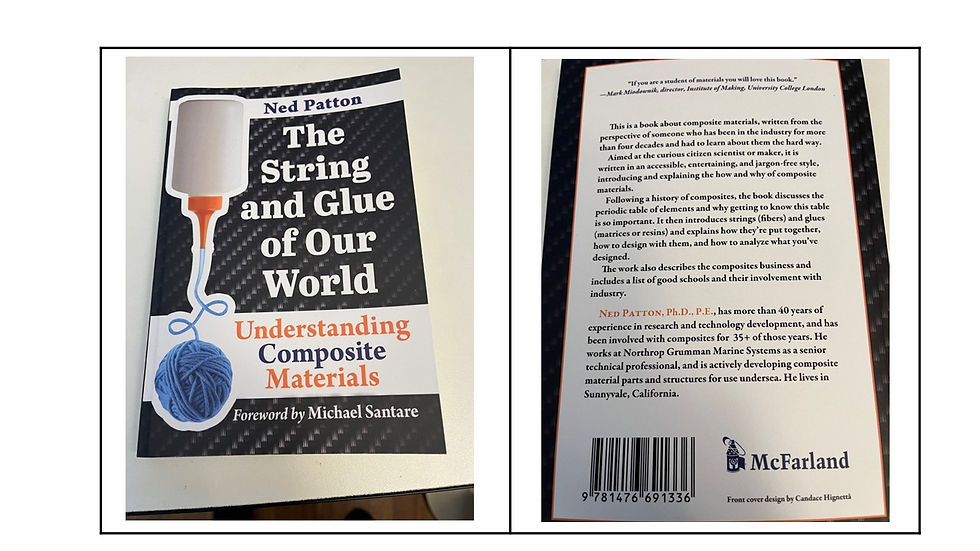
Last but not least, I still need to plug my first book. “The String and Glue of our World” pretty much covers the watershed in composites, starting with a brief history of composites, then introducing the Periodic Table and why Carbon is such an important and interesting element. The book was published and made available August of 2023 and is available both on Amazon and from McFarland Books – my publisher. However, the best place to get one is to go to my website and buy one.
So, I will send you a signed copy of either or both books for the same price you would get charged on Amazon for an unsigned one, except that I have to charge for shipping. Just go to the link to the product page on my website (https://www.nedpatton.com/product-page) and order either book. And as usual, here are pictures of the covers of both books.


Comments