Glass Fiber Composites in the Construction Industry

I thought for this week I would change course a little bit and talk about the construction industry and the application of composites to that industry. The thing that prompted this is an article in Composites World (12/1/2025) announcing that ACMA – The American Composites Manufacturers Association – has put out what they call a product category rule or PCR for fiberglass rebar. And for those of you that haven’t been around concrete construction before, this is the reinforcing bar that is used to reinforce poured concrete. While it is still most commonly steel, at least in the housing construction industry, since about 2000 we have seen an increase in the use of fiberglass rebar where there are concerns about corrosion of the steel over time. This is for marine piers, bridges, highways in areas where they salt the roads, etc. I have talked about this stuff even in fairly recent posts, like when I talked about basalt fiber and how it is stronger and stiffer than glass as well as being even more resistant to corrosion, albeit still more expensive than glass and not available in glass fiber quantities (total tonnage).

The article I read about the ACMA PCR demonstrates to me that composite rebar, and specifically fiberglass rebar, is finally coming of age here in the U.S. What this PCR provides is a standardized means of reporting environmental impacts of these products, so now the manufacturers of fiberglass rebar have a standard means of developing and reporting Environmental Product Declarations for their products. These statements or declarations are required for most Government funded infrastructure projects, as well as state and local governmental agencies that require environmental impact assessments to be filed in any major construction projects.
What this also means is that the manufacturers of these products now have a consistent set of rules that they can follow, as well as standards for how they manufacture their products and also maintain all of the documentation required to provide not only product performance and life expectancy information, but also now include the environmental impacts of their products, all on a consistent basis. This is a big step forward that will lead to widespread adoption of fiberglass rebar for all manner of infrastructure construction projects.
And being the curious person that I am, I decided to look into the history of fiberglass rebar, and also fiberglass structural shapes that are currently available and have become the material of choice for the upper floors of what used to be steel frame structures in skyscrapers. As it turns out, it all started at MIT in the 1950’s. If any of you are old enough to have been to Disneyland between 1957 and 1967, you might have seen and toured what is called Tomorrowland. I am old enough to remember this thing. The iconic Tomorrowland house (Monsanto House of the Future) was the first introduction of glass fiber reinforced plastics to primary structure in a building construction.

When Disneyland decided to demolish this house in 1968, apparently they originally took after it with a wrecking ball, thinking that it would be simple enough to take down, just like any other building. What a surprise when the wrecking ball merely bounced off of this thing. They ended up demolishing it by hand, but the foundation of the house (that pillar under the house) remains and is part of Tomorrowland to this day.
This was just the beginning of the story about fiberglass use in construction projects but it was a very clear demonstration of the strength and longevity of glass fiber reinforced composites. Since that time, and starting in the early 1980’s, glass fiber reinforcing bar or rebar as it is known, was being developed here in the U.S. as an alternative to steel rebar. This coincided with the development of more alkali resistant glass fibers (AR Glass) than the more commonly known E-Glass or electrical glass that is used for fiberglass boat hulls. The glass fiber manufacturers realized that the addition of zirconium oxide in the standard glass making process rendered the resulting fiber very resistant to alkali attack from Portland cement. Initially, just this fiber itself, most probably in chopped fiber form, was used to reinforce concrete allowing for a thinner and lighter weight concrete than the steel reinforced standard in the construction industry. Then in 1984, Houston-based Kordec, led by a polymer expert by the name of Leroy Heston, introduced what he called Kodiak fiberglass rebar. Leroy initially created the stuff and introduced it to the market, presumably for offshore infrastructure since he is located in Houston. The company went through very extensive testing of their product, finally culminating in a standard published by the American Concrete Institute – ACI 440. This standard provides the engineers and designers of corrosion resistant reinforced concrete infrastructure a means to certify their design with fiber reinforced polymer rebar to a U.S. industry standard.
The very first bridge that used all fiberglass rebar was built in 1996 over Buffalo Creek in McKinley, West Virginia. This bridge infrastructure project used Kodiak FRP rebar as the only concrete reinforcement in its construction and is still in use and in good repair to this day.

Since that time, there has been quite a bit of development of the technology and a number of companies are in the business of making and selling fiberglass rebar. While many of the newer entrants to this field have gone with a somewhat less expensive albeit still corrosion resistant glass (E-CR glass which is just boron free E-Glass) than what Kodiak uses, Kodiak is still the market leader in the large infrastructure FRP rebar business. This is because when Leroy Heston first developed this product he recognized that he needed not only an alkali resistant glass, he also needed a resin system that was compatible not only with the corrosion resistant glass fiber but also was very resistant to alkali attack. He settled on a Vinyl-Ester / Epoxy mix that had the right set of properties to make it amenable to high rate production while also being strong, fatigue resistant, and made a good bond with the Portland cement in concrete.
Today you can buy this product, as well as FRP rebar from Greenbar (pictured at the beginning of this post), IKK Mateenbar (Pultron Composites in New Zealand), Dextra Group in Thailand which was formed by French expats, and a few others that are either material suppliers to these companies (Owens Corning, Johns Manville, Saint-Gobain) or are more niche players like MRG Composites and Electech Industries. There are even a few products that have a silicon dioxide coating applied to them just to ensure that there is a strong chemical bond between the rebar and the Portland cement to go along with the mechanical bond that is formed because of the helical ridges on the rebar.
And in case you are interested or thinking about your own home building construction, Home Depot and Lowes sell FRP rebar that you can buy. I took a look at what Home Depot has for sale and it appears that their main product is Greenbar. They sell it for about the same price as steel rebar, so the manufacturing technology for making this stuff has come a very long way in a very short span of time. Steel rebar is pretty cheap because it is made using about the least expensive (cheapest) grade of steel you can buy. And they make this stuff by the mile and sell it by the foot. Having a composite product that is higher performance than the equivalent steel product at the same price per foot has basically transformed this industry.
The same is true of fiberglass structural shapes that can replace their steel equivalents at the same cost and half the weight. I have mentioned this in previous posts, and this material also is transforming the construction of very tall buildings to bring the overall weight of the upper floors down so that these very tall buildings can withstand hurricanes and earthquakes. So, since I have one more post to write this year, I think I will leave a deep dive into the fiberglass structural shape business and its history for next week.
So, that’s it for this week’s post. As always, I hope everyone that reads these posts enjoys them as much as I enjoy writing them. And I hope people who are interested find something they can use in their lives or at least some ideas that they might be able to put into practice. At least I hope that these make people think a bit about sustainability and some of the major issues looming before us.
I will post this first on my website – www.nedpatton.com – and then on LinkedIn. And if anyone wants to provide comments to this, I welcome them with open arms. Comments, criticisms, etc. are all quite welcome. I really do want to engage in a conversation with all of you about composites because we can learn so much from each other as long as we share our own perspectives. And that is especially true of the companies and research institutions that I mention in these posts. The more we communicate the message the better we will be able to effect the changes in the industry that are needed.
My second book, which will be out sometime next year, is a roadmap to a circular and sustainable business model for the industry which I hope that at least at some level the industry will follow. Only time will tell. At least McFarland announced it in their Fall Catalog. And this time it is under a bit different category – Science and Technology. Maybe it will get noticed – as always that is just a crap shoot.
As I have said before, my publisher and my daughter have come to an agreement about the cover. So, I’ve included the approved cover at the end of this post. Let me know whether or not you like the cover. Hopefully people will like it enough and will be interested enough in composites sustainability that they will buy it. And of course I hope that they read it and get engaged. We need all the help we can get.
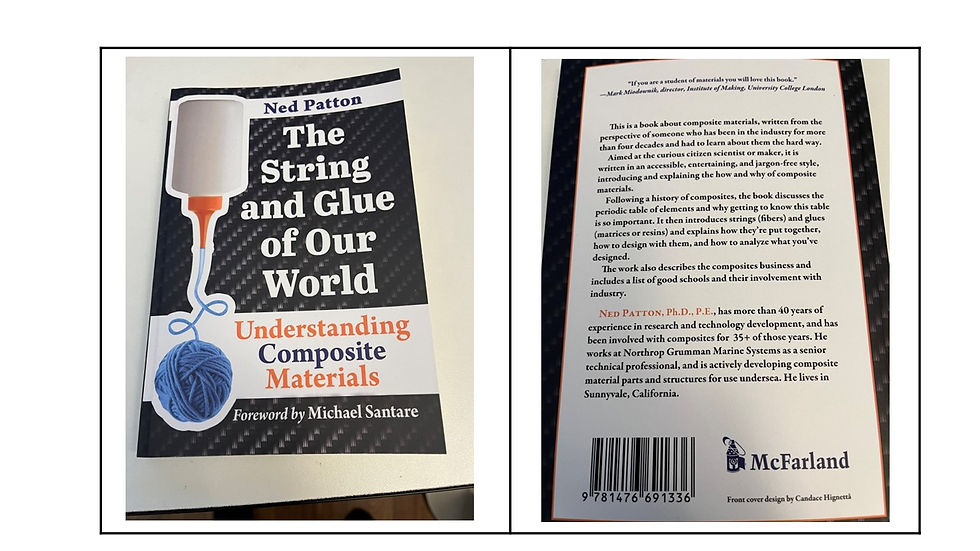
Last but not least, I still need to plug my first book. “The String and Glue of our World” pretty much covers the watershed in composites, starting with a brief history of composites, then introducing the Periodic Table and why Carbon is such an important and interesting element. The book was published and made available August of 2023 and is available both on Amazon and from McFarland Books – my publisher. However, the best place to get one is to go to my website and buy one. I will send you a signed copy for the same price you would get charged on Amazon for an unsigned one, except that I have to charge for shipping. Anyway, here’s the link to get your signed copy: https://www.nedpatton.com/product-page/the-string-and-glue-of-our-world-signed-copy. And as usual, here are pictures of the covers of both books.


Comments