Some Interesting News on the Recycling Front

I saw a very recent article in the news from Chemical Recycling about a new method of breaking down hard thermoset plastics very easily. What has happened is that a team of researchers from UT Austin, Sandia Albuquerque, along with the University of Illinois at Urbana-Champaign and MIT have developed a method using a Ruhenium catalyst and polydicyclopantadiene (sorry for the mouthful, common plastic used with fiberglass or carbon fibers) to break down this hard epoxy into constituents that allow them to be removed from the fibers.

They used a ruthenium-catalyzed ring-opening metathesis polymerization (ROMP) of this compound in which the polymer they were taking apart has a ring structure (benzene mostly) that was taken apart and converted into long chain hydrocarbons in the form of liquids. This process all happened at room temperature and pressure, so this is a new type of solvolysis that seems to work rather well. It left intact fibers and a liquid that could then be reprocessed into new resin. The UT-Sandia team then tried some other more environmentally friendly solvents than toluene or xylenes and had a similar result.
As far as carbon footprint goes, since this process does not burn or otherwise destroy the hydrocarbons and does not evolve CO2, it has a much lower carbon footprint like most other solvolysis techniques. The cost tradeoff is going to be to recover the ruthenium catalyst so it can be reused, but that appears to be a problem for tomorrow with the smart chemists that worked up this process. It is at least one of the more benign solvolysis processes out there and does not require process heat or pressure to make it work. And it is apparently fairly quick at room temperature, only taking less than a day to completely dissolve a good bit of resin. Still to be worked are using the newer solvent without the need for inert gases to avoid oxidizing the resin and affecting the solvolysis reaction as it progresses, but again progress is being made in this regard as well.

In the recycling arena, Composites UK has a new conference in Rotterdam on November 25 of this year where the entire conference is devoted to how composite waste can be “recovered, transformed and brought back into productive use.” The theme of this conference is “Turning Composite Waste into Value: Circularity and Market Adoption”. Of course I appreciate the fact that Composites UK is doing this which is what I have been advocating for a couple of years at this point.
The conference is being put on at the Advanced Manufacturing Research Center in Rotterdam, and will have participation from several organizations – National Composites Center (Bristol), University of Strathclyde, University of Nottingham, the Warwick Composites Group, University of Manchester, James Cropper, University of Sheffield/AMRC, Verretex, Imperial College London, National Physical Laboratory, RECOUP, Uplift 360, B&M Longworth, and the list goes on.
One of the key themes of this conference is going to be how they make the transition form the laboratory to commercial reality. This generally is the rub in these sorts of endeavors because demonstration in the laboratory while it take a long while is often difficult to scale. Laboratory settings are usually on the order of less than a pound of product and commonly do not focus on the economics of the process. More focus is on making the process work than turning it into a money making endeavor. This is unfortunately commonly the case when trying to scale up a process to unseat an incumbent that is using traditional raw materials to make their product.
Fortunately this conference is all about how we are going to scale all of these laboratory processes into meaningful tonnage, money making, low carbon footprint industries. And fortunately this is not only the major theme of this conference, it is also how this conference is organized. The perspective will be to consider the entire value chain from collection of the waste products from all composites industries and end users, learning how to efficiently and effectively sort and reprocess the materials, and what the entire value stream looks like from waste collection to finished high value added product.
The conference will collect manufacturers, recyclers, material suppliers, researchers, technology developers, and even end users to provide the entire value chain for recycled composites. The idea here is to develop a framework for a circular economy for composites that includes representatives from the entire value stream.
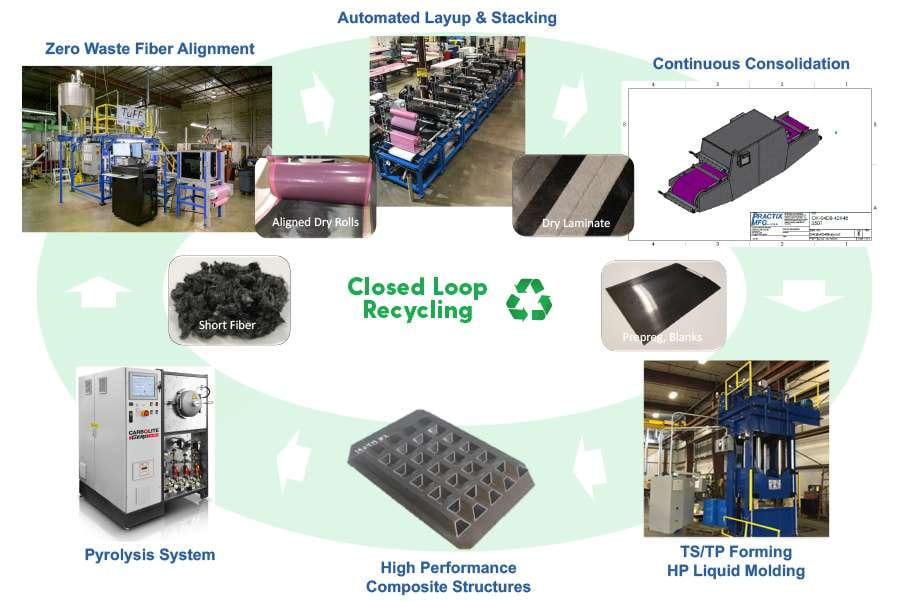
Finally for this week, I want to talk about what has been happening at the U of Delaware Center for Composite Materials since I graduated from there in 1991. CCM has always been one of the premier composites manufacturing institutions in the US certainly, and also in the world.
What this figure shows is the TuFF (Tailored Universal Feedstock for Forming) project at UD that is funded by DOE and is being performed in partnership with NREL, Arkema Chemical and Axiom Materials. Since it has this list of performers, this is another example of an organization that is actively developing a scalable, low cost, low carbon footprint, circular framework for recycling and reuse of composite materials.
Thi8s project is taking the TuFF process developed at U of Delaware for short fiber (recycled fiber is all fairly short), using a solvolysis process that dissolves the epoxy in acetic acid (epoxy acytolysis), and putting it with recycle-by-design acrylic thermoplastics to make new high value added high performance composite parts.
You can see from the pictures above that DOE funded this because they have a circular, sustainable path for quite a bit of their technology development funding. This is of course in an effort to reduce cost while scaling up fully industrial processes without evolution of CO2 and using an available waste stream to develop high value added products that can then be again recycled. This is the full industrial circularity that the Department of Energy has been pushing for now for a few years.
Sustainability has finally come mainstream in the composites business and those of us that have been yelling from the rooftops now for several years are being vindicated. It is actually quite heartening to see this transform. And while we can have hindsight quite well, what we have been saying people are actually believing. Circularity and reduction of CO2 footprint saves money. And it also reduces our footprint on the planet and once completely developed it can be adopted in not only the developed world but the developing world as well. It is about time those that really want to build these businesses in their local communities that have been underserved get a chance.
So, that’s it for this week’s post. Fust FYI, a really good (plant based, nutrition forward – nutritarian diet) and lifelong exercise left me less vulnerable to the debilitating effects of my event. As, I’m back to being the irascible engineer focused on spreading the word about the carbon footprint of the composites industry. Fortunately from where I sit it appears that the industry has waken up to their problem. This is what this week’s newsletter is about after all.
Finally, as always, I hope everyone that reads these posts enjoys them as much as I enjoy writing them. And I hope people who are interested find something they can use in their lives or at least some ideas that they might be able to put into practice. At least I hope that these make people think a bit about sustainability and some of the major issues looming before us.
I will post this first on my website – www.nedpatton.com – and then on LinkedIn. And if anyone wants to provide comments to this, I welcome them with open arms. Comments, criticisms, etc. are all quite welcome. I really do want to engage in a conversation with all of you about composites because we can learn so much from each other as long as we share our own perspectives. And that is especially true of the companies and research institutions that I mention in these posts. The more we communicate the message the better we will be able to effect the changes in the industry that are needed.
My second book is a roadmap to a circular and sustainable business model for the industry which I hope that at least at some level the industry will follow. Only time will tell. Maybe it will get noticed – as always that is just a crap shoot. I’ve included a picture of the cover at the end of this post. Let me know whether or not you like the cover. Hopefully people will like it enough and will be interested enough in composites sustainability that they will buy it. And of course I hope that they read it and get engaged. We need all the help we can get.
Last but not least, I still need to plug my first book. “The String and Glue of our World” pretty much covers the watershed in composites, starting with a brief history of composites, then introducing the Periodic Table and why Carbon is such an important and interesting element.
Both books are available both on Amazon and from McFarland Books – my publisher. However, the best place to get one is to go to my website and buy one. So, I will send you a signed copy of either or both books for the same price you would get charged on Amazon for an unsigned one, except that I have to charge for shipping. Just go to the link to the product page on my website (https://www.nedpatton.com/product-page) and order either book. And as usual, here are pictures of the covers of both books.


Comments