Composites in Infrastructure – Repair and life Extension

First - sorry I'm late this week, like they say - stuff happens.
I saw an ad recently in Composites World about a company called GridWrap which got me to thinking about aging infrastructure and the problems that we face as a nation with our aging electric infrastructure.
Long ago I ran a research and development project for what was then the Gas Research Institute. What they were looking for was a means of remediating steel natural gas transmission line with hoop wound composites to not only extend the life of the aging pipeline but also increase its pressure capacity. This would allow them to use a 24” line that was not leaking to potentially carry the amount of gas that a 36” line would carry at a higher pressure. At the time they had lots of 24” line that they needed to upgrade to a higher capacity, and they were also talking about using a 24” line for the Trans-Alaska pipeline for natural gas that they never could make happen because of the environmental damage that the line would pose.
Long story short, that line never got built but I never lost sight of the potential for composite materials to help with aging infrastructure.
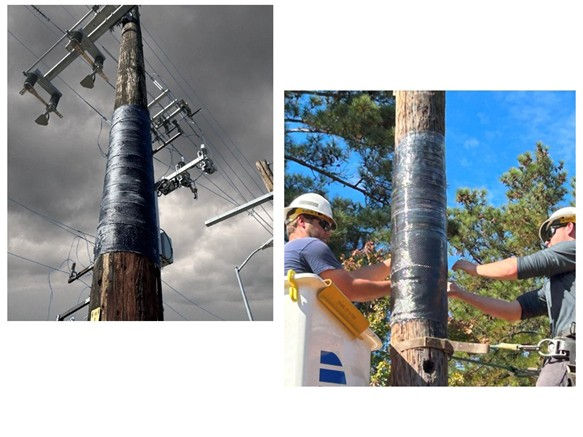
Until I read this ad that was. I had heard about this company that was using very much the same thing we came up with for GRI which was to wrap aging infrastructure as long as it is round with a composite tape to reinforce it and make it resistant to all sorts of environmental challenges that are difficult to meet using natural materials like trees.
It is apparent that they even use this stuff for wildfire mitigation or even mitigation of urban or residential fires. It can even be used up at the top of line poles to mitigate electrically started fires because of aging electrical lines and the potential for shorts in bad weather.

They call themselves Affordable, Resilient Grid Hardening Solutions for Utilities. Here in California I am quite hopeful that the utilities that have aging wooden line poles in wildfire prone areas are aware of this product and how much they can reduce the chance of wildfire. I can only imagine what the infrastructure safety engineers and the utility insurance companies are talking about at this point. And I would imagine that the utility executives are also involved in these discussions. All of that is most probably a good thing and may prevent some of the disasters that we have had recently with aging line poles and aging wiring infrastructure.
Speaking of aging wiring infrastructure, there is something else that I need to bring up in this post that is related and along the same lines as the GridWrap we see above. Current high tension, high voltage lines typically have a steel strength member surrounded by aluminum conductors. This is because at high voltages the current is carried by the outside wires rather than all the way through the conductor. What this means is that the strength member doesn’t need to carry electricity. In the past, the least expensive and easiest to implement was a high strength steel wire core. This is, however, rather heavy so there is lots of sag in the lines and they have lots of inertia in the wind.

This is the motivation for use of composites in the core of high voltage, high tension lines. As you can see from the picture above, the composite core is at least as strong if not stronger than steel, and nearly a quarter the weight, so there is considerable less sag. Additionally, since these conductors are exposed to heat, and since steel has a fairly high thermal expansion coefficient, on a hot summer day the steel cored cables sag far more than on a cold winter day. This of course is accommodated for in design and was a significant limitation of the traditional grid transmission lines.
However, with the use of a unidirectional carbon core, there is significantly less sag at approximately the same cost. And there is an additional benefit to using carbon fiber rather than steel. Carbon fiber has a near zero coefficient of thermal expansion (it is actually slightly negative, so it shrinks just a little bit). What this means is that the line with a unidirectional fiber core will not sag at high temperatures like on a hot summer day. And it also will not shrink appreciably on a cold winter night either. This opens up a number of possibilities for high voltage lines in major grid infrastructure at a nominal cost because carbon fiber has come down so much in price in the last 20 years or so. And there is a lot of aging grid infrastructure out there where the lines are in need of replacement now, but the towers are still in good shape.
An additional benefit of these lines is that because they are lighter weight and do not sag as much the line can have more and higher conductive capacity lower tensile strength annealed aluminum that can carry significantly more current. That means that the grid operators just need to update the aging lines and the aging insulators for the grid to significantly enhance the infrastructure and potentially handle the magnitude of the increase in grid demand that is coming in the near term.
And that brings up another place in grid infrastructure that composite materials have made significant inroads. Current ceramic insulators with metallic interconnections are also relatively heavy and also do not have sufficient insulating capacity for the higher voltages and higher currents that will be made available with the new carbon fiber cored aluminum conductors. Fortunately, there are also new composite insulators that have non-conducting composite strength members to hold them together that are lighter weight, have even lower conductivity, better resistance to arcing over, better weather resistance, and longer life than the older ceramic insulators.

This is one small example of composite insulators being used on a somewhat lower voltage line, but it does show that they are increasingly being used. One example of where they are used extensively now is in the interconnects within the grid where lines must be connected and branched. These are inordinately complex and the insulators and standoffs must be as light as possible and resistant to wind, rain, and other environmental loads as possible.

Now to move on to other parts of the infrastructure, there are also carbon and composite fiber repair and rehabilitation methods for pavement that are much smarter and longer lasting than traditional double shot and cover patch methods. Just for those that are either uninitiated in road repair or uneducated, this is the traditional patch method where two shots of road tar are laid down and then gravel is spread on top and rolled into the pavement. This is more traditional blacktop roads which are all over the Western US.

The newer patch methods involve typically composite fabric that is either impregnated with tar or left as a mat, and then tar is spread over the mat or fabric and then gravel is spread on top for a road surface. There is a company that is a good example of this, Tensar, which is a division of CMC located in Georgia. They manufacture and provide all manner of mostly glass composite mat reinforcements for road construction that are tarred or not, and even a product that can be used directly that has a finer gravel road surface embedded into it so it can be applied to a road surface in one shot.

It is pretty obvious that composites have not only become mainstream, they are already making great strides and inroads into industries that are very conservative, slow moving, and where costs are intentionally kept as low as possible. In other words, composites are no longer a nice to have, they are mandatory in certain industries and have taken over from traditional materials like even steel and concrete. And they are also demonstrating availability in very high tonnage and very reasonable prices and compete easily with more traditional materials even in extremely high tonnage applications. Such is truly the case in infrastructure construction and repair.
It is so good for me to see how far composites have come from the industry when I first got started with them. They used to be such exotic materials and those of us that have been in this business as long as I have still remember those days when we were just trying to make the lightest thing we could make and hang the cost. Carbon fiber was on the order of $150-200 a pound and there were maybe two companies in the entire world that made an industrial carbon fiber that was accepted by the aerospace community. The composites industry is no longer a story about how we are going to make this exotic thing from this exotic material, it is now about the cost/performance trade-off and how much of it can we make at a cost that is competitive with traditional materials. Composites have come of age.
So, that’s it for this week’s post. So, as always, I hope everyone that reads these posts enjoys them as much as I enjoy writing them. And I hope people who are interested find something they can use in their lives or at least some ideas that they might be able to put into practice. At least I hope that these make people think a bit about sustainability and some of the major issues looming before us.
I will post this first on my website – www.nedpatton.com – and then on LinkedIn. And if anyone wants to provide comments to this, I welcome them with open arms. Comments, criticisms, etc. are all quite welcome. I really do want to engage in a conversation with all of you about composites because we can learn so much from each other as long as we share our own perspectives. And that is especially true of the companies and research institutions that I mention in these posts. The more we communicate the message the better we will be able to effect the changes in the industry that are needed.
My second book is a roadmap to a circular and sustainable business model for the industry which I hope that at least at some level the industry will follow. Only time will tell. Maybe it will get noticed – as always that is just a crap shoot. I’ve included a picture of the cover at the end of this post. Let me know whether or not you like the cover. Hopefully people will like it enough and will be interested enough in composites sustainability that they will buy it. And of course I hope that they read it and get engaged. We need all the help we can get.
Last but not least, I still need to plug my first book. “The String and Glue of our World” pretty much covers the watershed in composites, starting with a brief history of composites, then introducing the Periodic Table and why Carbon is such an important and interesting element.
Both books are available both on Amazon and from McFarland Books – my publisher. However, the best place to get one is to go to my website and buy one. So, I will send you a signed copy of either or both books for the same price you would get charged on Amazon for an unsigned one, except that I have to charge for shipping. Just go to the link to the product page on my website (https://www.nedpatton.com/product-page) and order either book. And as usual, here are pictures of the covers of both books.


Comments